AI Data Centers' Next Bottleneck: Getting Power From the Grid to the GPU
Securing a gigawatt of power does not mean a gigawatt reaches GPU compute. The next fight in AI infrastructure is happening inside the data center, over how little electricity gets wasted before it reaches the chip.
From Power Plant to GPU, Electricity Changes Form Many Times
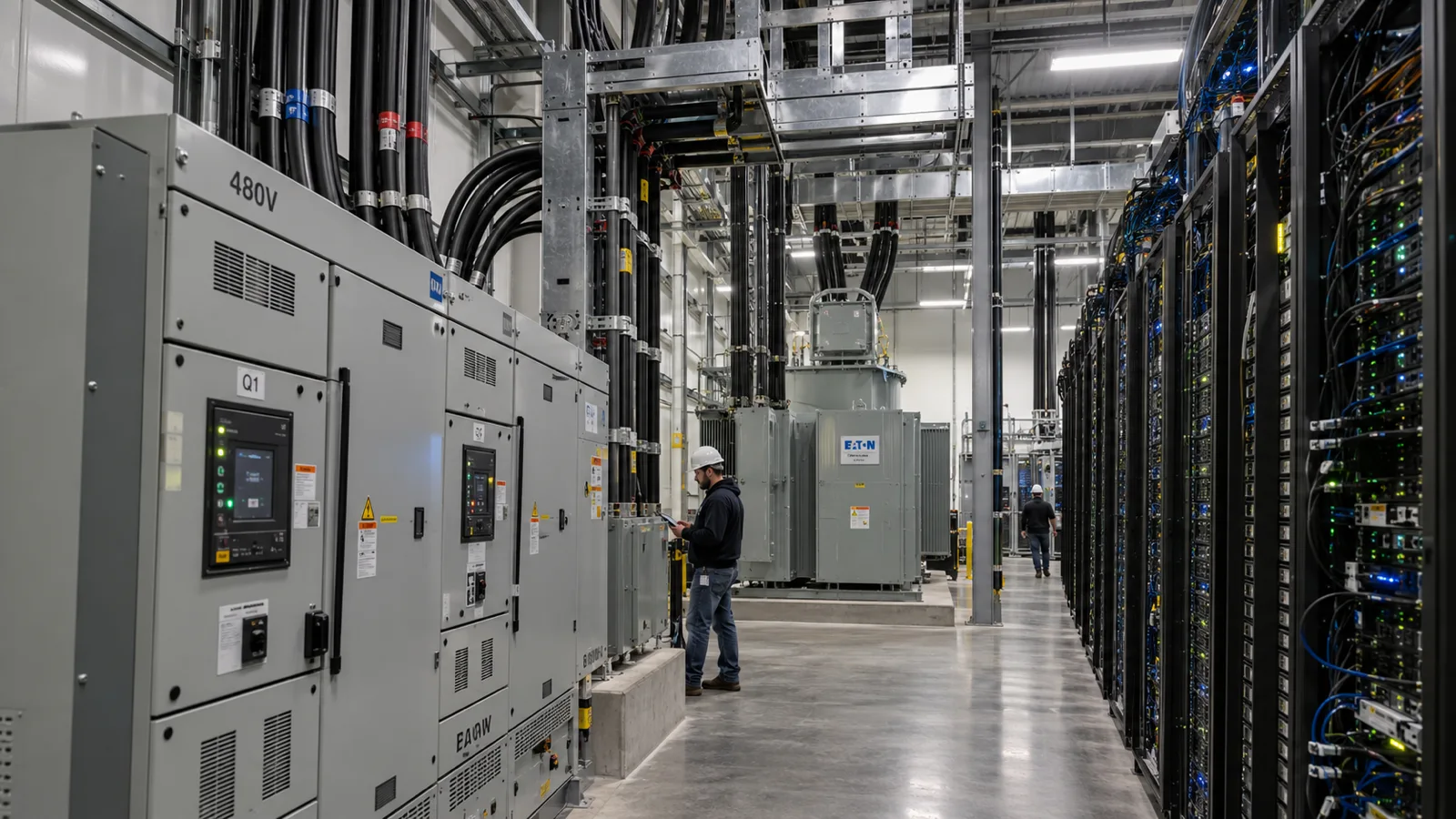
Most of the conversation about AI power so far has focused on one question: how many gigawatts can you secure. Nuclear plants, gas turbines, renewables, transmission lines and grid interconnection have been the key variables. But the problem does not end once electricity reaches the data center site. The alternating current coming off the grid is not something a GPU can use directly.
In a conventional data center, voltage gets stepped down, passes through a UPS, arrives at the rack where AC converts to DC, then converts again to the low voltage GPUs actually run on. Each additional stage adds loss, heat, equipment footprint and another point of failure.
Today's power flow, simplified:
Grid → Transformer / UPS → PDU / Busway → Rack PSU → DC/DC → GPU
Separate from securing more power, the new competitive variable is what share of the power already secured actually reaches compute.
At 1GW, One Percentage Point of Efficiency Is 10MW
The math makes the gap concrete. Take 1GW arriving at a data center. At 90% power-conversion efficiency, 900MW survives the conversion. At 95%, it is 950MW. The difference between those two scenarios is 50MW. One percentage point of efficiency equals 10MW.
This calculation isolates power conversion alone. Real facilities also draw power for cooling, pumps, fans and lighting, non-IT loads captured in the industry's standard metric, PUE. So "1GW of site power" does not equal "1GW of GPU power," and power-conversion efficiency is not the same concept as PUE.
Key numbers:
- 1 percentage point of efficiency at a 1GW site equals 10MW
- 50MW is the gap between 90% and 95% power-conversion efficiency
- 5 percentage points is the maximum end-to-end efficiency improvement Nvidia has targeted with its 800 VDC design
Why 800 VDC: Moving the Same Power at Lower Current
The basic power equation is Power = Voltage × Current. To deliver the same 1MW, raising the voltage lowers the current required. Because resistive loss scales with the square of current, cutting current reduces cable heating and distribution loss, and eases the burden on thick copper conductors.
Nvidia says the physical limits of a conventional 54 VDC rack architecture become significant once racks exceed 200kW. The company is pushing an 800 VDC architecture to support IT racks rated at 1MW and above starting in 2027, arguing that 800V distribution can carry more power through the same conductor size while using less copper.
The important part is that this is not Nvidia moving alone. Google and Microsoft are participating in 800 VDC standardization through the Open Compute Project, and more than 80 equipment and infrastructure companies are developing related products. That points to 800 VDC moving from a single supplier's idea to a supply-chain-wide standards race.
Why GaN and SiC Are Growing Outside the GPU
The partnership between Wise Integration and Navitas is a small slice of this shift. The two companies are combining Wise's digital control technology with Navitas's GaN and SiC power semiconductors for AI data center power supply units and power-conversion topologies in high-voltage, high-power environments.
GaN and SiC can operate at higher switching frequencies than silicon-based power semiconductors and offer room to improve efficiency and power density in high-voltage settings. That helps shrink power-conversion equipment and cut thermal losses. As AI racks climb from hundreds of kilowatts toward the megawatt range, the economic value of that advantage may grow with them.
| Layer | Bottleneck | Key technology / components | What investors should watch |
|---|---|---|---|
| Grid → Facility | Grid interconnection, transformation | Transformer, switchgear, SST | Lead times, power capacity, interconnection timing |
| Facility → Row | High-voltage distribution loss | 800 VDC, busway, UPS/BESS | Efficiency, safety standards, footprint |
| Row → Rack | Current, copper, heat | Power rack, DC/DC | Volume and efficiency per kW |
| Rack → Chip | Low-voltage conversion | GaN, SiC, PMIC | Power density, heat, number of conversion stages |
Insight Times Editorial Desk