Anthropic's Record Revenue Came With Slower Growth. What Matters Next

Third-quarter revenue hit a record, but growth fell sharply from the second quarter as the IPO roadshow began. The numbers so far suggest growth has not stopped. How long customers keep spending now matters more.
Anthropic's Record Revenue Came With Slower Growth. What Matters Next

The 20-second read

1
Anthropic's third-quarter revenue was its largest ever at $16.956 billion, but the growth rate fell from 144% in the second quarter to 47%.
2
The annualized revenue run rate at the end of October was about $81 billion, $10 billion higher than at the end of September, so paid usage has not suddenly turned down.
3
The next test is likely to be whether it can keep business customers spending more and still grow revenue through price cuts.

The 20-second brief

  • Third-quarter revenue was a record. The explosive pace of the prior quarter has cooled.
  • Paid usage activity widened again at the end of October. One quarterly figure is not enough to call the direction of growth.
  • The next test is less about any new model than about how often, how long and how much enterprise customers use it.

1. Why call it slowing growth after earning this much?

Anthropic is a company whose revenue jumped and yet draws the label "slowing growth." The numbers look odd at first. Third-quarter 2026 revenue was $16.956 billion, the largest of any quarter the company has disclosed. CNBC and Reuters nonetheless reported that growth had slowed.

The reason is simple. In the second quarter, revenue rose 144% from the quarter before, well more than double. In the third quarter revenue still grew, but the rate fell to 47%. The car is still moving forward fast, but the force that was making it accelerate has weakened.

Two things need to be kept apart: the size of revenue and the speed at which it grows. Record revenue and slower growth do not contradict each other. A company that is already very large needs to add far more new dollars every quarter to keep growing at the same rate.

So the question changes. It is not "has it ended because it can no longer double?" It is "how much new revenue can it create from a much bigger base?" Anthropic's third-quarter results pose exactly that question.

2. Customers kept spending more after the third quarter

Hearing that growth slowed, it is natural to imagine that things went well through July and customers suddenly left in August or September. But official monthly revenue and growth rates for July, August and September have not been confirmed. A quarterly result that bundles three months cannot be used to reconstruct any single month.

What the amended registration statement filed Tuesday, Nov. 10, does show is this: at the end of October, the annualized revenue run rate was about $81 billion, $10 billion higher than at the end of September.

An annualized run rate assumes recent paid usage and subscription fees continue at the same level for a year. It does not mean revenue actually earned over a year, and it is not a forecast. It is still useful for seeing how much customers have been spending lately.

That the figure rose further in October is notable. It means the third-quarter slowdown did not immediately stop demand for paid usage. For investors, what matters more than a single slowdown is whether customer spending continues afterward.

3. The next growth driver is the customer who keeps using it, not the new one

Anthropic repeatedly points to new models and product launches, rising usage and a growing customer base as drivers of revenue growth. A more useful model draws new people in. Durable revenue, though, gets built afterward: when a first-time user becomes a daily user, and one team's tool spreads into a company-wide work system.

The enterprise market shows this shift most clearly. Over the past 12 months, more than 11,900 customers spent $100,000 or more with Anthropic. That is not simply a count of companies that signed up. It means that many customers are actually spending substantial sums.

A company might start by giving Claude to a few people. Once it sees results, it connects the tool to more work: development teams, customer support, internal document processing. It stops being a service staff ask occasionally and becomes a tool called every time work moves forward. With that kind of use, revenue can grow within existing customers without constantly recruiting new ones.

The filing's net revenue retention of about 900% tells the same story. It means revenue from the existing customer cohort grew sharply over the comparison period. It does not mean every customer spent nine times as much, but it shows that a model of landing customers and then going deeper is working.

This arguably matters more than swings in quarterly growth. Once a company takes in AI as part of its work, what moves revenue is not the name of the model making headlines but the usage that repeats every day.

4. What if prices fall as usage rises?

Higher usage does not mean revenue grows at the same speed. Anthropic said that about $600 million of the revenue effect from higher third-quarter usage was offset by price cuts on new models and contract discounts.

The scene shows how competitive the AI industry is. As models improve, customers gain more value, but rivals also release better models. Customers weigh not only performance but price, stability and integration with existing work systems. The competitors Anthropic names directly are Google and OpenAI.

For enterprise customers, this is good news: more work can be done more cheaply. The seller takes on a different problem. Usage has to grow faster than prices fall for revenue to grow strongly.

Customer mix has also become important. Anthropic said it stepped up enforcement against usage-policy violations in August and September, and that this could lower future growth. That is why it matters to look not only at current revenue but at which customers keep buying, and how consistently.

The next contest, then, will not end with one performance announcement. What counts is the ability to keep giving customers reasons to use the product in real work, and to turn that usage into revenue despite price competition.

5. INSIGHT TIMES VIEW: the habit of growth, not the rate

Anthropic began its IPO roadshow on Tuesday, Nov. 10. An IPO draws market attention, but the question likely to outlast this quarter's results is not the share price. It is whether the company's customers will keep spending more.

The third-quarter results are hard to read in only one direction. The growth rate that once doubled has come down. Yet revenue set another high, and enterprise usage widened. The numbers point not to the end of growth but to how much more the manner of growth now matters.

Going forward, it is worth watching the dollar increase in quarterly revenue together with the number of enterprise customers spending large sums. Whether existing customers keep raising spending, and whether revenue can grow even as prices drop, also matters. Rather than cheering each new model's benchmark scores, it may be more useful to check how often customers use it in everyday work.

An AI company's real strength is not the ability to impress someone on a first try. It is the ability to give them a reason to pay again next month. Anthropic's next stretch of growth will likely be decided there.

How much was Anthropic's third-quarter revenue?
  • Third-quarter 2026 revenue was $16.956 billion.
  • It is the largest quarterly figure the company has disclosed.
Why call it a growth slowdown when revenue is at a record?
  • Because revenue is growing more slowly.
  • In the second quarter it grew 144% from the prior quarter, and in the third quarter the growth rate was 47%.
  • The size of revenue and the speed at which it grows need to be looked at separately.
What is the annualized revenue run rate?
  • It is a figure calculated by assuming recent paid usage and subscription fees continue at the same level for a year.
  • It does not mean actual revenue for the year or future results.
  • At the end of October it was about $81 billion, $10 billion higher than at the end of September.
How much have Anthropic's business customers grown?
  • Customers that spent $100,000 or more over the last 12 months numbered more than 11,900.
  • Net revenue retention was disclosed at about 900%.
  • That means existing customers sharply increased their spending, but not every customer increased it by the same rate.
How did price cuts affect Anthropic's revenue?
  • About $600 million of the revenue gain from higher third-quarter usage was offset by price cuts and contract discounts.
  • It remains to be seen whether usage will grow faster than prices fall.

What to watch

Quarterly revenue growthWatch whether growth in the next quarter's results falls further below 47%, and whether the dollar increase in revenue holds up.
Customers spending $100,000 or moreWatch how much the figure, now above 11,900 on a trailing 12-month basis, rises in the next disclosure.
Net revenue retentionWatch whether the roughly 900% rise in existing customers' spending continues in the next disclosure.
Price-cut offsetWatch whether the roughly $600 million offset from price cuts and discounts in the third quarter grows or shrinks next quarter.
Anthropic's growth rate has cooled, but so far the numbers point less to a stall than to a test of how long customers keep using and paying for its models.

Insight Times Editorial Desk

More by topic

Starting with this story's topics, then what readers are following now

Investor psychology, decision-making and books on investing

IPO

This story's topic20 storiesSee all →

Anthropic's IPO: The Number That Matters More Than $100 Billion Is $2 Trillion

Claude-maker Anthropic is growing at a stunning pace, but the real question for investors is not how fast, only how long, and how much cash is left after GPUs and data centers.

Tech

Anthropic Started Late but Took the Lead in Enterprise AI Revenue

Claude Code changed the game. But understanding the $2 trillion IPO story means looking past explosive revenue growth to $518 billion in compute commitments and customer concentration.

Tech

Anthropic Posts a Profit, but Investors Are Uneasy About the $2 Trillion Question

Reported third-quarter revenue of $16.8 billion and an adjusted profit show AI can make money. Slowing growth and $518 billion in long-term commitments are the open questions.

Tech

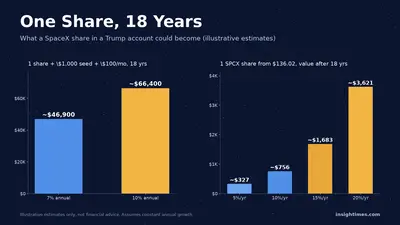
Editorial chart cover: illustrative 18-year growth of one SpaceX (SPCX) share in a Trump account, comparing 7% vs 10% returns and 5-20% share growth scenarios.

Why Musk wants to give 72 million US children a share of SpaceX

Elon Musk says he will gift one SpaceX share to every American child. The plan is not yet detailed, and the bigger driver of a child's wealth may be 18 years of steady saving.

Investing

SK hynix Shelves Solidigm IPO, but the Funding Question Remains

SK hynix dropped a plan to raise up to $15 billion in a Solidigm US listing. Dilution fears eased, but the cost of new US NAND and SSD capacity now lands back on the parent's balance sheet.

Investing

AI's Next Bottleneck Is Money, Not Chips

Broadcom is lending Anthropic up to $42 billion, and Nvidia wants to build a $500 billion market for loans backed by GPUs. The AI race may turn on what rate buyers pay to borrow.

Tech

Anthropic's $2 Trillion IPO Question: Is AI Software, or the New Utility?

This isn't an IPO asking how popular Claude is. Public markets are about to price, for the first time, whether a frontier AI model company can build an economic engine that outruns its own massive compute bill.

Tech

HBM

77 storiesSee all →

Memory stacked next to the GPU.

Memory Is Still Short, but Less Short: Checking for the Peak This Week

Citi trimmed its 2027 DRAM and NAND shortage forecasts together. Server pricing remains strong, while consumer markets show weakness. This week's numbers show where the memory boom may peak.

Investing

The Real ASML Number Isn't the 3% Pop, It's the 30% Capacity Hike

ASML's rally isn't just an AI trade. Customers are already locking in 2027 tool slots, and ASML is raising Low-NA EUV capacity by roughly 30% to keep up.

Investing

A 3x P/E is not a discount. It is a verdict on how long memory profits last

Nomura's buy case on Samsung Electronics and SK Hynix does not stop at higher memory prices. It argues that if AI has turned memory from a cyclical component into strategic infrastructure, the formula the market uses to value both companies has to change too.

Investing

2027 Isn't the End: Citi's Case for a Memory Supercycle Running to 2031

Citi says the memory shortage timeline is stretching again. If AI shifts from "train once" models to continual learning, HBM, server DRAM and enterprise SSDs could all fall short at the same time.

Tech

AI ran out of memory before it ran out of GPUs

The HBM bottleneck is spreading into DRAM prices, server costs and the price of the next laptop or phone.

Tech

Has Memory Peaked? Prices Are Cooling, but the Shortage Looks Set to Run to 2028

Price growth has slowed and consumer demand is already breaking. Server and HBM supply remains short, and Micron says more than 75% of its 2027 volume is already committed to customers.

Tech

AI Chip Peak Check: Demand Still Rising, Risk Building in 2027-2029 Supply and Funding

DRAM and NAND contract prices are still climbing and HBM suppliers hold the edge. Power shortages, AI financing costs and simultaneous memory expansion are the risks for later years.

Investing

A building that houses servers and networking gear and supplies them with powe…

Nvidia and Palantir Put AI Inside the Supply Chain - The Real Shift Is That It's Learning Judgment

A single Vera Rubin rack holds 1.3 million parts. The real breakthrough in Nvidia and Palantir's new supply chain AI isn't automating that complexity, it's capturing the judgment calls that used to live only in planners' heads.

Tech

Is Space Cooler for AI? Why Musk Wants Data Centers in Orbit

The next limit on AI may be power and cooling, not GPUs. Elon Musk is looking to Earth orbit for an answer, but the test is cost per hour of compute.

Tech

Musk Sees the Next Phase of AI Infrastructure: Who Can Switch GPUs On, Fast

If neoclouds struggle under financial pressure, AI demand may not shrink. It may simply favor the few operators with the capital and execution to serve it, a shift that could matter for SpaceX and Tesla.

Tech

White House Swaps AI for "SI." The Real Investment Signal Is Infrastructure, Not the Name

An executive order renames artificial intelligence "Super Intelligence" and six frontier labs sign a voluntary safety accord. What investors should watch is the data center, power, nuclear and chip policy now gathered under one national-competitiveness frame.

Tech

The Cheaper Tokens Get, the Bigger Your AI Bill Gets

As AI shifts from training to inference, the token is becoming an industrial commodity. Falling prices are not cutting demand, because agents and automation consume tokens at a scale no human chat session ever did.

Investing

Marvell's $115 Billion Lumentum Deal: Is AI's Next Bottleneck Light, Not Chips?

Marvell's purchase of Lumentum points to a contest beyond GPU speed, in data transfer and power efficiency. Whether the price is right is not yet confirmed.

Tech

Workers in hard hats beside a communications equipment cabin, with a Starship rocket on its launch tower at dusk in the background

SpaceX Forecast at About $730 Billion in 2028 Revenue: The Bigger Opportunity Musk Sees

Sequoia Capital made a bold forecast, and Elon Musk replied, "I think we can do better." The future SpaceX is looking at is far bigger than the rocket launch business. The plan is to link satellite communications, AI data centers and orbital computing into one giant business.

TechEXPLAIN

NVDA

96 storiesSee all →

Who Hits $1 Trillion Next: Reading AMD and ASML by Different Rules

One company is chasing Nvidia's GPU empire. The other sells the machine that draws the chips for every advanced chipmaker, including Nvidia. Both get floated as 2028 trillion-dollar candidates, but the numbers investors need to watch are entirely different.

Investing