SpaceX Revenue of $731.1 Billion by 2028? What Sequoia's Maguire Is Betting On

Shaun Maguire's model is less about launch counts than about linking rockets, connectivity, power and AI compute into one cost advantage. It is a shareholder's hypothesis, not reported results.
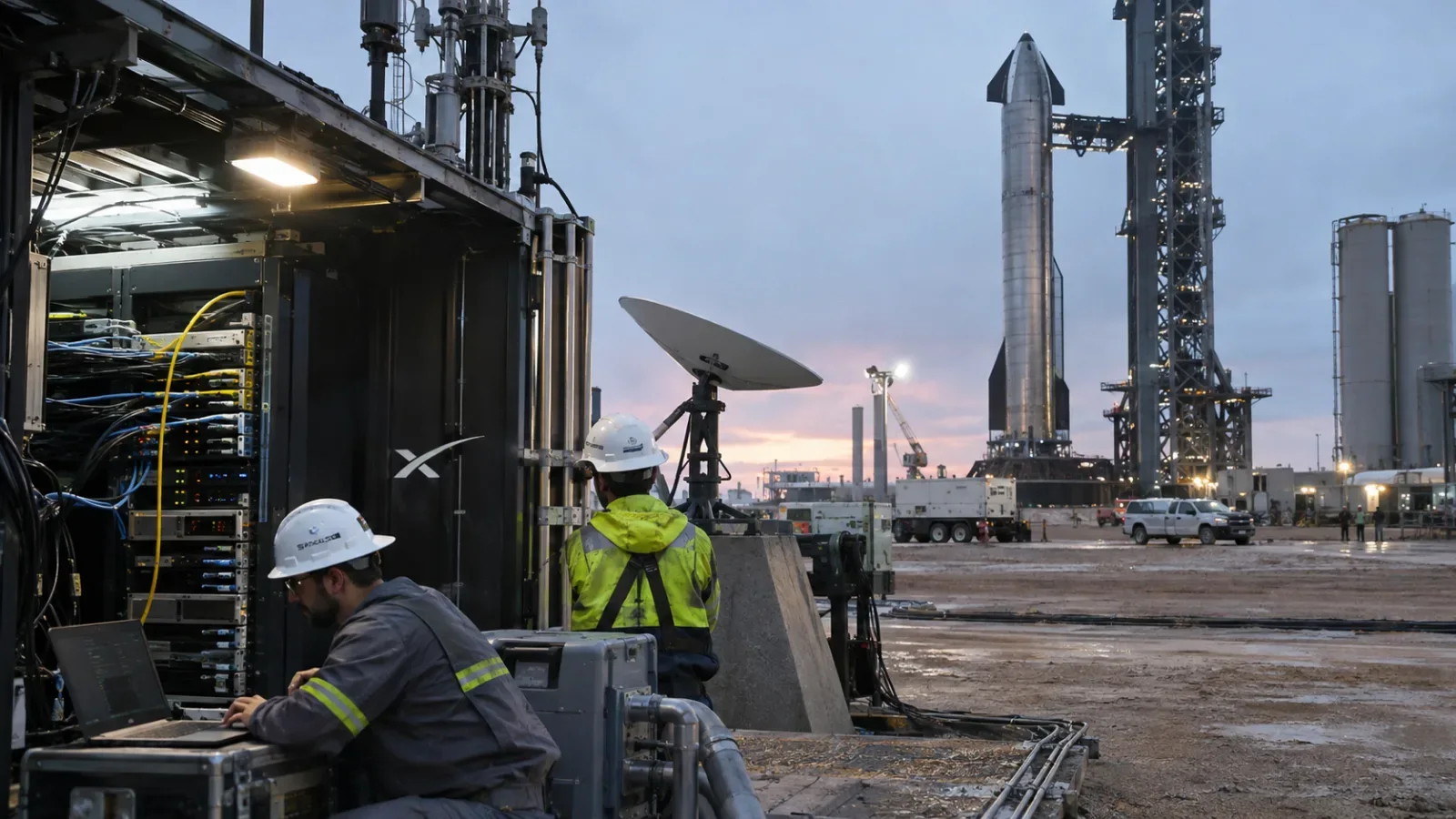
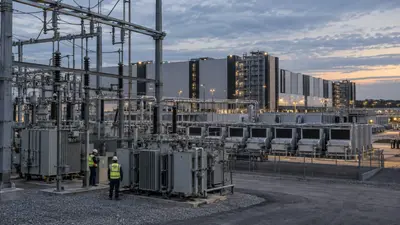
Workers in hard hats beside a communications equipment cabin, with a Starship rocket on its launch tower at dusk in the background
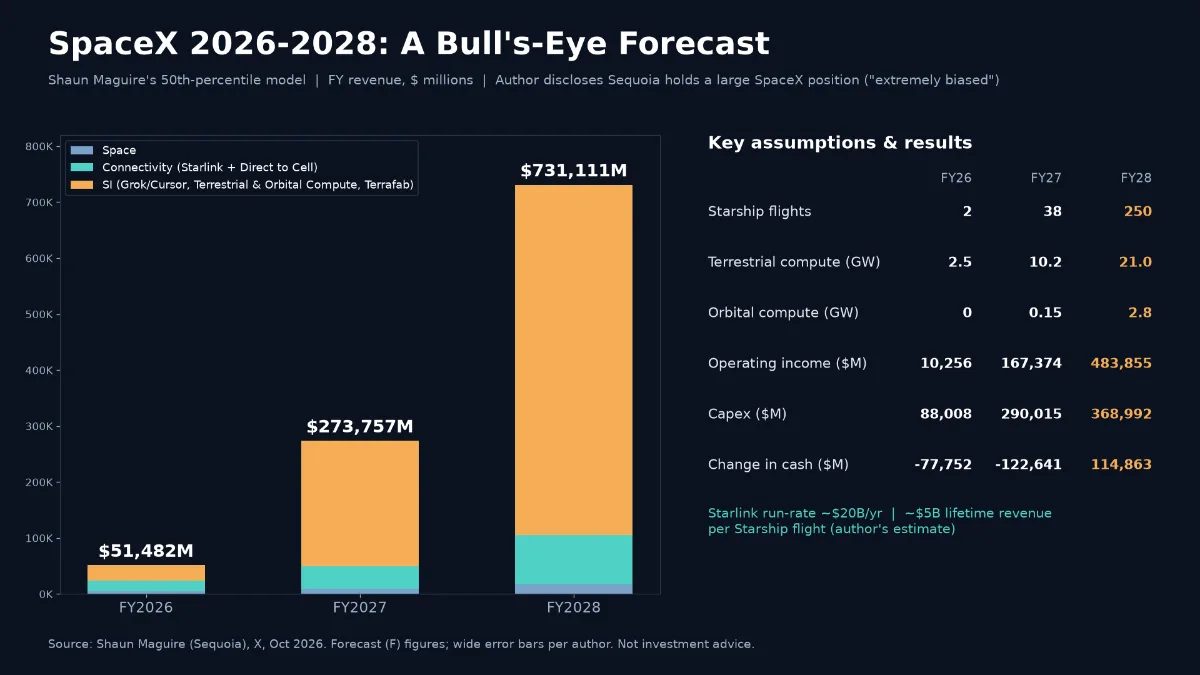
Infographic: SpaceX revenue forecast by Shaun Maguire of Sequoia, from $51.5B in 2026 to $731.1B in 2028. Not investment advice.

1. Who forecast $731.1 billion in 2028 revenue?

Shaun Maguire, a partner at Sequoia Capital, projects SpaceX revenue of $731.111 billion (731,111 million) in 2028. The path runs through $51.482 billion in 2026 and $273.757 billion in 2027. He points to Nvidia's revenue surge over the past three years as a comparison.

Maguire is a physicist and has led Sequoia's SpaceX investment since 2020. He also disclosed that Sequoia holds a large stake in SpaceX, so he is "extremely biased." The forecast is not reported results. It is his own 50th-percentile scenario.

He built an internal model in the fourth quarter of 2020, when Starlink was recording its first revenue. That model put 2026 Starlink annual revenue at $25,218,103,720. At the time it looked absurd, he recalls. Here too, what matters is less the record of past predictions than whether the new assumptions can come true.

2. When a rocket explodes, excuses don't work

Maguire's first competitive edge is people and organization. At SpaceX, whether a rocket flies or explodes is the harshest measure. Failures have to be traced physically, so technical results outrank internal politics, he argues. In his words, "physics beats politics."

He gives examples: if turbines are a bottleneck, build them in-house; if a power plant permit is blocked in Tennessee, run a plant in Mississippi and connect transmission lines. These are less verified facts about individual projects than illustrations of an execution culture that does not push problems outside the organization.

He sees a gigawatt-scale AI data center as 10 to 100 times harder than the data centers of tens of megawatts in the past. If that is right, the winners in AI may be decided not only by chip purchasing power but by the ability to solve power, facilities, networking and transport at once.

3. Starship's moat is the time rivals need to catch up

Maguire defines a moat this way: give the best people unlimited resources, and how long does it take them to reach today's technology? In his view, Starship is among the most complex systems humanity has built.

He estimates China is about five years behind TSMC in semiconductors and about ten years behind SpaceX in launch. He notes SpaceX's first booster recovery came in 2015 and China's in 2026, and argues the chip gap is narrowing while the space gap is widening. This is Maguire's assessment, not an independently confirmed industry gap.

The core is Starship's vertical integration. If design, production, testing and supply chain are combined in-house, a competitor must catch up not with one rocket but with the whole system that builds and improves it repeatedly. A large technical moat does not, however, guarantee a high return on investment.

4. Can SpaceX also produce AI compute most cheaply?

Maguire sees AI compute as closer to oil production than to the broadband overbuilt in the dot-com era. If prices fall, higher-cost suppliers are squeezed first and low-cost ones can hold up better.

He argues SpaceX could keep its edge even if compute cost per gigawatt falls to about $10 billion. He also considers it very unlikely that cost drops below $20 billion per gigawatt within roughly four years. These are his views, not confirmed market prices.

He stresses the assumption that revenue per gigawatt and capex per gigawatt move together. If selling prices fall and build costs fall in a similar direction, a low-cost operator has room to add capacity. He concedes, though, that power permitting and supply delays mean the revenue decline is not fully offset. The Anthropic customer concentration and contract termination risk flagged in an earlier Insight Times article is not removed by this logic alone. Cheap capacity can still see utilization fall if customers leave.

5. The $5 billion economics of one Starship launch

This is the most intuitive calculation of Starship's economics. Maguire puts the current Starlink constellation's annual revenue run rate at about $20 billion, built with about 400 Falcon 9 launches. He assumes one Starship can deploy satellites equivalent to about 20 Falcon 9 launches.

StepMaguire's assumption and result
Current constellationAbout 400 Falcon 9 launches, annual revenue run rate of about $20 billion
Launch capacity conversion1 Starship = about 20 Falcon 9
Equivalent constellationAbout 20 Starship launches
Supported revenue per launchAbout $1 billion a year
Assumed life of about 5 yearsAbout $5 billion in lifetime revenue per launch

The $5 billion is neither the selling price of a launch nor the net profit from one. It is a simple conversion of the revenue the satellites deployed in that launch could support over their lifetimes. Actual profit depends on the cost of building satellites, launching, operating and acquiring customers.

6. After Starlink: phones and orbital compute

Direct to Cell (DTC) lets ordinary phones connect directly to the satellite network. Maguire bets DTC revenue will pass Starlink's in 2029 or 2030. It is not current reported results but an outlook in which satellite deployment costs fall and the connectable market widens.

Orbital computing is the idea of placing compute facilities in space. Maguire sees its economic effect starting in earnest in 2029 and expects SpaceX to be as vertically integrated in chips as in rockets ten years from now. Between the technical concept and commercial monetization, steps remain to be verified.

7. What has to go right for the 2028 forecast

Compressed into annual figures, Maguire's company-wide model looks like this. All numbers are his model's, and should not be read as reported results or official company guidance.

Metric20262027 forecast2028 forecast
Total revenue ($M)51,482273,757731,111
Space segment revenue ($M)5,2399,38917,345
Connectivity segment revenue ($M)19,09440,56788,538
Total SI revenue ($M)27,149.8223,802625,228
Operating profit ($M)10,256167,374483,855
Capex ($M)88,008290,015368,992
Change in cash ($M)-77,752-122,641114,863
Starship flights per year238250
Year-end ground compute capacity2.5 GW10.2 GW21.0 GW

For 2028 revenue of $731.111 billion and operating profit of $483.855 billion to hold, more Starship flights, gigawatt-scale buildout, compute sales and cost control all have to line up at once. In the model, the change in cash is -$77.752 billion in 2026 and -$122.641 billion in 2027, then turns to +$114.863 billion in 2028.

Maguire himself acknowledges wide error margins on revenue per gigawatt, capex per gigawatt and "terafab" capex, and that his post does not justify most of its numbers in detail. The model is less a target for investors to accept as is than a hypothesis showing what to verify.

What to Watch

  • Starship flights: whether actual operations approach the model's path of 38 and 250 flights a year.
  • Ground compute capacity: whether the expansion to 10.2 GW and 21.0 GW grows alongside customer usage.
  • Revenue and capex per gigawatt: how much build-cost savings absorb falling selling prices.
  • Change in cash: whether it turns positive in 2028 after the heavy investment.
  • Contracts and utilization: whether major customers stay and replacements can be found.
The $731.1 billion figure is one biased shareholder's hypothesis, and Starship flight counts and compute buildout are likely to decide it.

Insight Times Editorial Desk

More by topic

Starting with this story's topics, then what readers are following now

Investor psychology, decision-making and books on investing

Data Centers

This story's topic86 storiesSee all →

A building that houses servers and networking gear and supplies them with powe…

US AI Data Centers Are Headed for 90GW. Gigawatts Now Matter More Than Dollars

Goldman Sachs expects US data center capacity to grow from 64GW at the end of 2026 to 90GW at the end of 2027. The AI race is moving from buying GPUs to building power plants and transmission lines alongside them.

Tech

Why Nvidia Is Happy to Help Make AI Models Nearly Free

Falling model prices can squeeze model makers. For Nvidia, the number that matters is the total volume of tokens generated worldwide and the compute that produces them.

Tech

Tesla Energy's 13.7GWh Paradox: Expectations Ran Faster Than Deployments

Q2 deployments recovered but margins collapsed. Q3 set a record for deployments and still missed estimates. The issue is not the size of AI power demand but how fast it converts into Tesla revenue and profit.

Tech

Why the White House Swapped "AI" for "Super Intelligence"

Executive Order 14434 renames AI across the federal government without defining a new technology. The real story is about roughly $700 billion in capex, free cash flow and electricity.

Tech

Nvidia's Next Target After GPUs: Controlling What AI Agents Are Allowed to Do

OpenShell and Sentry are not about policing what an AI says. They are about controlling, at the server infrastructure level, which files and APIs an AI can touch, what it can execute, and who can actually pull the plug when something goes wrong.

Tech

2027 Investing Needs Alignment, Not Prediction

A new investing book argues the hard part was never picking the next winner. It's staying aligned with where value and bottlenecks are moving while keeping old human weaknesses in check.

Investor Mind

AMD Crossed $1 Trillion, and the Market Started Looking at CPUs Again

AMD's stock topped a $1 trillion market cap for the first time. The rally isn't just about being an Nvidia alternative. It reflects a reassessment of AMD as a full-stack AI infrastructure vendor, one that bundles CPUs, GPUs and networking, as AI shifts from chatbots to agents and reignites data center demand for CPUs.</deck> <parameter name="oneline">As AI moves from chatbots to agents, the market has started counting the CPU sitting next to the GPU again.

Tech

HBM

75 storiesSee all →

Memory stacked next to the GPU.

Has Memory Peaked? Prices Are Cooling, but the Shortage Looks Set to Run to 2028

Price growth has slowed and consumer demand is already breaking. Server and HBM supply remains short, and Micron says more than 75% of its 2027 volume is already committed to customers.

Tech

AI Chip Peak Check: Demand Still Rising, Risk Building in 2027-2029 Supply and Funding
DRAM and NAND contract prices are still climbing and HBM suppliers hold the edge. Power shortages, AI financing costs and simultaneous memory expansion are the risks for later years.

Investing

AI Chips Haven't Peaked. The Real Risk Sits in 2028 Supply

HBM and server DRAM shortages are now spreading into enterprise SSDs. The question isn't today's strength, it's how much new capacity these prices are pulling in and when it lands.

Investing

Memory Chip Supercycle: Not at Peak Yet, But 5 of 6 Warning Signs Are Flashing

Memory prices are still climbing, but the pace is slowing and PC and smartphone demand is starting to crack under the weight of higher chip costs. This looks less like a price peak and more like a profit plateau building toward the next supply cycle.

Investing

2027 Isn't the End: Citi's Case for a Memory Supercycle Running to 2031

Citi says the memory shortage timeline is stretching again. If AI shifts from "train once" models to continual learning, HBM, server DRAM and enterprise SSDs could all fall short at the same time.

Tech

Samsung, SK Hynix Sold Off on AI Fears. The Orders Haven't Followed Yet

The selloff reflects a market recalculating AI capex speed and memory earnings expectations, not confirmed cancellations. So far, the data show a gap between fear and reality.

Investing

How Far Can China Push DRAM Without EUV

CXMT says it has shrunk DRAM features to 11.95nm using quadruple patterning instead of EUV lithography. The real question is not whether China caught up, but how much more it now costs China to get there.

Tech

NVDA

83 storiesSee all →

Amazon Goes After Nvidia's Strongest Moat, and It Is Software, Not GPUs

Amazon's open-source TorchNeuron aims to let existing AI code run on its Trainium chips. The contest comes down to the total cost of AI compute and the return on Amazon's $220 billion in annual capital spending.

Tech

The US-China Summit Didn't Erase Taiwan Risk for Chip Stocks

Washington's Taiwan policy held, but roughly $14 billion in arms sales is still on hold. For AI chip investors, the summit reads less like risk removed and more like a fragile balance extended.

Macro

AI's Next Bottleneck Is Money, Not Chips

Broadcom is lending Anthropic up to $42 billion, and Nvidia wants to build a $500 billion market for loans backed by GPUs. The AI race may turn on what rate buyers pay to borrow.

Tech

Nvidia Put $2 Billion Into Lumentum. Optics May Be the Next Bottleneck, but the Stock Has Already Run

Optical networking is emerging as the next constraint on AI data centers. Investors need to separate the industry's growth potential from the price they are already paying for it.

Tech

ASML Is Discussing 2030 Orders. How Long Can the AI Chip Supercycle Last?

Despite bubble worries, ASML sees equipment shortages through 2028. Investors should watch future production capacity, not just today's orders.

Tech

Nvidia's $500 Billion Experiment: Wall Street Asks Who Backs the GPU, Not Just the Chip

The real issue in Nvidia's financing platform is not chip sales. It is how far Wall Street will trust GPU resale prices and rental income three to four years out.

Tech

AI Data Centers' Next Bottleneck: Getting Power From the Grid to the GPU

Securing a gigawatt of power does not mean a gigawatt reaches GPU compute. The next fight in AI infrastructure is happening inside the data center, over how little electricity gets wasted before it reaches the chip.

Tech

GPU

60 storiesSee all →

A chip built to draw graphics, whose ability to run thousands of identical cal…

The Next AI Chip Race Is About How Chips Connect

Applied Materials will lift its stake in Dutch equipment maker BESI from about 9% to 20%. The bet is less about control than about a new way to link chips.

Tech

The AI Bubble Question Has Changed: By Late 2026, It's ROIC Over GPUs

There is no sign yet that AI investment is slowing. If anything, hyperscaler spending forecasts keep climbing. But as the scale of that capital has grown, the market's question has shifted from "is AI growing" to "when, and how much, does this capital come back as cash."

Tech

The Cheaper Tokens Get, the Bigger Your AI Bill Gets

As AI shifts from training to inference, the token is becoming an industrial commodity. Falling prices are not cutting demand, because agents and automation consume tokens at a scale no human chat session ever did.

Investing

Before Robots Sell, Chips Sell First: Following the Money in the Humanoid Race

Billions of dollars are moving before humanoid robots reach mass sales. Compute suppliers may see revenue first, but that does not guarantee stock returns.

Tech

Two Companies Drive 34% of S&P 500 Earnings Growth as AI Pays Sellers First

Nvidia and Micron generate a third of expected earnings growth in US large caps. Apollo says the financial effect of AI is not yet visible in the S&P 493.

Investing

Musk Borrowed $40 Billion for GPUs. He Also Warned AI Cloud Firms Could Go Bust

SpaceX's giant financing shows a new dividing line in AI: who borrows matters as much as how much is spent. Firms with other revenue may outlast those that rent out GPUs alone.

Tech

Why Nebius Is Keeping Some 2027 AI Capacity Off the Shelf

Nebius mixes long-term contracts, short-term premiums and auctions. Holding back capacity pays only if the servers stay busy, and it is not yet clear the pricing will last.

Tech