Nasdaq Falls 2.86%, Chip Index Sinks 7.20%: Bear Market Start or Last Dip Before a Rebound?
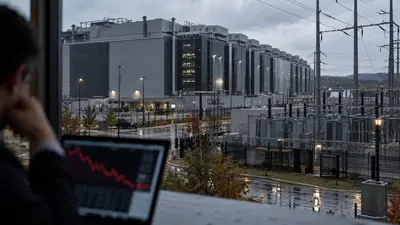
AI cloud revenue is surging, yet the Philadelphia semiconductor index lost 7.20% in a day. The task is less about calling the bottom than separating real risk from overblown fear.

1. What happened this week
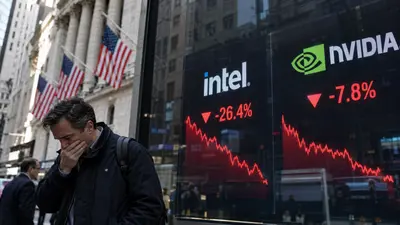
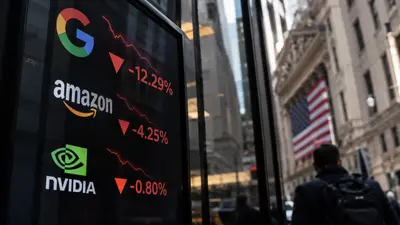
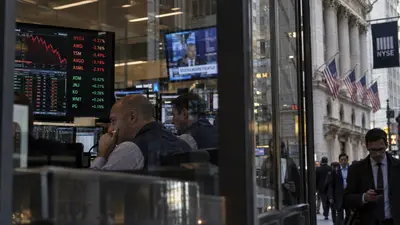
On the last trading day of October, US stocks fell sharply, led by tech. On Friday, Oct. 30, the Dow closed down 1.09%, the S&P 500 down 1.82%, the Nasdaq down 2.86% and the Philadelphia Semiconductor Index down 7.20%.
| Index | Oct. 30 close | Daily change |
|---|---|---|
| Dow | 51,770.31 | -1.09% |
| S&P 500 | 7,580.07 | -1.82% |
| Nasdaq Composite | 25,437.00 | -2.86% |
| Philadelphia Semiconductor | 10,688.80 | -7.20% |
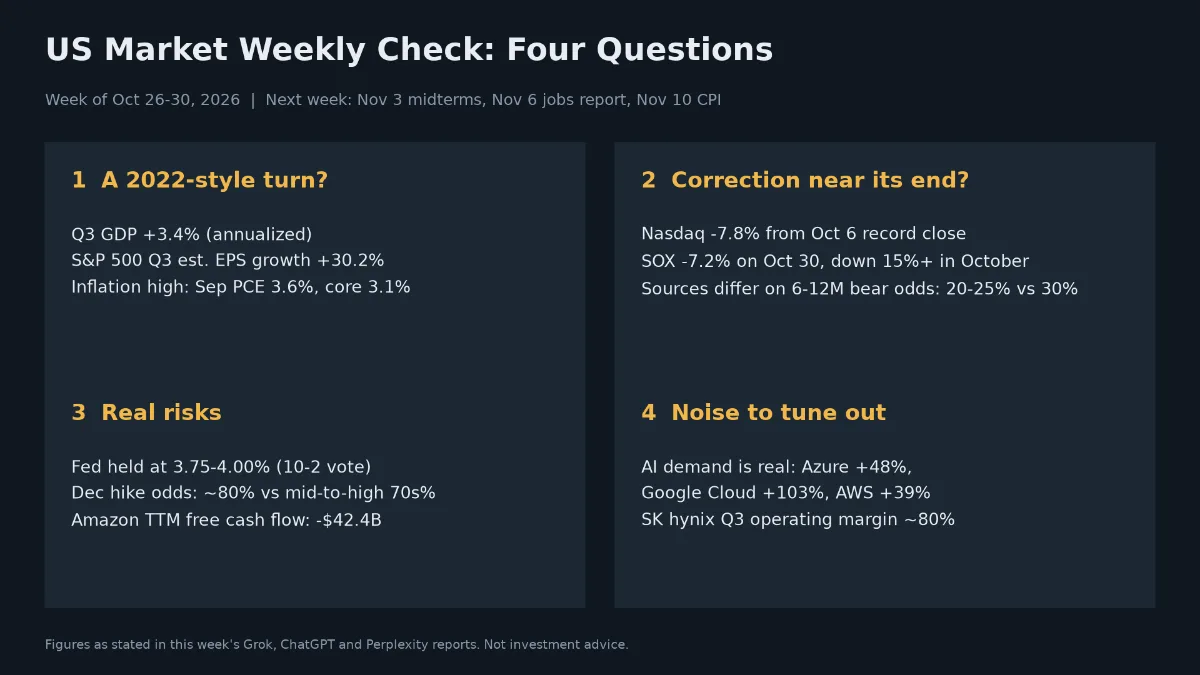
Oddly, AI demand is strong. Microsoft's Azure grew 48%, Google Cloud 103% and Amazon's AWS 39%. Yet Amazon's trailing 12-month free cash flow was a deficit of $42.4 billion. The market's question is shifting from "Is AI growing?" to "Can the spending be recouped?"
2. Is this the turn into a 2022-style bear market?
Too many signals conflict to call it that. Third-quarter US GDP grew at a 3.4% annualized rate, and expected Q3 EPS growth for the S&P 500 is 30.2%. Of the companies that have reported, 82% beat EPS estimates. That is far from a sign that corporate profits are collapsing.
But September PCE inflation is 3.6% year over year, and core PCE is 3.1%. The Fed held its benchmark rate at 3.75% to 4.00% in October, on a 10-2 vote. A strong economy that keeps rates high weighs on growth-stock valuations.
Valuation measures also need to be kept apart. One analysis puts the S&P 500 P/E at 25 to 26 and the Shiller CAPE at about 40. Another puts the forward 12-month P/E at 18.7, below the five-year average of 19.8 and the 10-year average of 19.1. Different valuation measures should not be compared as if they were the same number.
For investors who buy in installments, it is more useful to check whether the earnings outlook and funding conditions of the companies they own are actually deteriorating than to presume a market-wide collapse.
3. Or is this the last stage of a correction before a rebound?
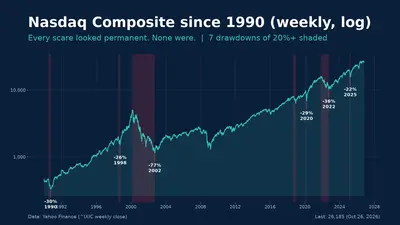
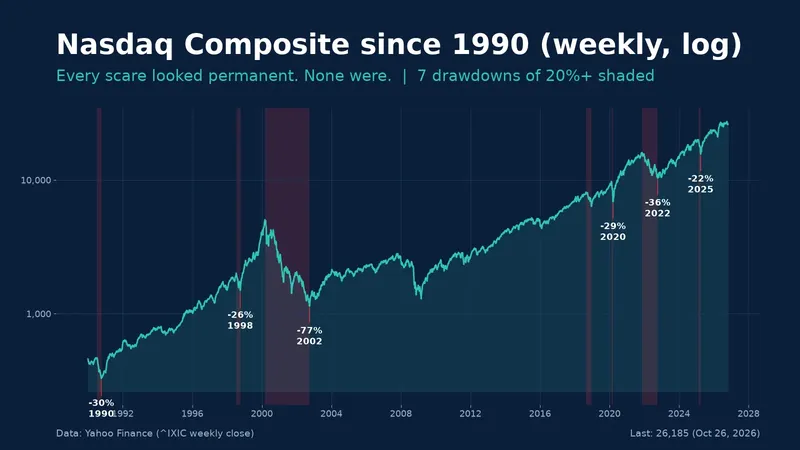
There is no basis for ruling out a rebound, but there is also too little evidence to say the correction is over. The Nasdaq is down 7.8% from its record close on Tuesday, Oct. 6. Growing earnings are a positive, but the test of capital efficiency in AI investment now looks to be starting in earnest.
The size of the earnings beats is also modest. The share of companies beating EPS estimates is 82%, but the average surprise is 1.9%, below the five-year average of 7.5%. That is why good results do not necessarily mean a strong rebound in share prices.
If growth in AI capital spending stabilizes and free cash flow improves, the case for a rebound could strengthen. If spending keeps rising while cash recovery lags, the correction could last longer. For investors buying in installments, reviewing their existing buying schedule and the position size they can tolerate makes more sense than trying to pick the bottom in one move.
4. Which risks deserve attention now?
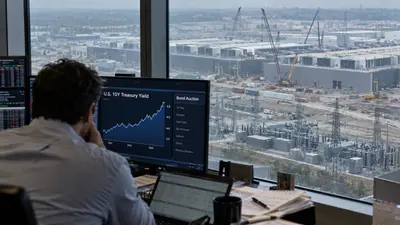
First, rates and inflation. One analysis puts the odds of another rate hike in December at around 80%, another in the mid-to-high 70s. A different source describes a separate policy path, with 75 basis points of cuts in 2025 and an expected further 50 basis points in 2026. These differing forecasts cannot be merged into one settled conclusion.
Second, oil and geopolitics. One analysis cites WTI at about $104 and Brent in the high $110s. Another gives Oct. 30 settlements of $102.95 for WTI and $113.10 for Brent. The key is the channel by which higher oil prices could feed back into inflation and rates.
Third, AI spending and financial risk. Alphabet reported quarterly capital spending of about $51.4 billion and quarterly free cash flow of about negative $9.1 billion. Financial institutions, leasing arrangements and special-purpose vehicles are increasingly involved in AI chip purchases. It matters who profits, and just as much who bears the losses if the investments go bad.
Fourth, the semiconductor supply cycle. SK hynix's third-quarter revenue of 104.6 trillion won and operating profit of 83.3 trillion won show a strong industry. For long-term HBM (high-bandwidth memory) demand, however, one account says most capacity is booked through 2027, while another says more than 50% of 2027-2028 capacity is under long-term contracts. Contract terms, supply expansion and slower price increases are the next things to watch.
Investors buying in installments should first check whether the direction of earnings forecasts, free cash flow, debt and supply expansion has changed, rather than focusing on the price drop itself.
5. What fear can be ignored?
One is the fear that a 7.20% one-day drop means AI chip demand is over. Cloud growth rates and memory earnings remain high. A falling share price is not the same as an industry failing.
The opposite conviction, that "it has fallen so much it must rebound," deserves caution too. If high growth was already priced in, shares can correct further even as the company grows.
The possible Tesla-SpaceX merger and the pressure from SpaceX's lockup expiry should also be kept separate. A merger is a scenario with uncertain terms and regulatory approval, and a lockup is a supply-and-demand factor. Neither automatically determines a company's long-term cash generation.
For long-term investors, the unnecessary fear is treating one day's price move as proof that their whole investment thesis has collapsed. If earnings and balance sheets are actually damaged, though, earlier judgments should be revised.
6. Checklist for next week
| Date | Event | What to check |
|---|---|---|
| Tue, Nov. 3 | US midterm elections | Policy and regulatory uncertainty |
| Fri, Nov. 6 | October jobs report (scheduled) | Hiring slowdown and the rate outlook |
| Tue, Nov. 10 | October CPI (scheduled) | Whether inflation is picking up again |
| Mid-November | Nvidia earnings (expected) | AI GPU demand and customer investment |
| In November (being pursued) | Anthropic IPO | Valuation of AI model companies |
| Dec. 8-9 | FOMC | Whether rates rise further |
Dates can change. Next week, the Nov. 3 policy event and the Nov. 6 jobs data come first. After that, it helps to trace how CPI and corporate earnings change the read on rates and AI profitability.
Insight Times Editorial Desk