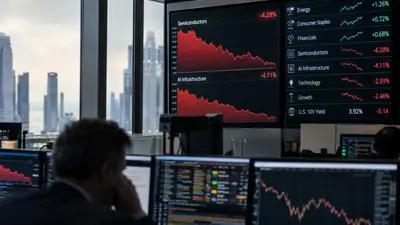
AI Is Growing. Why Are AI Stocks Falling?
Chip demand is strong, yet prices are wobbling. In October 2026 the market is asking not how fast AI grows, but how quickly the capital behind that growth returns as cash.
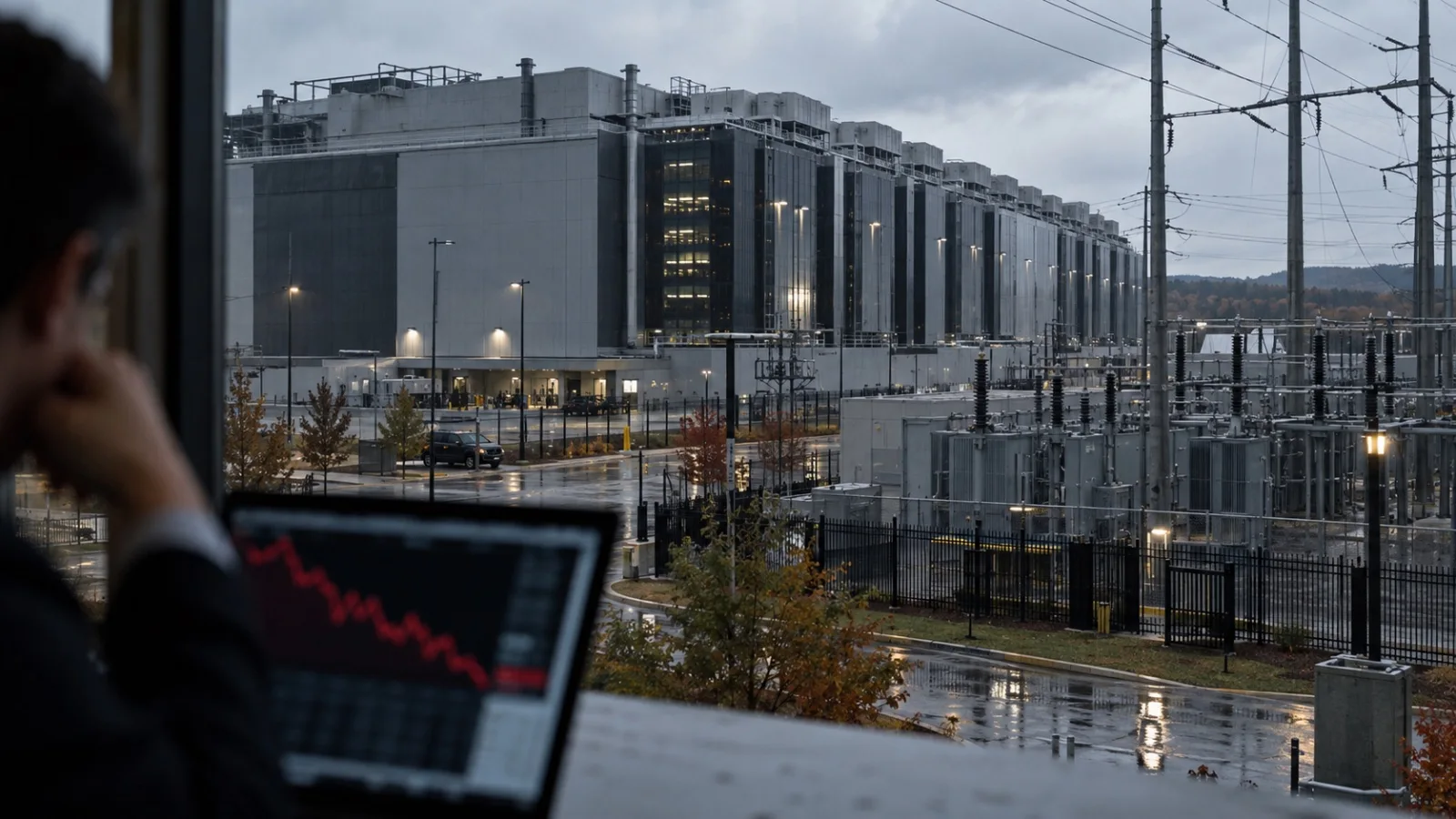
This pullback looks less like an "AI collapse" and more like a repricing of AI
On Oct. 16, the S&P 500 closed at 7,659.44 and the Nasdaq at 26,140.03. For the week, the S&P 500 fell 1.9% and the Nasdaq fell 4.5%. The Dow rose 0.7%. Many S&P 500 members also gained over the same stretch. The headline indexes look like risk aversion. Underneath, it looks more like a sector rotation as the concentration in tech eases.
Inflation and rates sit in the background. September CPI rose 3.7% from a year earlier and 0.6% from the prior month. PPI rose 1.3% on the month and 6.3% on the year. The Fed raised its policy rate by 25 basis points in September, to 3.75% to 4.00%. When the rate used to discount a growth stock's future cash flows rises, the fair value of the stock falls, even at the same revenue growth.
Brent crude also climbed to $109.86 a barrel on Oct. 16. AI data centers use a lot of power and a lot of capital at once. When energy prices and funding costs rise together, the industry can keep growing while the return to investors shrinks.
The numbers show a market contradiction
| Metric | Value | Note |
|---|---|---|
| Nasdaq, weekly | -4.5% | Pullback in AI and high-growth tech |
| Some CoreWeave bonds | 15% to 16% | High risk premium demanded by credit markets |
| TSMC Q3 revenue | $46.72B | +41.2% year over year in dollars |
| TSMC Q3 gross margin | 66.4% | Strength of advanced-node demand |
| Anthropic Q3 revenue | $16.8B | +45% quarter over quarter |
| Brent crude | $109.86 | Energy costs rising again |
The real warning came from CoreWeave's bonds, not its stock
The most important signal this week is not the sharp drop in CoreWeave's shares. It is that the market yield on some of its corporate bonds jumped to the 15% to 16% range. That does not mean all of its existing debt will be refinanced at that rate. It does mean credit markets have begun pricing the risk of AI infrastructure companies far higher.
AI infrastructure means securing GPUs and data centers first, then recovering the investment from customer revenue over several years. When the cost of capital jumps, the economics of the same data center change. Investors now have to look past how many GPUs a company bought. Debt maturities, interest expense, utilization, contract quality and free cash flow matter more.
Anthropic raises a similar question. The company reported third-quarter revenue of $16.8 billion, up 45% from the prior quarter. Separately, in a reported chip financing deal, returns above 10% were mentioned for Blackstone's money. In an industry where revenue growth and financing costs are both surging, growth alone does not explain a company's value.
Chip earnings have not broken
TSMC's third-quarter results collide head-on with the case for an AI demand collapse. Revenue was $46.72 billion in dollar terms, up 41.2% from a year earlier. Net income was NT$763.06 billion, up 68.7%. Gross margin was 66.4% and operating margin was 58.7%. Advanced processes at 7 nanometers and below made up 79% of wafer revenue.
The fourth-quarter guidance matters more. TSMC guided to revenue of $52.3 billion to $54.3 billion and a gross margin of 65% to 67%. The real demand confirmed so far is strong. Reading the drop in chip stocks as an industry peak would be premature.
Still, stock prices look first at 2027 and beyond, not at current earnings. Expanding memory supply, slower hyperscaler capex, ASIC competition and higher long-term rates could together push multiples lower even if earnings are good. The current pullback is less about AI demand disappearing than about what price to pay for good demand.
Power is still AI's most practical bottleneck
Power is a second sign that the AI investment case is alive. The EIA's latest October outlook points to continued high prices and demand pressure in the US power market. Data center and manufacturing buildouts keep lifting commercial and industrial power demand, and that has not changed.
On Oct. 14, AEP announced a roughly $4 billion, 702 MW fuel cell project in Wyoming to supply power to Google. The contract runs 20 years, with full operation targeted for the end of 2028. The point is less the fuel cell technology than the demand to secure power faster without waiting for a grid connection.
Schneider Electric also raised its 2026 outlook again, citing data center demand. Third-quarter organic revenue rose 16.9% from a year earlier, and the company expects full-year organic growth of 12% to 14%. The thesis that the bottleneck after GPUs moves to power, distribution and cooling still holds.
How the market is pricing things now
| Area | Core strength | Main risk | Current approach |
|---|---|---|---|
| AI chips and advanced foundry | Strong real demand | Rate and multiple pressure | Hold, add in stages |
| AI cloud and neoclouds | Strong demand | Debt and interest expense | Be selective |
| Power, grid and cooling | Strong structural demand | Elevated valuations | Check orders and FCF |
| Health care and staples | Defensive cash flow | Limited growth | Ease AI concentration |
| Space and robotics | Long-term option value | Monetization unproven | Limit weight |
Insight Times Editorial Desk