AI Demand Is Strong. So Why Are AI Stocks Falling?
The market is moving from an era of supply shortages to an era of investment payback. The question is no longer how big AI gets, but who keeps the cash.

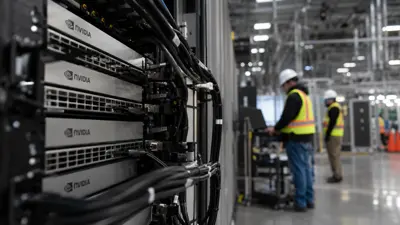
AI chips are selling well. Memory is in short supply, and there is not enough power to run the data centers. Companies keep raising their AI spending. Yet stock prices are falling.
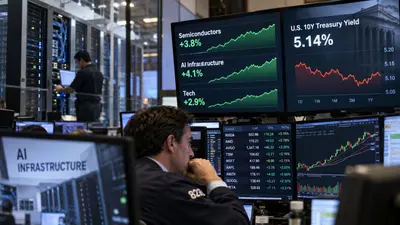
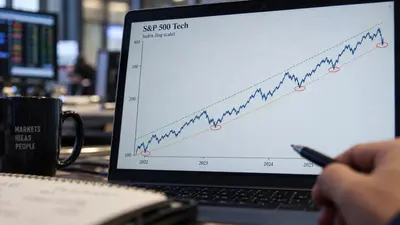
On Oct. 22, the Nasdaq fell 2.60% and the Philadelphia Semiconductor Index fell 6.7%. The growth potential of AI did not suddenly vanish. The yardstick the market uses to judge these companies is changing.
Until now, the market's question was "How much will AI grow?" Now it is shifting to "How much will be spent to get that growth, and how much cash will ultimately be left for shareholders?"
A good industry is not the same as a good investment
A company's profit can rise 30% and its stock can still fall. Suppose a company's earnings per share (EPS) rise from $10 to $13. What happens if the price-to-earnings (P/E) multiple the market is willing to pay drops from 40 to 25?
| Price | Basis | |
|---|---|---|
| Before | $400 | EPS $10 × P/E 40 |
| After | $325 | EPS $13 × P/E 25 |
Earnings up 30%. Stock down 18.75%.
A hypothetical example for illustration. These are not actual stock price data for any company.
This is the paradox of growth investing. Even with strong results, a stock can fall if the price paid earlier for expectations was too high. So an earnings report calls for more than a look at profit growth. How far results beat market expectations, and how the multiple placed on future earnings may change, both need to be checked.
What Meta shows about the new math
Meta set its 2026 AI-related capital spending outlook at $135 billion to $145 billion. That raises the low end of its earlier range by $5 billion. For investors, the key question is not only revenue growth. It is whether the cash generated by the existing business can carry this enormous investment bill.
Meta also disclosed a plan to issue a new non-voting Class C share. On Oct. 22 its stock fell more than 7%, and its five-year credit default swap (CDS) hit 114.79 basis points, then an all-time high.
A CDS is a financial product similar to insurance against a company's default. A rising CDS price does not mean an actual default is near, however. Demand for hedging and uncertainty about funding can also push the price up.
Operating profit is an accounting result. Free cash flow (FCF) is the cash left after running the business and paying for capital spending. An AI data center takes a huge amount of cash up front. Its cost, though, runs through the income statement over many years via depreciation. That is why a growing company's operating profit can rise while its free cash flow worsens.
Who earns the money in AI, and who pays the bill?
Rising demand across the AI industry does not mean every participant's profit rises with it.
- Chip and memory makers: revenue from selling AI hardware
- ↓ the buyers' capital spending cost
- Data center and cloud companies: revenue from providing computing infrastructure
- ↓ the operating cost of AI service providers
- AI service companies: revenue from software and AI usage fees
- ↓ payments from actual customers
- Businesses and consumers: productivity gains and economic benefit
In reality, the industry is tangled with cross-investments, prepayments and financial transactions. This chain simplifies the basic way costs are passed along.
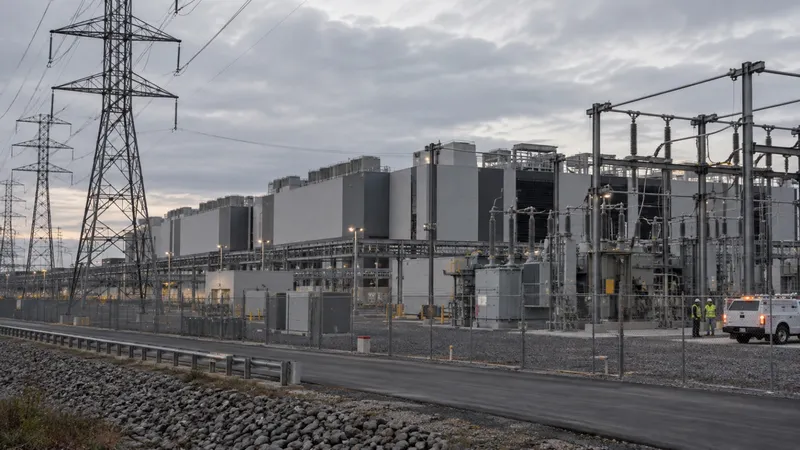
A memory shortage can give memory makers pricing power. For server buyers, it is a higher cost. Power shortages work the same way. For a data center that has already secured power, it can be a competitive edge. For an operator waiting on a grid connection, it means delayed revenue.
In the end, an industry bottleneck is a gain for one party and a cost for another. The task is to judge where in the supply chain the economic profit from that demand ends up.
The end customer's wallet completes the AI economy
GPU orders and large data center contracts are signals of future demand. They do not guarantee that the investment will be recouped. In the end, businesses and consumers must use AI services to gain real economic value, and keep paying for it.
The IMF, in its 2026 annual report, also warned of circular financial ties in which AI companies are each other's customers, investors and funders. Such ties could spread a shock at one company to others.
That does not mean every AI contract is hollow. What matters is separating money moving around inside the industry from independent end-customer demand. If AI gets smarter and usage fees fall, the market could grow even larger. Price competition, on the other hand, could squeeze the margins of service providers. Nothing guarantees that technological progress and shareholder returns move in the same direction.
The credit market is already telling companies apart
A Oct. 23 analysis by J.P. Morgan Private Bank shows the whole AI industry is not exposed to the same financial risk. Five-year CDS for large AI companies with strong cash generation generally sat at 50 to 120 basis points. For some AI infrastructure companies that rely heavily on borrowing, CDS rose as high as 1,100 basis points.
That is roughly a tenfold gap in the cost of protection. It suggests there are stretches in which balance sheets matter more than technology. Still, the credit market's warning need not be read as a forecast of an industry-wide collapse. Risk in the broader investment-grade corporate bond market was relatively limited.
Companies with ample cash can keep investing in AI. Companies that depend on borrowing may have to slow their spending because of funding costs, even in the same demand environment.
When will the AI stock correction end?
Pinpointing the exact bottom is hard. Instead, three paths can be considered.
| Scenario | Conditions needed | Likely effect on prices |
|---|---|---|
| Monetization recovers | Revenue and cash flow catch up with the investment bill | A recovery that prices in better earnings ahead of time |
| Correction through time | The industry grows, but the burden of high valuations persists | Prolonged sideways trading as valuation pressure eases |
| Spending cuts spread | Tighter funding leads to lower capex and fewer orders | Further declines extend to infrastructure suppliers |
These are not probability forecasts. They are a framework for telling situations apart. Stocks can move before an actual recovery. So it is more realistic to check whether earnings and financial-market signals are improving in the same direction than to try to call the bottom.
Conclusion: Analyze who owns the AI future, not just the future itself
The AI industry can keep growing. Technology can advance, and demand for power and memory can rise. Even so, returns on investment at some companies can fall. The value the industry creates can flow to customers, concentrate in suppliers of scarce components, or be used up by huge investment costs and financing expenses.
What long-term investors must endure is price volatility. What they must keep testing to the end is the investment thesis.
Insight Times Editorial Desk