Chips Surge on Oct. 19, but CoreWeave and a 5.14% 10-Year Show the Cost of AI Debt

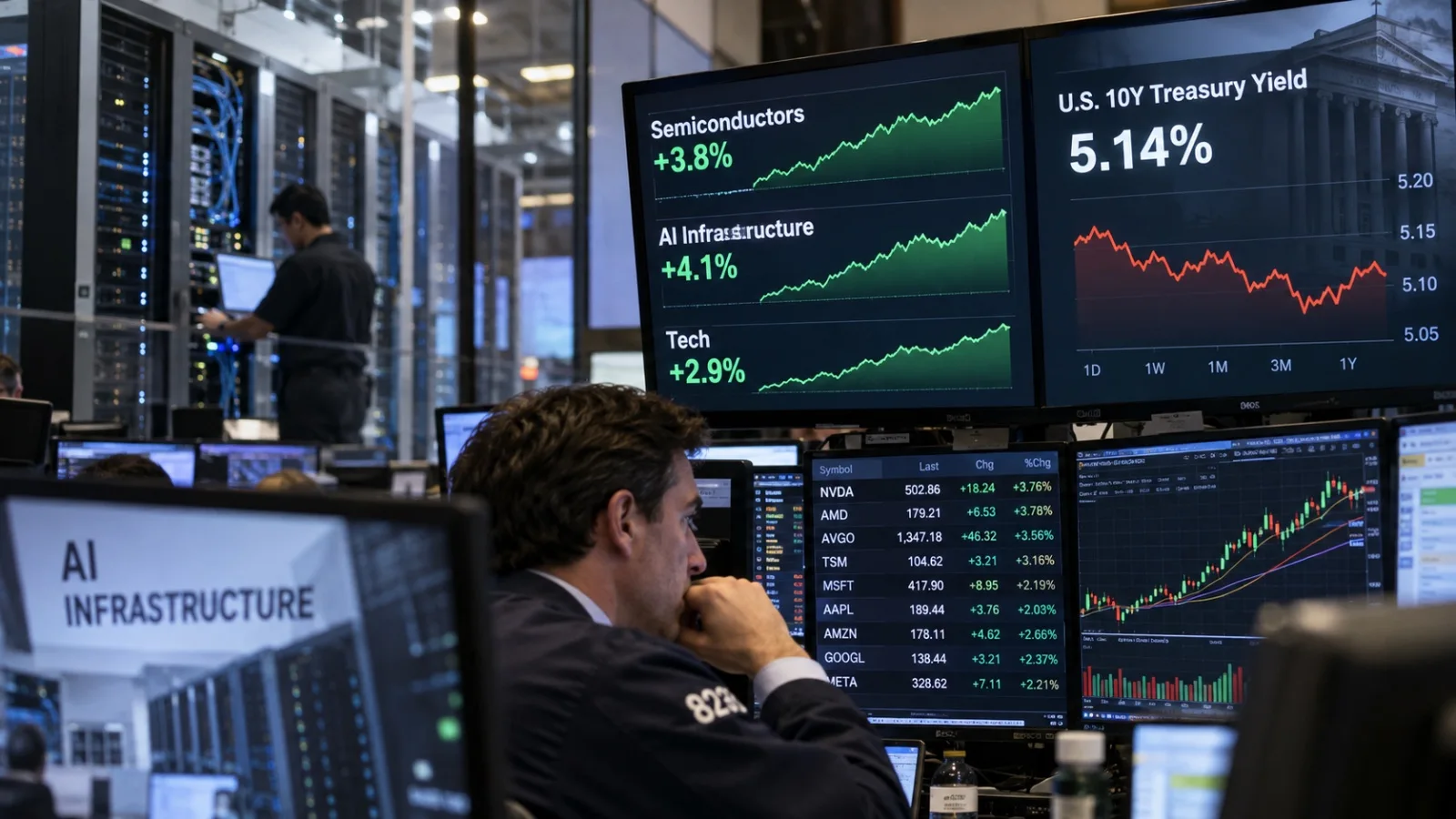
SanDisk rose 5.53%, Micron 2.97% and the Nasdaq 1.11%. CoreWeave slipped 0.44%, and the 10-year Treasury yield hit 5.14%. Hopes for AI demand and the financing risk of AI infrastructure are starting to pull in different directions.
1. AI demand is alive. Who pays for the buildout?

The most interesting stock in the U.S. market on Oct. 19 was not Nvidia, which rose, or SanDisk, which jumped. It was CoreWeave, which fell 0.44%.

Goldman Sachs upgraded CoreWeave from neutral to buy. It also cut its price target from $139 to $106. The firm recommended the stock while lowering its expectations for the company's value.

The core issue is not a shortage of AI computing demand. It is how expensive the debt used to expand data centers will be, and whether the new equipment will generate enough cash.

CoreWeave's bonds due 2031 yielded more than 16% last week and came down to about 15.13% on the 19th. That is an improvement, but the cost of capital is still high.

Investors need to separate two things.

Growth in AI demand and the return on investment of the companies serving that demand are not the same thing.

As demand for AI data centers grows, Nvidia, memory makers and chip-equipment suppliers get new sales opportunities. Data center operators, by contrast, carry huge up-front investment, interest costs and the profitability of their customer contracts.

That gap was the most important message of the session.

2. Chips rose, but the broader market did not follow

Major U.S. index closes, Oct. 19

IndexCloseChange
S&P 5007,690.73+0.41%
Nasdaq26,430.89+1.11%
Dow51,966.03-0.07%
Russell 20002,728.30+0.25%

Buying concentrated in semiconductors. SanDisk gained 5.53%, Lam Research 3.13% and Micron 2.97%. The chip ETF SOXX rose 1.73%.

Money piled into the supply chain expected to benefit most directly from AI data center expansion.

Amazon rose 4.98% and Tesla 3.76%. Amazon was helped by being named a top pick at Morgan Stanley, and Tesla by anticipation of its earnings report.

The problem is the breadth of the move.

Index gains versus the market's interior, daily change

GaugeChange
Nasdaq+1.11%
S&P 500+0.41%
Russell 2000+0.25%
Dow-0.07%
Equal-weight RSP-0.32%

The cap-weighted S&P 500 rose 0.41%, but RSP, the equal-weight ETF that gives each stock a similar weight, fell 0.32%. Among sector ETFs, consumer discretionary and technology were strong, while utilities fell 2.01%, real estate 1.16% and financials 0.83%.

The index gain is clear. So is the fact that many stocks did not take part in the rebound.

To call this the restart of a bull market, investors would need to see not just the size of the gains but a widening of the stocks participating.

3. A 5.14% 10-year yield is the most realistic hurdle for AI spending

The 10-year Treasury yield rose about 4 basis points to 5.14%. Brent crude stayed high, above $100 a barrel.

While growth stocks rebounded, the bond market stayed wary of high inflation and the risk of tighter policy.

Higher rates do not weigh equally on every AI company. Big tech firms that can invest from abundant operating cash flow and companies that expand data centers through heavy borrowing have different financial strength.

Even within the same AI investment cycle, the risks differ for those who supply the money, those who borrow to build the equipment, and those who use it.

In particular, if interest on debt and new capital spending grow faster than revenue over the coming years, the cash left for shareholders could be limited.

For AI infrastructure, then, investors should watch not only revenue growth but return on invested capital (ROIC), free cash flow (FCF) and borrowing costs.

4. What differed by stock

StockOct. 19 closeChangeNext test
CoreWeave$61.12-0.44%Bond yields, ability to raise funds
Tesla$368.06+3.76%Auto margins, FCF
Amazon$262.45+4.98%AWS growth, AI returns
Nvidia$217.09+1.38%AI orders, gross margin
Palantir$194.15+4.36%Commercial customer growth, valuation

CoreWeave could not hold gains despite the buy rating. Tesla entered earnings with strong expectations, but it has to prove through results that its auto business is recovering profitability.

For Amazon, the key is whether AI can be monetized through AWS. For Nvidia, what matters is real chip orders and whether its high gross margin lasts.

Each company connects to AI in a different way. A rise on the same day does not justify applying the same investment logic to all of them.

The Oct. 19 rebound leaves one question. It is not whether money for AI will keep coming in, but whether that money can come back with enough profit.

The more clearly that question is answered, the firmer this rebound is likely to prove.

Rising AI demand does not guarantee returns for companies that borrow to build capacity, because those returns hinge on rates and cash flow.

Insight Times Editorial Desk

More by topic

Starting with this story's topics, then what readers are following now

Nasdaq

This story's topic7 storiesSee all →

HBM

59 storiesSee all →

Memory stacked next to the GPU.

Has Memory Peaked? Prices Are Cooling, but the Shortage Looks Set to Run to 2028

Price growth has slowed and consumer demand is already breaking. Server and HBM supply remains short, and Micron says more than 75% of its 2027 volume is already committed to customers.

Tech

How Far Can China Push DRAM Without EUV

CXMT says it has shrunk DRAM features to 11.95nm using quadruple patterning instead of EUV lithography. The real question is not whether China caught up, but how much more it now costs China to get there.

Tech

AI Chip Peak Check: Demand Still Rising, Risk Building in 2027-2029 Supply and Funding

DRAM and NAND contract prices are still climbing and HBM suppliers hold the edge. Power shortages, AI financing costs and simultaneous memory expansion are the risks for later years.

Investing

2027 Isn't the End: Citi's Case for a Memory Supercycle Running to 2031

Citi says the memory shortage timeline is stretching again. If AI shifts from "train once" models to continual learning, HBM, server DRAM and enterprise SSDs could all fall short at the same time.

Tech

China's Memory Challenger Raises a Harder Question for the AI Boom: How Long Will Profits Last?

Samsung, SK hynix and Micron have more to watch than Chinese output alone. Wall Street's focus is moving to how long today's outsized profits can last.

Tech

If TSMC Runs Terafab, Musk's Chip Plan Shifts From Self-Built Fab to Dedicated Foundry

Talks with TSMC are not a contract. But if a deal happens, Terafab may become less about Musk making chips himself and more about tying TSMC's manufacturing to a captive supply chain for his companies.

Tech

Micron's Real Number Is $32 Billion in Customer Commitments, Not Revenue

Customers have put up cash to reserve memory supply, while HBM eats into DRAM wafer capacity. That changes how investors should read the AI memory supercycle.

Tech

A building that houses servers and networking gear and supplies them with powe…

Tesla Energy's 13.7GWh Paradox: Expectations Ran Faster Than Deployments

Q2 deployments recovered but margins collapsed. Q3 set a record for deployments and still missed estimates. The issue is not the size of AI power demand but how fast it converts into Tesla revenue and profit.

Tech

Why Nvidia Is Happy to Help Make AI Models Nearly Free

Falling model prices can squeeze model makers. For Nvidia, the number that matters is the total volume of tokens generated worldwide and the compute that produces them.

Tech

AI Needs to Find $1 Trillion a Year From Somewhere to Pay Back Its Capex

Saying AI capex is big is no longer the point. The harder question is what end users have to pay for the buildout to pencil out, and Goldman Sachs puts that number at roughly $1 trillion a year.

Tech

Nvidia Put $2 Billion Into Lumentum. Optics May Be the Next Bottleneck, but the Stock Has Already Run

Optical networking is emerging as the next constraint on AI data centers. Investors need to separate the industry's growth potential from the price they are already paying for it.

Tech

Nvidia's Next Target After GPUs: Controlling What AI Agents Are Allowed to Do

OpenShell and Sentry are not about policing what an AI says. They are about controlling, at the server infrastructure level, which files and APIs an AI can touch, what it can execute, and who can actually pull the plug when something goes wrong.

Tech

The AI Correction Is Not a Buy-the-Dip Signal. It's a Profitability Screen

As AI stocks wobble, the question isn't whether the theme survives. It's where bottlenecks still convert into real orders, pricing power and yield. Memory is at the center of that question right now.

Tech

If GPUs Are the Muscle, the Network Is the Nervous System

AI data centers do not get faster just by buying more GPUs. When thousands of accelerators cannot exchange data on time, the most expensive asset in the building sits idle. That is the whole investment case for Arista.

Investing

NVDA

69 storiesSee all →

China Is Now Copying Something Harder Than Nvidia's GPUs: CUDA

DeepSeek and Huawei have open-sourced compute, communication and programming tools for Ascend. The contest with Nvidia is moving beyond chip speed to how easily developers can switch.

Tech

AI Has Five Years to Find $4.2 Trillion in New Annual Revenue

The AI infrastructure question is no longer how many more GPUs to buy. It is how quickly the trillions already committed can produce enough cash flow.

Tech

AI's Next Bottleneck Is Money, Not Chips

Broadcom is lending Anthropic up to $42 billion, and Nvidia wants to build a $500 billion market for loans backed by GPUs. The AI race may turn on what rate buyers pay to borrow.

Tech

Nvidia's $500 Billion Experiment: Wall Street Asks Who Backs the GPU, Not Just the Chip

The real issue in Nvidia's financing platform is not chip sales. It is how far Wall Street will trust GPU resale prices and rental income three to four years out.

Tech

Jobs Cooled, Yields Rose, and Only Chip Equipment Stocks Rallied

The S&P 500 slipped 0.17% on Sept. 29 while SOXX gained 1.19%. Investors did not abandon AI. They appear to be picking the AI names that can live with high rates.

Tech

Samsung's HBM4 Yield Hits 80% - Now the Real Fight Is Production Volume

Reports confirm Samsung's HBM4 yield has climbed to roughly 80 percent, but the bigger number is capacity: HBM wafer input is projected to jump nearly 40 percent next year, from about 180,000 to 250,000 wafers a month.

Tech

The US-China Summit Didn't Erase Taiwan Risk for Chip Stocks

Washington's Taiwan policy held, but roughly $14 billion in arms sales is still on hold. For AI chip investors, the summit reads less like risk removed and more like a fragile balance extended.

Macro