Stocks Bounce, but the AI Selloff May Not Be Over: A Two-Week Playbook
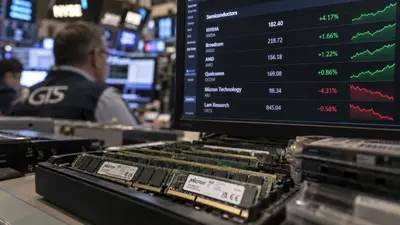
The Dow rose more than 1% while the Nasdaq barely moved and semiconductors kept falling. A W-shaped retest looks more likely than a V, and the task now is surviving the next drop.
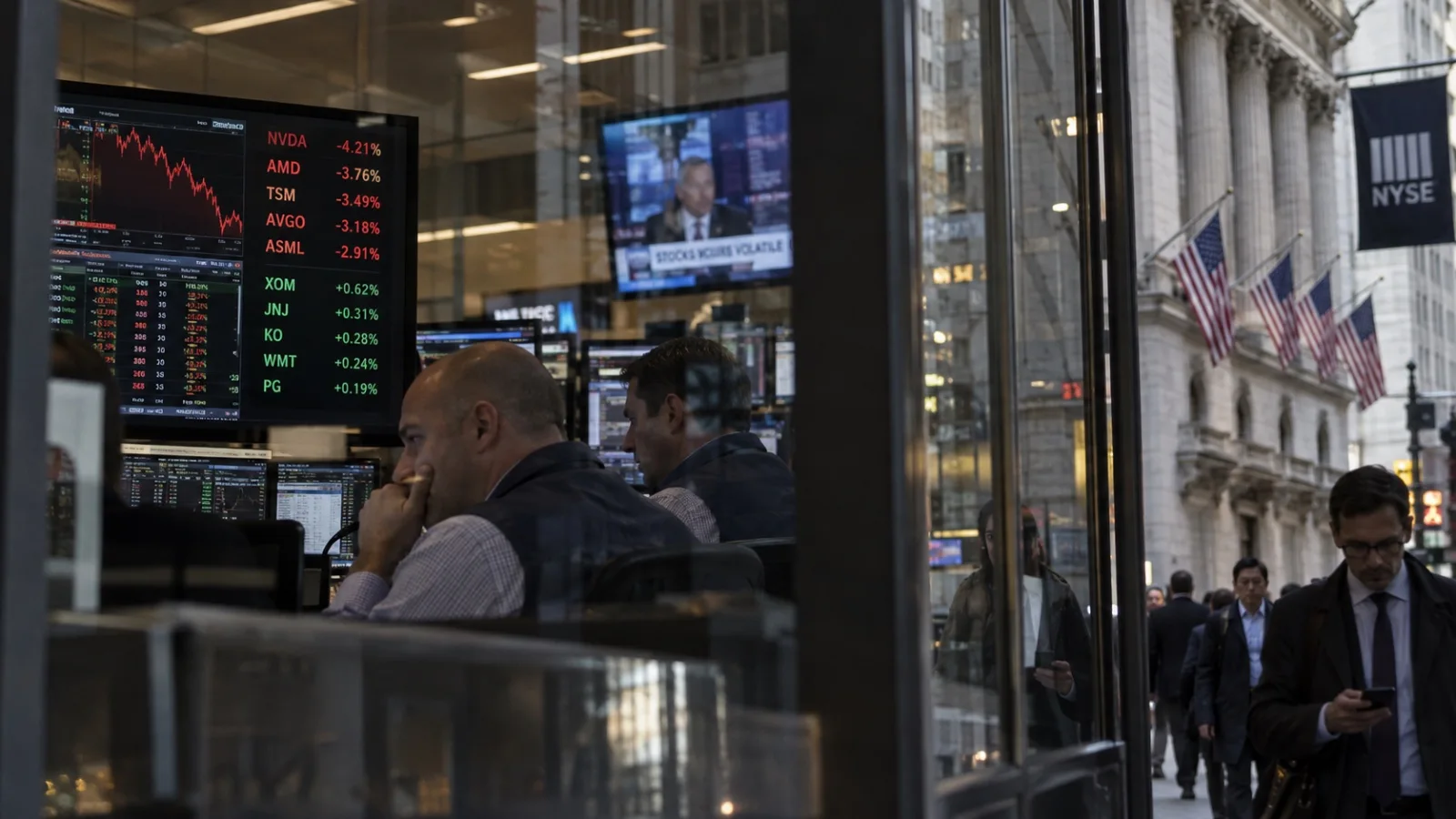
U.S. stocks bounced after a sharp selloff. The Dow rose more than 1%. But the leaders of the AI trade did not drive the move, and the rebound says little about whether AI stocks have bottomed.
A rebound abroad does not end the AI correction
South Korea's KOSPI fell 7.57% on Oct. 15 to close at 5,554.22, after losing about 20% over seven sessions. On the morning of the 16th it bounced 2% to 3%.
The arithmetic is unforgiving. A market that falls 20% from 100 to 80 and then gains 3% stands at only 82.4. It would still need about 21.4% more to regain its prior high.
The math of a rebound after a sharp drop
| Before the drop | After a 20% decline | After a 3% bounce |
|---|---|---|
| 100 | 80 | 82.4 |
A 25% gain is needed to get back to the starting point after a 20% decline. That is why a single day's bounce cannot show that a bottom is in.
Foreign investors kept selling in Korea on the morning of the 16th. Institutional flows changed depending on when in the session they were tallied, so it is hard to call them sustained net sellers for the full day.
Korea's rebound suggests global risk appetite could recover. Unless U.S. semiconductors and long-term yields stabilize, though, it is not enough to count as evidence of a trend reversal.
The Dow rose. Why was the Nasdaq flat?
U.S. regular-session closes, Oct. 15:
| Index | Change | Close |
|---|---|---|
| Dow | +1.08% | 52,177.69 |
| S&P 500 | +0.33% | 7,744.06 |
| Nasdaq | +0.08% | 26,713.03 |
| Russell 2000 | +1.38% | 2,767.27 |
U.S. stocks closed higher, but AI was not the driver. Health care and consumer-related sectors were strong, while the S&P 500's technology sector was weak. The Philadelphia Semiconductor Index fell for a seventh straight session.
That cuts two ways.
On the positive side, money leaving AI stocks has not fled the market entirely. Strength in other sectors is cushioning the shock to the broader market.
On the other hand, a recovery in demand for the AI leaders that had lifted the U.S. market has not yet been confirmed.
A rebound in the index and a bottom in AI stocks are not the same event. Going forward, the gain in the S&P 500 matters, but so does how many stocks are taking part in it.
Tonight, the close matters more than the open
Fed Chair Kevin Warsh did not signal further rate hikes in remarks on Oct. 16. The market-implied probability of an October hike fell to about 15%, and U.S. stock index futures rebounded.
A lower chance of a hike does not mean better earnings prospects, however. Even if the Fed does not tighten again right away, high funding costs can keep weighing on companies.
The 16th is also U.S. monthly options expiration. Position unwinds and hedge adjustments could widen intraday swings.
A plausible base case is a bounce in oversold tech stocks, followed by profit-taking and risk-reduction selling. The desk leans toward the Dow and the equal-weighted S&P 500 continuing to outperform the Nasdaq.
If long-term yields fall further and semiconductors close strongly on heavy volume, though, that cautious view would need revising.
The next two weeks: a W more than a V
Two rebound scenarios: a V-shaped recovery versus a W-shaped retest of the lows. Conceptual sketch only. It is not an index forecast or a probability.
There are three reasons to give a W-shaped retest meaningful weight.
First, U.S. inflation has firmed again. The September consumer price index rose 3.7% from a year earlier, and worries about further Fed tightening have not fully disappeared.
Second, credit risk in AI infrastructure has emerged as a new variable. Companies expanding equipment with borrowed money must prove interest costs, refinancing terms and actual cash inflows, even when customer contracts are plentiful.
Third, semiconductors can move more on institutional position adjustments than on earnings. Even if profit forecasts hold, continued selling to trim concentrated holdings could push prices lower.
Still, if credit markets stabilize and earnings estimates rise at the same time, a recovery without a retest is possible. The W is not a prophecy. It is a base case for preparing against current risks.
AI is not over, but not every AI company will survive
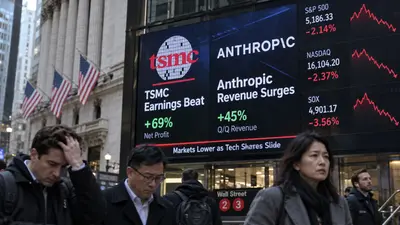
TSMC's third-quarter 2026 net income was NT$763.06 billion, up 68.7% from a year earlier. Revenue was NT$1.49424 trillion, up 50.9%. Gross margin, however, slipped 1.3 percentage points from 67.7% in the prior quarter to 66.4%.
The numbers show how strong AI chip demand is. They also show that investors need to check the quality of profitability, not just revenue growth.
Three tests are likely to separate AI stocks from here.
Is real profit being generated? Does free cash flow remain after the investment? How much borrowing is needed to sustain the growth?
Cash-generating AI (Nvidia, TSMC, Broadcom and others): If earnings and margins hold, these may stabilize first. High valuations are a separate risk.
Debt-reliant AI infrastructure (neoclouds, some data centers): The speed at which contracts turn into cash, financing costs and refinancing prospects matter more than backlog.
Expectations-driven AI (some richly valued software): If slowing growth coincides with higher long-term yields, valuation pressure could build.
None of this means cash-generating companies' shares must rise. A industry's long-term growth potential and whether today's price is fair should be judged separately.
The takeaway
The goal is less to call the bottom than to build a portfolio that can withstand the next decline.
U.S. stocks can rebound first. But it is hard to rule out another test for AI and semiconductors. Nor is there reason to deny the growth of the AI industry itself.
The outcome of this correction is likely to differ company by company. Firms that turn invested capital into more cash may hold their valuations better than those that simply own more AI equipment.
Insight Times Editorial Desk