Gas Prices, Not Politics, Are Deciding This Midterm Market Story
Forecasts of a Republican defeat are not exaggerated. The House has tilted clearly toward Democrats, the Senate has moved from a toss-up to a slight Democratic edge, and Trump's net approval is the lowest of either term.
The verdict up front
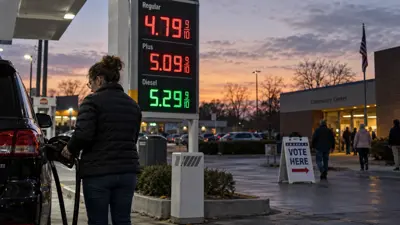
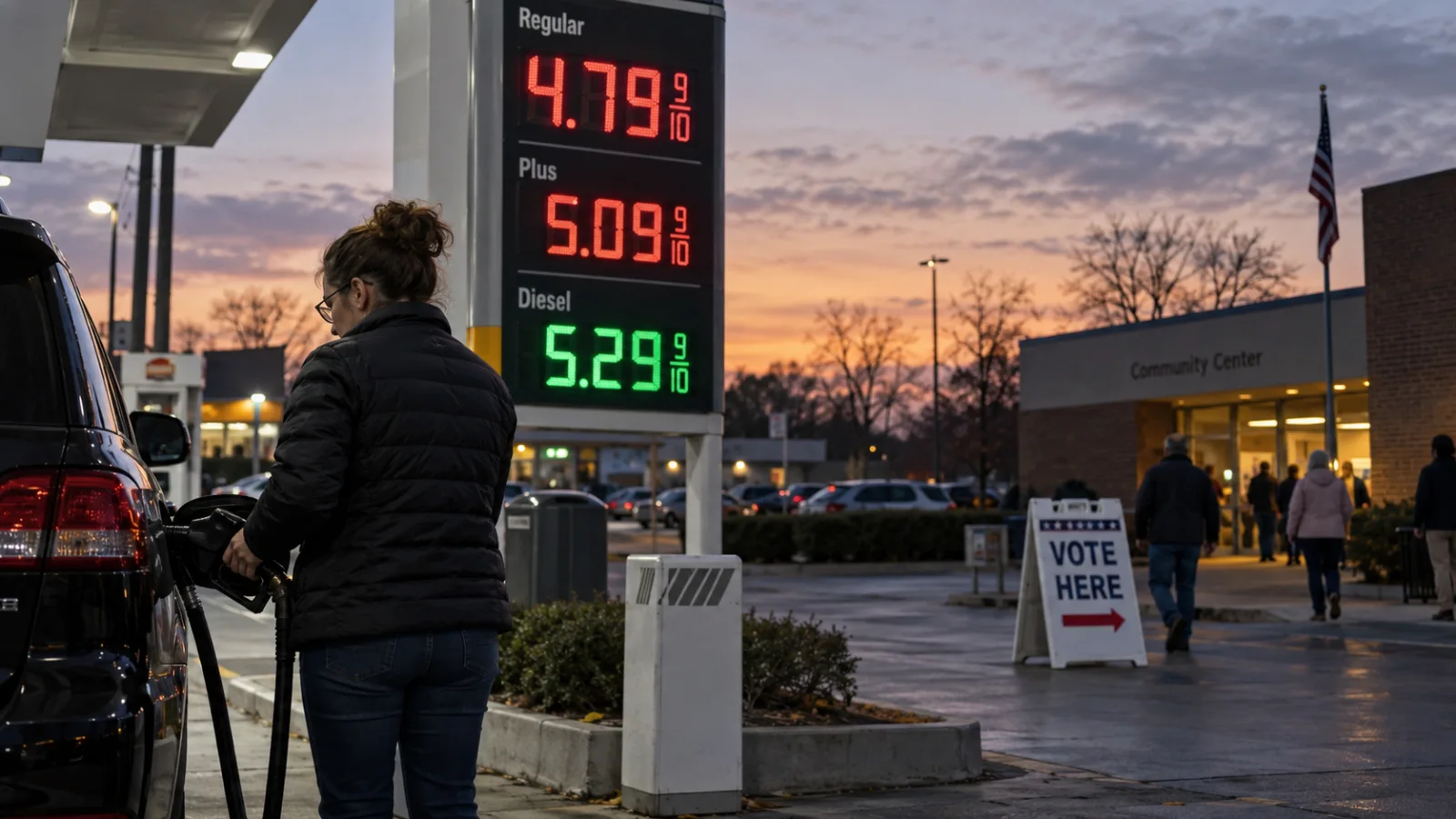
The cause is almost entirely the cost of living. Gasoline that cost under $3 before the Iran war is now near $4.50. The Federal Reserve raised rates in September, and the 10-year Treasury yield spiked to 5.2%. Voters are angry at the price level itself.
Even a Democratic sweep does not mean a policy revolution. Trump holds the presidency and the veto pen through January 2029. A Democratic Congress cannot pass new law on its own; it can control spending, hold hearings, and launch investigations. That means the shock lands on specific sectors and stocks, not the index as a whole.
The real market variable is something else. Barclays, Morgan Stanley and RBC all say the same thing: oil prices and interest rates, not the election, will decide stock prices this fall. The election is volatility layered on top.
1. The race, in numbers
The House currently stands at 218 Republicans to 214 Democrats. The Senate is 53-47 Republican. Democrats need only a few House seats, but a net gain of 4 in the Senate, because Vice President Vance breaks 50-50 ties.
- 72% — DDHQ model's probability Democrats win the House (Sept. 24)
- 54% — DDHQ model's probability Democrats win the Senate (Sept. 24)
- 64% — Polymarket price on a Democratic sweep of both chambers
- 226-209 — Cornell University's House seat projection; this model has called the winner in all of the last 14 midterms
- D+11 — Emerson national poll on party preference (53-42), Sept. 21-22
- 38.0% — Trump's approval polling average, with 59.6% disapproval (Sept. 18)
- -22.4 — Silver Bulletin's net approval score; at the same point in his first term it was -11.6
- 3 of 30 — Number of midterms since 1906 in which the president's party gained House seats
The Senate battlegrounds are North Carolina (former Governor Cooper is running, and it's seen as Democrats' best pickup opportunity), Maine (Collins), the Ohio special election (Sherrod Brown vs. Husted), an open seat in Iowa, Texas, Alaska, and Michigan, which Democrats have to defend. Outside North Carolina, most of these are within the margin of error, meaning the Senate could still flip in the final two weeks.
2. Why Republicans are losing ground: the economic chain
Several causes look separate, but they link into a single chain, each link knocking down the next.
February 28: the Iran war begins, and the Strait of Hormuz is blockaded. A war that opened with US and Israeli airstrikes effectively shut a strait that carries about 20% of the world's oil supply. There was a ceasefire from early April to early July, but fighting resumed on July 8, and on September 11 Saudi Arabia's east-west pipeline was also halted.
Oil: $118, then $70, then $109 again. Brent crude spiked to roughly $118 in late March, fell back to $70 by early July, and hit $109 again in early September. US gasoline has gone from under $3 a gallon before the war to near $4.50 now, and diesel is at a record $6.52.
Prices: headline inflation at 3.4%, gasoline up 27.4%. August CPI came in at 3.4% year over year, above the 2.9% Trump inherited at inauguration. Core inflation is a calmer 2.4%, but gasoline is up 27.4% over the past year, a textbook case of an energy shock where the number people feel diverges from the number that gets reported.
Rates: the first hike in three years, the highest Treasury yield in 19 years. The Fed under Chair Warsh raised rates unanimously by 25 basis points on September 16, taking the benchmark to 3.75-4.00%. The median dot plot points to one more hike by year-end. The 10-year Treasury yield hit an intraday 5.225%, the highest since 2007, with the 30-year touching 5.5%. Mortgage rates are in the 7% range.
Households: real wages have gone negative, sentiment is at rock bottom. Prices are rising faster than income, pushing real wages negative. CNBC estimates the combined burden of oil and rates at roughly $1,700 per household. Consumer sentiment at 47.8 is roughly half the average of 85 seen in past election years. 47% of voters name the cost of living as their top voting issue.
On top of that: tariffs and data centers. The Supreme Court ruled in February that IEEPA tariffs were unlawful, but the administration moved through temporary Section 122 tariffs before imposing new Section 301 tariffs of 10-12.5% on 60 economies starting July 24. The effective tariff rate is the highest since 1943. Meanwhile AI data centers are drawing bipartisan backlash over electricity bills and water use (a Quinnipiac poll found opposition at 78% among Democrats, 66% among independents, 56% among Republicans).
3. Why Republicans could still hold on
The odds of Republicans holding the status quo are not zero, and it's worth knowing the counterargument so headlines don't whipsaw you.
Structural advantages for Republicans
- Redistricting: A Bloomberg Government analysis of the Texas-triggered redistricting fight finds the net effect favors Republicans by roughly 10 seats.
- Few competitive seats to begin with: Of 435 House seats, only around 42 are genuinely competitive. Even a big wave has a narrow levee to clear.
- Money: Republican campaign committees currently lead in fundraising, and Elon Musk is again putting large sums into Republican super PACs.
- The Senate map: Democrats need to flip two or more seats in states Trump won by more than 10 points.
Late-breaking wildcards
- Iran ceasefire: At the September UN General Assembly, Iran offered a 60-day ceasefire and a phased roadmap to reopen the Strait of Hormuz, with a proposal to reopen within seven days on the table. Trump's position is that there is no lifting the blockade until good faith is confirmed.
- A sharp drop in oil: If a deal comes before the election and gasoline prices fall quickly, some independent voters could swing back.
- Polling error: RBC notes polls have historically underestimated Republican turnout operations.
- The 2022 precedent: A predicted red wave ended as a modest Republican win, a reminder that wave size is often mispredicted.
Bottom line: We put Republicans' odds of holding both chambers at roughly 10-20%. Holding the House, in Cornell's model's words, would require "everything to break the Republicans' way." Holding the Senate is far more realistic, at roughly 40%. This is our own synthesis of the sources above, and it could move sharply on a single event like a ceasefire deal.
4. What changes under each scenario
One premise matters throughout: even a Democratic sweep of both chambers still leaves divided government. Overriding a veto requires two-thirds of both chambers. The scores below come from an RBC Capital Markets survey of sector analysts, on a scale from +2 (very bullish) to -2 (very bearish).
Scenario A: Democrats sweep both chambers — RBC composite score: -0.35 (mildly bearish)
Policy: Further tax cuts and big spending bills are blocked. With the House controlling the budget, DHS and ICE funding and government shutdown fights become the main battleground. The Senate checks the administration through confirmation power over Fed governors and regulators. War powers resolutions on Iran would likely pass easily but get stopped by veto.
Investigations: Rep. Fallon, likely to chair Energy and Commerce, has supported a national moratorium on data centers. AI safety, algorithmic pricing, the Trump family's crypto ventures, and Palantir's immigration enforcement contracts are top candidates for hearings.
Rates and the dollar: One view (Saxo) holds that blocking further deficit expansion could ease upward pressure on long rates; another holds that fiscal uncertainty itself could weaken the dollar further. Either way, both views point toward a softer dollar.
Sector scores: Consumer staples +1.0, healthcare -0.17, tech -0.4, energy -0.4, communications -0.5, financials -0.67, utilities -2.0.
Scenario B: Democrats take the House, Republicans keep the Senate — RBC composite score: +0.02 (neutral)
Policy: A textbook gridlock. Neither side can pass major legislation, while the Republican Senate keeps confirming appointees. House investigations are as loud as in Scenario A, but the path to actual legislation is narrower.
History: Morgan Stanley's analysis finds that under a Republican president with a split Congress, the S&P 500's average return the following year has been 23%, the highest of any combination. Markets have not minded policy gridlock.
Sectors: Healthcare is the most comfortable at +0.5; tech is -0.2, industrials around -0.11, with most sectors near zero.
Scenario C: Republicans hold both chambers — RBC composite score: +0.56 (mildly bullish)
Policy: Deregulation continues, and a revival of the stalled CLARITY crypto market structure bill becomes more likely. Data center expansion keeps rolling without a federal brake.
The catch: Rising expectations of further fiscal expansion could hit the bond market first. If the 10-year yield, already above 5%, stays elevated, that's a burden on tech valuations regardless. Inflation and the Fed remain in place no matter who wins.
Sector scores: Utilities +2.0, financials +1.0, tech +0.8, energy +0.8, industrials +0.78, consumer staples -1.0.
5. Checking specific predictions floating around
The direction of most of these calls is roughly right, but the mechanism is often different. This is a story of hearings, budgets and public opinion more than new law, since the veto blocks most of that.
Big Tech and AI — partly right. Passing regulatory legislation is hard given the veto. The real target is data centers, not AI models themselves. Permitting, bills to strip bonus depreciation and opportunity-zone tax breaks, and rules against passing power costs onto ratepayers are all on the table. The shock order runs from pure-play data center operators and power utilities first, to hyperscalers next, and chipmakers like Nvidia last. Some post-election headline volatility is plausible, but earnings and capex set the trend. Consensus has S&P 500 earnings growth at 36% this year.
Tesla — directionally right, intensity overstated. Musk has returned as one of the Republican Party's largest donors. A Democratic Congress would likely increase Musk-related hearings and probes. But the agencies that actually write self-driving rules are NHTSA and the Department of Transportation, both under the Trump administration through 2029. The bigger swing factor is brand and political risk, the sentiment component of the stock, not direct regulation.
Palantir — right, but the core business is defensive. More than half of revenue is government. ICE contracts and a $1 billion DHS purchase agreement have made Palantir a Democratic target, and several Democratic candidates have returned Palantir donations. The stock dipped in July on reports Democrats were targeting its government contracts. But defense work, like a $10 billion, 10-year Army contract, is more bipartisan and less exposed. The company has also been increasing donations to Democrats as insurance.
Bitcoin and crypto stocks — already half priced in. A September 15 procedural vote on the CLARITY bill failed 49-50. Every Democrat opposed it, citing ethics concerns tied to the Trump family's crypto ventures; bitcoin fell 3%, Coinbase 8%, and Circle 10% that day. Under a Democratic Congress, 2027 legislation without ethics provisions looks unlikely, and a Trump-crypto-business probe would follow. On the other side, the SEC has said it will move on rulemaking even without a law. Bitcoin, roughly 37% below its all-time high of $126,000 at around $80,000, has a bigger enemy in Fed tightening than in the election.
Utilities and power — an unexpected soft spot. Utilities scored the worst (-2.0) in the RBC survey under a Democratic sweep. Data-center backlash, regulatory worry and the spike in Treasury yields have combined to push the sector down 7.4% since late July even as the S&P 500 rose 4.1% over the same stretch. Names most tied to the AI power theme carry the most election sensitivity.
Consumer staples and healthcare — relative winners. Staples are the only sector with a clearly bullish score (+1.0) under a Democratic sweep. Under divided government, healthcare is the most comfortable. Still, drug pricing and cost-of-living issues are core Democratic talking points, so pharma and insurers should expect hearing-related noise.
6. What happened to stocks around past midterms
- +6.6% — JPMorgan: average fourth-quarter gain in midterm years; the rebound tends to start about a month before the election, regardless of who wins
- +15.4% — Capital Group: average return in the year after midterms since 1950
- 13 of 13 — Schwab: average +12.4% in the six months after the election, positive in all 13 midterms studied
- -21% — RBC: average peak-to-trough drawdown around midterm years since 1934; this year already saw a 9% correction in the spring
The statistics look reassuring, but this year's setup differs. In a typical midterm year, the Fed has been finishing or pausing a tightening cycle. This time, it just started raising rates again. In 2018, during Trump's first term, stocks fell sharply right after Democrats took the House, a rare exception, and Fed tightening was the backdrop then too. The post-election rally pattern tends to work only once rates stop rising.
7. How investors might respond
Rather than betting on the outcome itself, it's more useful to decide in advance what to do under each scenario.
Two dials to watch: the 10-year yield and Brent crude. If the 10-year falls back below 5% and Brent drops under $90, that's a tailwind for stocks regardless of who wins. If the 10-year stays stuck above 5.2% and Brent retakes $110, the post-election rally statistics are probably not worth trusting this time.
Keep leverage inside strict rules during election week. Election night and the following week tend to bring large gaps. For anyone using 3x leveraged positions, entry conditions such as trading above the 40-week moving average, a weekly RSI above 55, and a positive weekly MACD histogram should be enforced especially strictly during this window, with limit-on-close orders rather than intraday reactions.
Sensitivity by name. Nvidia and the SOXX semiconductor index carry data-center headline risk but have earnings as a shield. QQQ is far more sensitive to rates than to the election. Tesla is the name most directly exposed to Musk's political risk. If AI names get pushed down by headlines right after a Democratic sweep, that would line up with the historical pattern as a scaled buying opportunity rather than a reason to exit.
A portfolio checklist. Look first at exposure to AI-power utilities and pure-play data center operators, names heavily dependent on government contracts, and crypto-linked stocks. Consumer staples and parts of healthcare offer some defense.
If Republicans beat expectations. A relief rally would likely show up first in utilities, financials, energy, crypto names, and politically-discounted names like Tesla and Palantir. But if long rates jump further on expectations of more fiscal expansion, it could be a short-lived party for tech. Following the rate reaction for a day or two looks safer than chasing the first-day move.
8. Key dates over the next five weeks
- October 5 — Senate expected to go into recess; effectively the deadline for another CLARITY bill vote
- October 14 — September CPI release, showing how much gasoline and core inflation trends feed through
- October 27-28 — FOMC meeting; a hold looks politically convenient a week before the election
- November 3 — Election Day; tight Senate races could take several days to call
- December FOMC — Whether the additional hike implied by the dot plot actually materializes
- Ongoing — US-Iran ceasefire talks; news on reopening the Strait of Hormuz is the one variable that moves both oil prices and the election at once
Insight Times Editorial Desk