Why a Wobbly Yen Carry Trade Hits US AI Stocks First
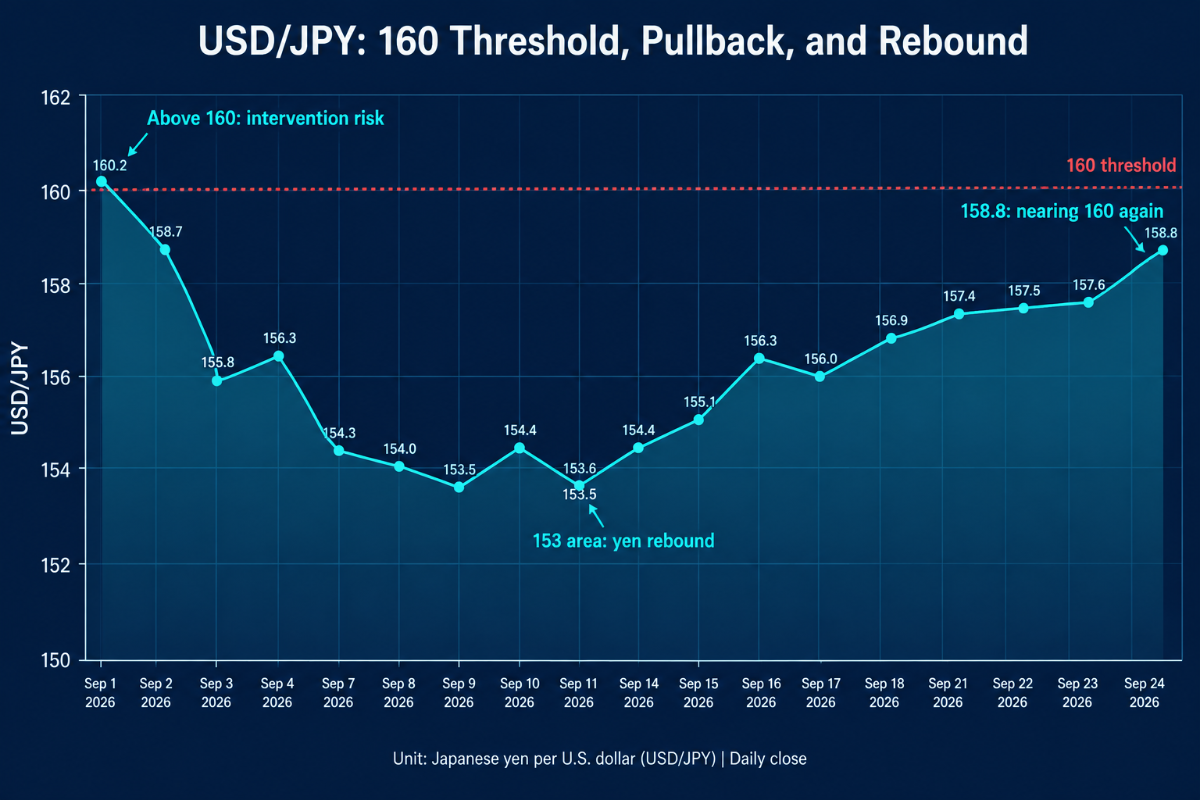
It is not just dollar-yen at 160. Watch the US-Japan rate gap, yen direction, volatility, and US long-term rates together, because AI and high-valuation growth stocks get squeezed first when all four move at once.

How this reaches US stocks
The way the yen carry trade affects US equities is harder to explain than the shorthand "borrow yen, buy Nasdaq."
The real drivers are the interest rate gap between the US and Japan, the direction of the yen, market volatility, and leverage.
| Stage | FX / rate shift | Investor behavior | Impact on US stocks |
|---|---|---|---|
| 1 | US-Japan rate gap widens, dollar strengthens, yen weakens | Investors keep or expand dollar and risk-asset positions funded by cheap yen | Global financial conditions loosen, potentially favoring risk assets |
| 2 | Dollar-yen climbs back toward levels that risk intervention | Yen short positions get trimmed, option hedging lifts FX volatility | Intraday volatility can rise before index direction does |
| 3 | Japan intervenes in FX markets, or the BOJ tightens more than expected | Yen spikes, existing carry positions lose money | Deleveraging and margin calls can force broader selling of risk assets, including stocks |
| 4 | US Treasury yields rise at the same time | Discount-rate pressure and deleveraging pressure overlap | High-valuation AI, software and semiconductor names, which rely on long-dated growth, are especially exposed |
| 5 | Yen and volatility stabilize, rate path becomes predictable again | Forced position-cutting eases | Stocks with strong earnings and cash flow tend to recover first |
The key point: a weaker yen does not automatically mean buying pressure on US stocks.
The yen carry trade means borrowing in a low-rate currency, the yen, and investing in dollar assets or other higher-yielding currencies. That money actually flows into US Treasuries, corporate bonds, developed-market equities and emerging-market assets alike. So it is hard to draw a straight line between the size of the carry trade and a Nasdaq rally.
When the yen is weak, volatility is low and the US-Japan rate gap is wide enough, it becomes easier to hold onto yen-funded leverage strategies. That can loosen global financial conditions and create a favorable backdrop for risk-asset prices.
The opposite happens when the yen strengthens suddenly. Two problems hit at once: currency losses, and falling prices on the risk assets investors are holding. Add a spike in volatility, and margin requirements and risk limits tighten, forcing investors to cut positions whether they want to or not.
Why higher US rates make this more complicated
There is one more variable layered on top of the usual picture: US rates are already elevated.
When US economic data comes in stronger than expected, markets price in a longer stretch of high Fed rates. That can push Treasury yields higher and strengthen the dollar.
- Strong US economic data — Markets price in a longer runway of high Fed rates.
- Treasury yields rise — The rate used to discount future earnings back to present value goes up.
- Dollar strengthens, yen weakens — Carry strategies may get easier to sustain in the near term, but extreme moves raise the risk of Japanese intervention.
- Growth stocks face opposing forces — Easier liquidity can help, but rising discount rates pressure valuations.
So understanding the current market takes one more step beyond asking "is the US economy strong?"
If discount rates rise faster than earnings growth, strong economic data can actually turn into bad news for growth stocks.
Why AI and semiconductors are more sensitive
AI and semiconductors are structural growth industries. But structural growth and a stock's short-term direction are two different questions.
Many of these companies already have data center investment, AI revenue growth, and margin improvement for the next two to five years priced in, not just current earnings.
Present value example:
- $100 received in 3 years, discounted at 4%: $88.90
- Same $100, discounted at 5%: $86.38
- Simple present-value decline: about -2.8% (real markets can add multiple compression on top of this)
The number looks small. But in real markets it is not just a 2.8% problem. Companies that earned a high price-to-earnings multiple on the assumption of high growth can see the multiple the market is willing to pay shrink on its own.
The most uncomfortable combination for AI investors: if a yen spike destabilizes carry trades at the same time US 10-year yields rise, liquidity shrinks on one side while the discount rate on future earnings climbs on the other.
That is the "double discount" that can hit AI and growth stocks.
Which stocks wobble first
Vulnerable assets share a pattern: a heavy weight of future expectations relative to current earnings, plus heavy leverage and momentum money attached.
| Relatively vulnerable area | Why it is sensitive |
|---|---|
| High-valuation AI software and AI infrastructure | Both the present value of future earnings and the multiple can get squeezed at once |
| Small and mid-cap growth stocks | Revenue-growth expectations outweigh current earnings, and they are sensitive to funding costs |
| High-volatility semiconductors | Heavy options trading and short-term momentum money can amplify volatility quickly |
| Leveraged and thematic ETFs | Falling underlying assets and rising volatility can erode returns at the same time |
| High-beta emerging-market and Asian assets | Sensitive to shifts in global risk appetite and dollar liquidity |
Relative defense, by contrast, comes from current earnings and cash flow. Companies with large free cash flow, substantial net cash, room for buybacks, and already-high operating profit tend to recover more resilient after a shock.
That said, in a deleveraging phase, selling does not distinguish between good companies and bad ones. So the right mindset for investors is not "good companies don't fall."
Insight Times Editorial Desk