The Less an AI Says, the Cheaper It Gets: What Jev Means for Investors
TypeSafe AI's new model Jev skips long text generation and returns only probabilities, choices and scores, pointing to a new axis of competition: not the smartest model, but the cheapest way to embed intelligence into software.

Not a chatbot. An "AI conditional"
Most large language models, whatever you ask them, end up producing a string of text. Even when you request JSON, the underlying process is still generating tokens one at a time. The application then has to parse that output, validate it, and only then act on it.
TypeSafe AI's new model, Jev, skips that step. Instead of prose, it returns three kinds of structured output that software can act on directly:
Probability of true. A yes/no judgment with a confidence score attached, such as whether a customer inquiry qualifies for a refund.
A choice among options. Picking one of several predefined answers, like which team, sales, billing or technical support, should handle a request.
A ranked score. An ordered evaluation such as risk level, urgency or quality.
TypeSafe says it trained Jev using a method it calls RLCD, Reinforcement Learning for Calibrated Decisions. The goal is to make a stated confidence level, say 80%, actually track the real-world accuracy rate. If that calibration holds up, developers can build operating rules like: auto-execute above 95% confidence, send anything between 80% and 95% back to a larger model for a second opinion, and route anything below that to a human.
Why this matters for developers
The biggest win for developers here is not raw model IQ. It is a drop in system complexity.
A conventional AI chain looks like this: call the LLM, generate text, parse the JSON, validate the format, retry if it fails, then make a follow-up call. A judgment-model chain looks like this instead: feed in the input, get back a structured probability, choice or score, then either execute a conditional or escalate to a larger model.
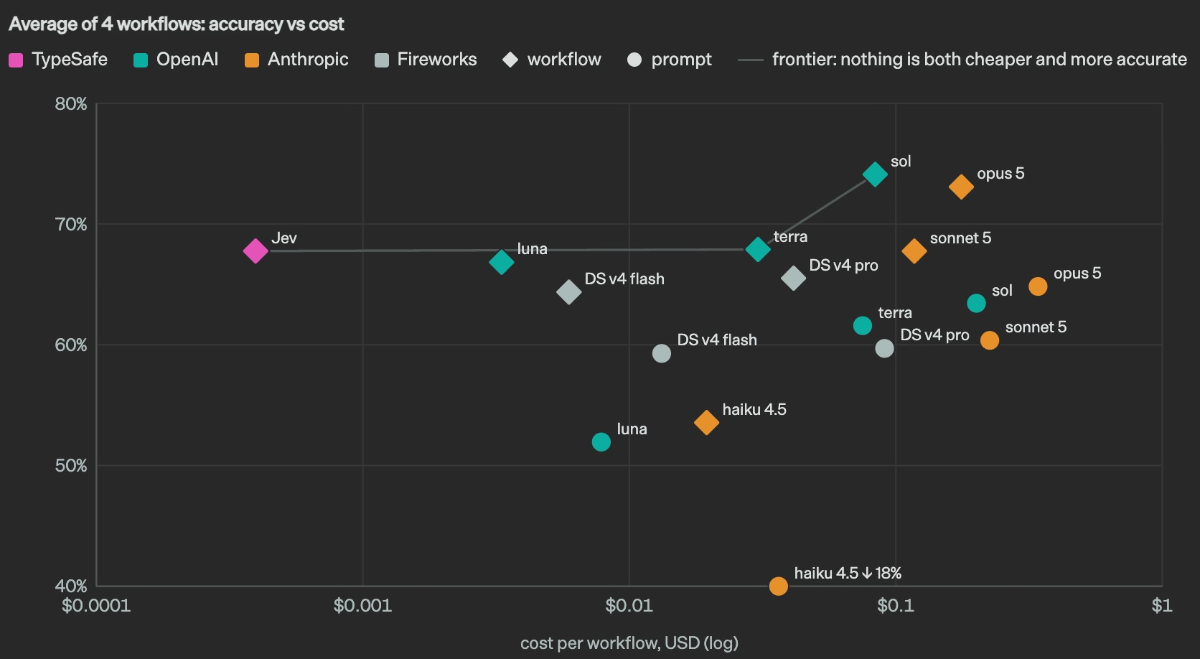
Pricing stands out too. TypeSafe lists Jev at $42 per billion input tokens, or $0.042 per million input tokens. (Some coverage has cited "$0.0424 per token," which is off by a factor of a million; the correct unit is per million tokens.) Output is not billed separately for now.
TypeSafe describes typical end-to-end latency of 70 to 500 milliseconds, and claims speed gains of 40x to 200x over comparable "System One"-style tasks. One workflow example on its homepage claims a 193.6x speed improvement and a 444.6x cost reduction. That specific figure should not be read as a general benchmark. But the direction is clear: strip out generation cost from tasks that never needed generation in the first place.
Where the productivity gain actually comes from
First, real-time UX. An AI that takes five seconds is something users wait for. An AI that takes 0.1 to 0.5 seconds can become internal logic inside search, editors, games, browsers and workplace software.
Second, per-step cost for agents. Unlike a chatbot that answers once, an agent observes, judges, clicks and re-checks dozens of times in a row. Routing easy judgment calls to a model like Jev and reserving frontier LLMs for hard reasoning can meaningfully lower average cost per task.
Third, failure becomes something you can design for. If confidence scores are well calibrated, automation stops being a binary right-or-wrong problem and becomes a threshold-design problem. What matters in enterprise software is not a model that is 100% accurate, but a system that knows when to stop and hand off to a pricier model or a human.
The bigger shift investors should watch: division of labor in AI
The real investment theme behind Jev is not one new model. It is the division of labor across the AI stack.
Increasingly, a single application may split work three or four ways: large generative models handle creative and complex reasoning, judgment models handle classification and routing, traditional code handles repetitive computation, and separate evaluators handle risk checks. Until now, the key question was which LLM to use. Going forward, the cost-competitive question becomes which size of intelligence to deploy for which task.
That matters a lot for AI SaaS companies. If revenue grows but model API costs grow right alongside it, software's traditionally high gross margins erode. If judgment tasks can instead be pushed down to much cheaper models, gross margin and free cash flow can improve at the same revenue level. Watching how efficiently an AI application company manages its model-call costs could become a more important valuation signal than it has been.
Falling costs could still mean rising GPU demand
The name Jev is a nod to economist William Stanley Jevons. It applies the Jevons paradox, the idea that greater efficiency and lower unit costs can actually increase total usage, to AI.
That means falling inference prices are not necessarily bad news for Nvidia or cloud providers. The compute required for a single judgment call may shrink, but if the price drops by 10x or 100x, the number of times software calls AI could grow even faster.
The right question for investors is not whether falling token prices will reduce GPU demand. It is whether the growth in the volume of AI calls outpaces the drop in cost per inference.
Who benefits, and who gets squeezed
| Area | Possible impact | What investors should watch |
|---|---|---|
| Agents / browser automation | Repeated small judgments mean big savings on latency and per-call cost | Calls per task, success rate, escalation rate to larger models |
| AI SaaS | Lower model costs could lift gross margin | Inference COGS, gross margin, free cash flow |
| Frontier LLMs | Can offload simple judgment calls and focus on complex generation and reasoning | Share of high-value tasks, total API usage |
| GPU / cloud | Compute per call falls even as total call volume rises | Total inference volume, utilization, capex ROI |
| Simple LLM wrappers | Charging premium prices for classification and routing alone may get harder | Product differentiation, automation rate, customer retention |
Insight Times Editorial Desk