US Rates Are at 5%. So Why Is the Yen Carry Trade the Real Risk?
The rate gap looks like a comfortable cushion, but it's the speed of the yen that decides whether carry trades survive. The August 2024 playbook, replayed against 2026's higher-rate world, points growth investors to USD/JPY, Japanese rates and volatility together, not the Fed alone.
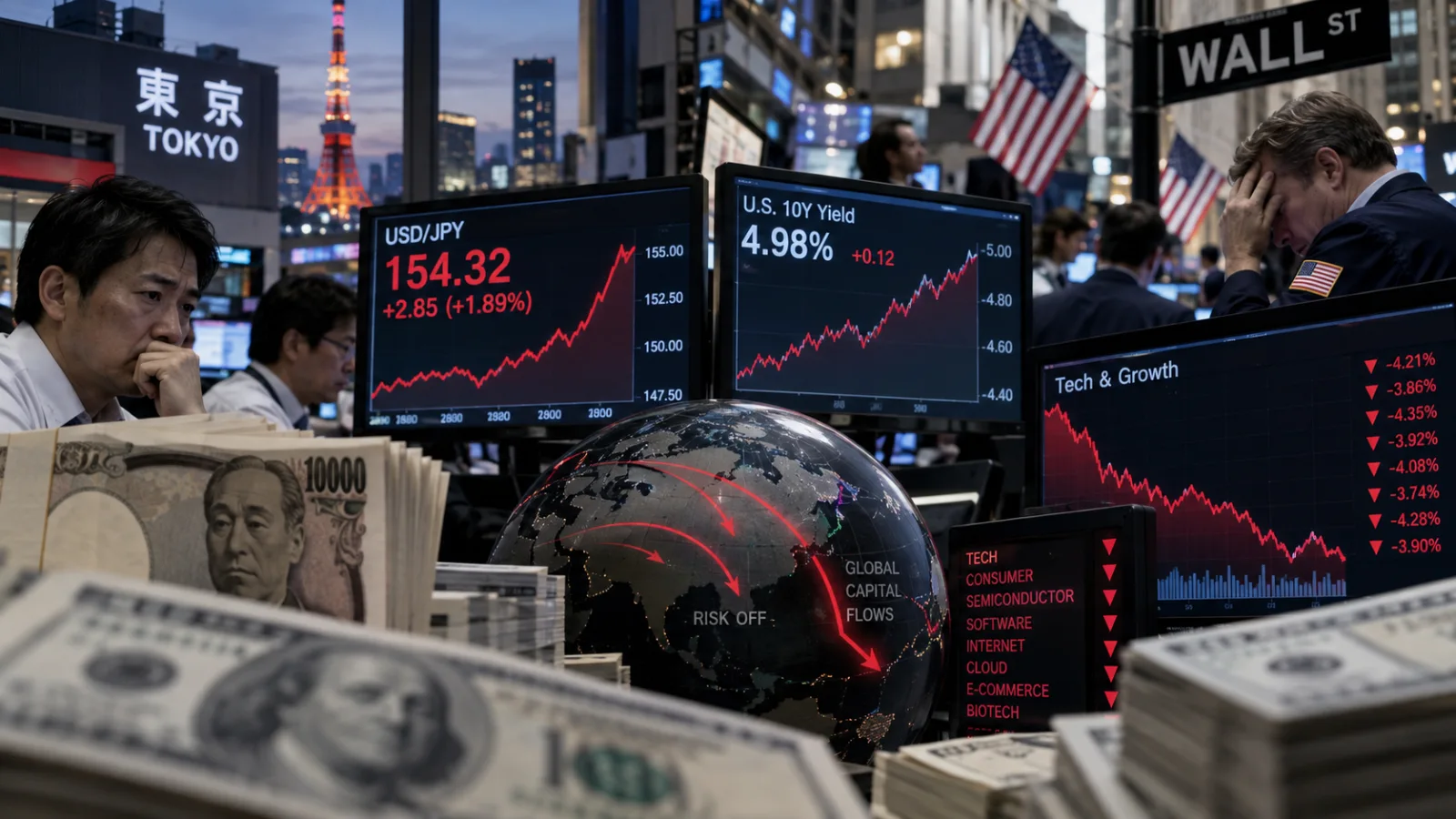
Why a Big Rate Gap Doesn't Mean Safety
A yen carry trade is simple in concept: borrow cheap yen and buy dollar assets that pay more. If US rates sit at 5% and Japanese rates at 1.25%, the headline rate gap is 3.75 percentage points. That looks like a generous cushion.
But 3.75% is what a trader earns over a full year of holding the position. Broken down daily, it comes to roughly 0.010%. Now flip it around. If USD/JPY drops from 155 to 140, the yen strengthens against the dollar by about 10%. On a simple calculation, that wipes out roughly 2.6 years' worth of that 3.75% rate gap in a matter of days.
That is why the more important variable in a carry trade isn't the size of the rate gap. It's the speed of the currency move. When the yen weakens slowly or stays stable, carry accumulates. But when the yen strengthens suddenly, losses, margin calls, asset sales, yen buying and further yen strength start feeding on each other.
August 2024: How a Small Rate Hike Turned Into a Big Shock
On July 31, 2024, the Bank of Japan raised its policy rate from 0.10% to 0.25%, a 15-basis-point move. On its own, that was a tiny shift. But leverage had already built up heavily on the assumption of a weak yen and low volatility.
Days later, weak US jobs data fueled expectations of Fed rate cuts, and the yen strengthened quickly. On August 5, Japan's Nikkei 225 fell 12.4% in a single day. The Bank for International Settlements later assessed the episode not simply as recession fear, but as a case where procyclical deleveraging of leveraged positions and rising margin requirements amplified volatility.
The key point is not a simple cause and effect where "the BOJ raised rates 15 basis points, so stocks fell 12%." A small policy change hit leveraged positions and currency exposure that had already built up, and when US growth worries hit at the same time, the speed of unwinding exploded.
2026 Is Even More Complicated
In September 2026, the Federal Reserve raised its policy rate by 25 basis points to a range of 3.75% to 4.00%, and the US 10-year Treasury yield climbed above 5%. Two days later, the Bank of Japan also raised its policy rate, to 1.25%. The US-Japan rate gap remains large.
Yet on September 18, the day the BOJ hiked, the yen actually weakened. Markets weren't convinced the BOJ would keep tightening at pace. That is an important counterexample. There is no automatic formula where a BOJ hike equals a yen spike equals a yen carry unwind.
Still, the fact that Japanese rates are no longer near zero, and that Japan's 10-year government bond yield has climbed to around 3%, marks a structural shift. Japan's holdings of US Treasuries stood at roughly $1.104 trillion as of July 2026, according to US Treasury Department TIC data. As yields on Japanese government bonds rise, Japanese investors have less reason to hold US assets while absorbing currency risk and hedging costs.
Here, a common shorthand deserves caution: the claim that "hedging a 5% Treasury yield back to yen turns it into -1.57%." That figure comes from subtracting an assumed 3.75-percentage-point US-Japan short-term rate gap from 5%, leaving about 1.25%. Actual hedged returns depend on forward exchange rates, cross-currency basis, maturity and transaction costs. The point isn't that hedged returns are automatically negative. It's that as Japanese rates rise, the hedged relative appeal of US bonds can shrink quickly.
Why Nvidia and Big Tech Get Hit First
When a liquidity crunch hits, markets don't sell the worst companies first. They sell whatever can be turned into cash fastest.
If a hedge fund needs to repay yen debt or meet a margin call, it can't sell private assets or real estate today. But mega-cap names like Nvidia, Apple and Microsoft trade in huge volume and can be liquidated instantly. So even when earnings are fine, stocks can swing sharply during forced-selling episodes.
Layer on top of that a 10-year yield at 5%, which is a separate burden for growth stocks. Discounting distant future profits back to present value at a higher rate compresses valuations. When high rates and a yen carry unwind hit at the same time, growth stocks can face multiple compression and liquidity-driven selling simultaneously.
The Core Loop
Calm markets: Low borrowing costs in Japan lead to yen borrowing, which funds purchases of dollar assets, which keeps volatility low, which lets carry positions grow.
Stressed markets: A sharp yen rally widens currency losses, triggering VaR breaches and margin calls, forcing sales of US stocks and bonds, which means converting dollars back to yen, which strengthens the yen further, triggering more forced selling.
In this loop, the most dangerous moment isn't when the rate gap disappears. It's the moment markets decide that currency losses are compounding faster than the rate gap can offset.
What Individual Investors Can Do
First, yen carry risk alone isn't a reason to dump good growth stocks. The priority instead is trimming structures that force a sale at the worst possible time: margin debt, buying on credit, or overly leveraged ETFs.
Second, there's no universal right answer for cash allocation. A figure like 15% to 20% doesn't fit everyone. It's more realistic to hold enough cash, sized to your own income stability, time horizon and tolerance for volatility, so that a sharp drop doesn't force you to sell and buying more during it doesn't disrupt your life.
Third, during a sharp selloff, separate stocks into two categories. A company whose earnings, free cash flow and competitive position remain intact but whose stock fell because of liquidity stress is different from an unprofitable growth stock whose business model itself is shaky at high rates. A yen carry unwind can drag both down together, but they won't recover at the same speed.
Insight Times Editorial Desk