Why Musk wants to give 72 million US children a share of SpaceX
Elon Musk says he will gift one SpaceX share to every American child. The plan is not yet detailed, and the bigger driver of a child's wealth may be 18 years of steady saving.
Elon Musk says he will give every child in the US one share of SpaceX stock from his own holdings. The idea is worth about $10.5 billion. The more interesting part is not the size of the money. It is that tens of millions of children could grow up as shareholders in a space company.
1. Musk is giving his own shares, not the company's money
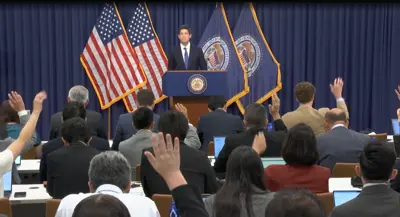
On Oct. 19, Eastern time, Musk said on X that next year he will give one share of SpaceX (SPCX) from his personal holdings to every child in the US. This is not a new share issue by the company. It is a plan to hand out shares he already owns.
The Census Bureau counted about 72 million people under 18 as of July 1, 2025. CNBC applied the Oct. 16 closing price of $146.03 and put the total value of the gift at about $10.5 billion. The exact eligibility rules for "every child" and the actual delivery method have not been announced.
2. The Shotwells also pledged one share each to more than 2 million children
SpaceX's Gwynne Shotwell and her husband pledged on July 6 to give one share each to more than 2 million children aged 11 to 17 in lower-income areas. The plan focuses on central Texas. Fortune valued it at about $330 million on Oct. 9.
One distinction matters. As of Oct. 20, those shares had not yet been distributed. A further report on Oct. 30 said distribution is planned for December, but planned is not done. The pledges from Musk and the Shotwells should not be added together to claim that child shareholders already exist.
3. How could a Trump Account receive the shares?
The Trump Account is a children's investment account under IRC §530A, created by the OBBBA enacted July 4, 2025. Accounts began opening on July 4, 2026, and about 60 million had been opened automatically by Oct. 1. The Treasury has cited a figure of about 70 million open accounts. That number is a different statistic from the 72 million child population.
Children born from 2025 to 2028 receive a one-time $1,000 from the federal government if they meet the requirements. The general contribution limit is $5,000 a year, and that includes a $2,500 limit on employer contributions. In principle, the money must go into US stock index funds or ETFs with fees of 0.1% or less. Funds cannot be withdrawn before Jan. 1 of the year the child turns 18, and traditional IRA rules apply after that.
Temporary Treasury and IRS rules that took effect Sept. 30 opened a path. A qualifying contribution from a government or a 501(c)(3) charity approved by the Treasury can put shares listed on a US exchange directly into the account. As a rule, those shares must be held until the earlier of five years after the gift or the end of the year the beneficiary turns 17. That does not mean ordinary account money can freely buy individual stocks.
Gerstner mentioned the possible use of Trump Accounts on CNBC, and the White House and Treasury Secretary Bessent have also raised related ideas. But which approval structure and delivery process Musk will actually choose has not been settled.
4. What tens of millions of young shareholders mean for SpaceX investors
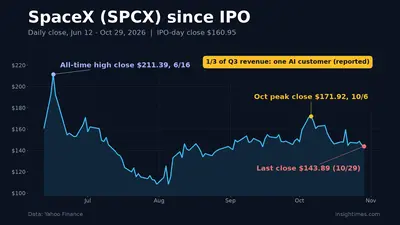
SpaceX listed on the Nasdaq on June 12, 2026. The IPO price was $135, it raised about $75 billion, and it closed the first day at $160.95. The Oct. 30 close was about $136.02. Market capitalization on Oct. 29 was about $1.95 trillion.
The more interesting angle is not the share price but the relationship between shareholders and customers. Watching a spacecraft in the news may feel different from watching a spacecraft built by a company you own. If that experience lasts, SpaceX could gain a brand asset that ties future customers, talent and supporters to it emotionally.
That is an interpretation, not verified financial performance. More young shareholders do not automatically raise revenue or profit. Gifting existing shares also brings no new cash into the company. Investors should weigh who actually receives shares, how many hold long term, business growth, and the expectations already priced into the valuation.
5. [Estimate] What if one share is held for 18 years?
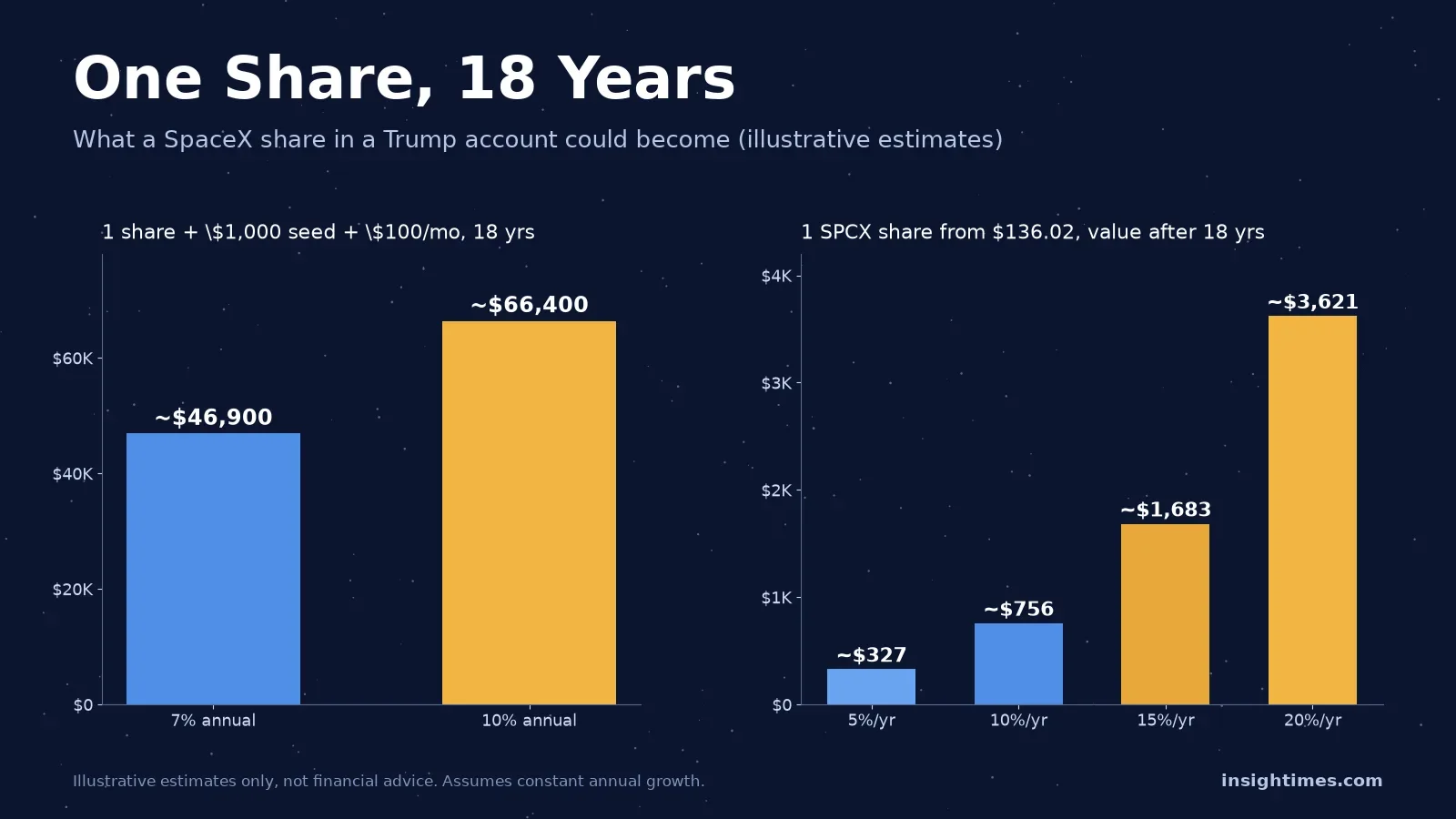
The table below is a compounding illustration, not a forecast. The base price is the Oct. 30 SPCX close of about $136.02, growing at the same annual rate for 18 years. Dividends, taxes, fees and inflation are not included.
| [Estimate] Average annual return | Value of one SPCX share after 18 years |
|---|---|
| 5% | About $327 |
| 10% | About $756 |
| 15% | About $1,683 |
| 20% | About $3,621 |
[Estimate] A scenario that mechanically applies a constant annual compound return. It differs from any real price path.
A 20% compound rate is attractive, but nothing guarantees it for 18 years. Individual stocks can lose principal through business failure, competition, dilution or changes in valuation.
6. [Estimate] Monthly $100 may make the real difference
Now add $1,000 of starting money to one SPCX share, and assume $100 a month goes into a US stock index for 18 years. Total principal contributed is about $22,736. The figures below apply the same annual return to the whole portfolio as a simple example. Dividends, taxes, fees and inflation are excluded, and contributions are assumed at the end of each month.
| [Estimate] Average annual return | Total after 18 years |
|---|---|
| 7% | About $46,900 |
| 10% | About $66,400 |
[Estimate] Rounded for illustration. It does not mean SPCX and the index will post identical returns. Regular contributions will also run through down periods.
One share is a starting point. The habit that builds wealth begins afterward. Time, steady contributions and diversification may matter more than a small gift.
7. Four things to watch
- Actual start of gifting: whether the pledge turns into approvals and deposits into accounts.
- Scope of recipients: whether all 72 million children are covered, or eligibility conditions apply.
- Holding structure: whether long-term shareholders remain after the legal minimum holding period.
- Business economics: whether SpaceX's revenue, profit and cash flow support expectations built into its valuation.
FAQ
Have US children already received SPCX shares? No. Musk announced a gifting plan for next year but has not said how the shares will be delivered. The Shotwells' gift also requires separating the pledge from actual distribution.
Can a Trump Account buy SPCX freely? In principle, the permitted holdings are low-cost US stock index funds and ETFs. Individual listed shares can enter through a separate route, an approved qualifying contribution.
Will more young shareholders push SPCX higher? Not necessarily. Transferring existing shares does not add to the company's revenue or profit. A possible brand effect is separate from a rise in the share price.
Is one share enough for a child? It can be a meaningful start to the experience of ownership, but it is not the whole of building wealth. Steadily adding to diversified assets over a long period is what matters.
In 18 years, what a child remembers may not be the price of the first share. It may be the experience of owning a company in their own name and spending years alongside it. Long-term investing is not the skill of guessing future prices. It is building a structure that can wait for the future.
Insight Times Editorial Desk