A 20% Drop in Chip Stocks Is the Norm, Not the Exception: SOX Data Since 1994

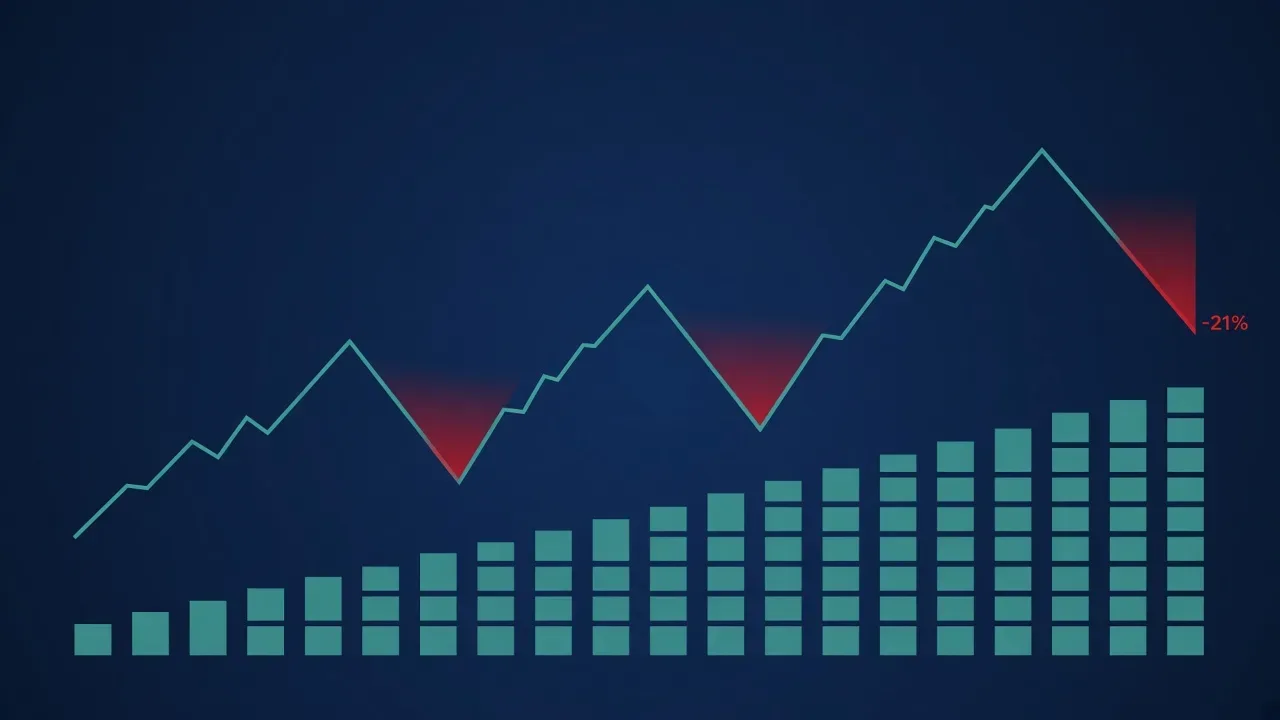
Since 1994 the Philadelphia Semiconductor Index has dropped an average of 29% within a year and still finished the year up 20.7% on average. For long-term investors, headlines about declines from the peak come with a useful counterweight.
A 20% Drop in Chip Stocks Is the Norm, Not the Exception: SOX Data Since 1994

The Philadelphia Semiconductor Index (SOX) rose 3.60% to close at 11,482.51 on Tuesday, Oct. 27. The Nasdaq gained 1.18% to 26,477.81, and the S&P 500 added 0.60% to 7,722.60. Even so, the SOX remains about 21.6% below its 52-week high of 14,655.29 (intraday), set June 22. On July 29 it was as much as 28.6% below that peak. The same index is up 62.11% so far this year.

Most of this month's news picked the first set of numbers. Worries about rising borrowing costs, and whether companies can keep funding AI spending with debt, weighed on chip stocks. The index, near 13,000 in early October, fell 6.72% in a single session on Thursday, Oct. 22. But 33 years of data suggest a 20% drop from the peak is less a crisis than the usual price of admission for semiconductor investors.

Down 29% a year on average, yet up 20.7%

Since 1994, the SOX's largest decline within a year has averaged 28.9% over 33 years. That is nearly double the S&P 500's 16%. Yet the average annual return was +20.7%. In 21 of those years, the index suffered a double-digit drop and still ended the year higher.

Recent years fit the pattern. In 2020, Covid sent the index down 35.0% in a month, yet it finished the year up 51.1%. In 2025, it fell 39.7% (from the July 2024 peak to the April 2025 low), regained its high five months later, and ended the year up 42.2%. This year, after a 28.6% fall, the index is still up about 62%.

Recovery was not free

Telling only the good half would be misleading. Of seven declines of more than 20% since 2004, the fastest recovery came in 2020, 2.6 months from the bottom. When the index fell 46.5% from December 2021 to October 2022, it took 14 months from the low to regain the high. In 2007-2008 it fell 68.7%, and recovery took more than five years. Investors who bought at the 2000 dot-com peak waited more than 17 years to get their money back.

What separated outcomes was less when investors bought than how. For someone who put in a lump sum at the peak, the recovery period was painful. For someone who bought in monthly installments, the same stretch was a chance to accumulate shares cheaply.

Facing tonight's headlines

The Federal Reserve is expected to hold rates this week (3.75% to 4.00%, per CME FedWatch). A run of big tech earnings is also due. Whether the headline says "AI bubble bursts" or "rally reignites," it will likely choose its starting point to fit a single day's move.

For investors who buy in installments, the number to watch is the time horizon, not the daily move. For an asset that drops close to 30% in a typical year, declines are a variable to plan for, not an exception. The task for a long-term investor is therefore not to predict the drop. It is to decide in advance the amount and the dates they can keep buying through one. Spreading purchases across the whole index also means a single peak does not decide the fate of an entire account.

The SOX has fallen about 29% in a typical year and still gained 20.7% a year on average, so drawdowns are likely a variable to plan for.

Insight Times Editorial Desk

More by topic

Starting with this story's topics, then what readers are following now

Investor psychology, decision-making and books on investing

Semiconductors

This story's topic51 storiesSee all →

The whole business of designing, fabricating and testing chips.

The US-China Summit Didn't Erase Taiwan Risk for Chip Stocks

Washington's Taiwan policy held, but roughly $14 billion in arms sales is still on hold. For AI chip investors, the summit reads less like risk removed and more like a fragile balance extended.

Macro

Memory Chip Supercycle: Not at Peak Yet, But 5 of 6 Warning Signs Are Flashing

Memory prices are still climbing, but the pace is slowing and PC and smartphone demand is starting to crack under the weight of higher chip costs. This looks less like a price peak and more like a profit plateau building toward the next supply cycle.

Investing

The Real ASML Number Isn't the 3% Pop, It's the 30% Capacity Hike

ASML's rally isn't just an AI trade. Customers are already locking in 2027 tool slots, and ASML is raising Low-NA EUV capacity by roughly 30% to keep up.

Investing

ASML Is Discussing 2030 Orders. How Long Can the AI Chip Supercycle Last?

Despite bubble worries, ASML sees equipment shortages through 2028. Investors should watch future production capacity, not just today's orders.

Tech

AMD Crossed $1 Trillion, and the Market Started Looking at CPUs Again

AMD's stock topped a $1 trillion market cap for the first time. The rally isn't just about being an Nvidia alternative. It reflects a reassessment of AMD as a full-stack AI infrastructure vendor, one that bundles CPUs, GPUs and networking, as AI shifts from chatbots to agents and reignites data center demand for CPUs.</deck> <parameter name="oneline">As AI moves from chatbots to agents, the market has started counting the CPU sitting next to the GPU again.

Tech

Musk's Real AI Strategy Isn't the Model, It's a Chips-to-Space Physical Stack

On the All-In Summit stage, Elon Musk and Gwynne Shotwell laid out AI peer review, Terafab, Starship, and orbital data centers as if they were separate topics. Strung together, they reveal Musk betting the AI race is decided less by who builds the smartest model and more by who can deploy intelligence at the lowest cost and largest scale.

Tech

Lam Research Falls 12%: The Problem Is the Timing of AI Growth, Not Its End

Revenue up 54%, an operating margin above 40% and $3.2 billion in free cash flow were not enough. The selloff likely reflects worry that revenue arrives later than hoped.

Investing

Fed

This story's topic23 storiesSee all →

The central bank of the United States, carrying a dual mandate — stable prices…

Is Bitcoin Coming Back? A Recovery That Still Has to Prove Itself

Bitcoin has slipped from above $126,000 to around $83,000 while AI stocks hog the spotlight. It is up more than 40% from its summer low, but it is too early to call a new bull market.

Investing

Why Elon Musk's 4% Growth Call Deserves a Serious Read

Elon Musk says AI could double US GDP growth next year from roughly 2% to 4%. The number that matters isn't 4%, it's the idea that intelligence is turning from scarce labor into replicable capital.

Macro

It's Not Just Hormuz: Why the Middle East War Is Becoming a Fed Problem Again

The US-Iran ceasefire has already collapsed, and the risk no longer sits in the Gulf alone. With the Red Sea and Saudi Arabia's bypass pipeline now under threat too, an energy shock is spreading into prices, the Fed, and growth-stock valuations.

Macro

S&P 500 Slips 0.22%, but 73% of the Market Fell

Long-term yields above 5% weighed on small caps and semiconductors on Oct. 7. A strong 10-year Treasury auction and a few large tech names limited the index's losses.

Tech

10-Year Yield at 5.34%: The Problem Isn't a Missing Buyer, It's the Price

Washington and the AI industry are pulling in huge sums at once, and the bond market is demanding higher yields to absorb it. Equity investors now need to watch long-term rates, financing costs and AI payback alongside the Fed's next move.

Macro

Weekly Check: The AI Bull Market Isn't Over, It's Just Gotten Harder

A 5% 10-year yield, 470 gigawatts stacked up in Texas, Chinese DRAM, and whether data centers actually get switched on are starting to decide who wins the AI trade through 2027.

Tech

Gas Prices, Not Politics, Are Deciding This Midterm Market Story

Forecasts of a Republican defeat are not exaggerated. The House has tilted clearly toward Democrats, the Senate has moved from a toss-up to a slight Democratic edge, and Trump's net approval is the lowest of either term.

Macro

S&P 500

This story's topic9 storiesSee all →

HBM

67 storiesSee all →

Memory stacked next to the GPU.

Has Memory Peaked? Prices Are Cooling, but the Shortage Looks Set to Run to 2028

Price growth has slowed and consumer demand is already breaking. Server and HBM supply remains short, and Micron says more than 75% of its 2027 volume is already committed to customers.

Tech

AI Chip Peak Check: Demand Still Rising, Risk Building in 2027-2029 Supply and Funding

DRAM and NAND contract prices are still climbing and HBM suppliers hold the edge. Power shortages, AI financing costs and simultaneous memory expansion are the risks for later years.

Investing

US AI Data Centers Are Headed for 90GW. Gigawatts Now Matter More Than Dollars

Goldman Sachs expects US data center capacity to grow from 64GW at the end of 2026 to 90GW at the end of 2027. The AI race is moving from buying GPUs to building power plants and transmission lines alongside them.

Tech

How Far Can China Push DRAM Without EUV

CXMT says it has shrunk DRAM features to 11.95nm using quadruple patterning instead of EUV lithography. The real question is not whether China caught up, but how much more it now costs China to get there.

Tech

2027 Isn't the End: Citi's Case for a Memory Supercycle Running to 2031

Citi says the memory shortage timeline is stretching again. If AI shifts from "train once" models to continual learning, HBM, server DRAM and enterprise SSDs could all fall short at the same time.

Tech

Samsung, SK Hynix Sold Off on AI Fears. The Orders Haven't Followed Yet

The selloff reflects a market recalculating AI capex speed and memory earnings expectations, not confirmed cancellations. So far, the data show a gap between fear and reality.

Investing

China's DRAM Push Tests the Memory Supercycle for SK hynix, Samsung and Micron

Memory looks tight through 2027, with oversupply a risk from 2028. Investors in AI chips need to keep the two timelines apart.

Tech