Musk's Real AI Strategy Isn't the Model, It's a Chips-to-Space Physical Stack
On the All-In Summit stage, Elon Musk and Gwynne Shotwell laid out AI peer review, Terafab, Starship, and orbital data centers as if they were separate topics. Strung together, they reveal Musk betting the AI race is decided less by who builds the smartest model and more by who can deploy intelligence at the lowest cost and largest scale.
The interview's real subject isn't a product, it's how the pieces connect
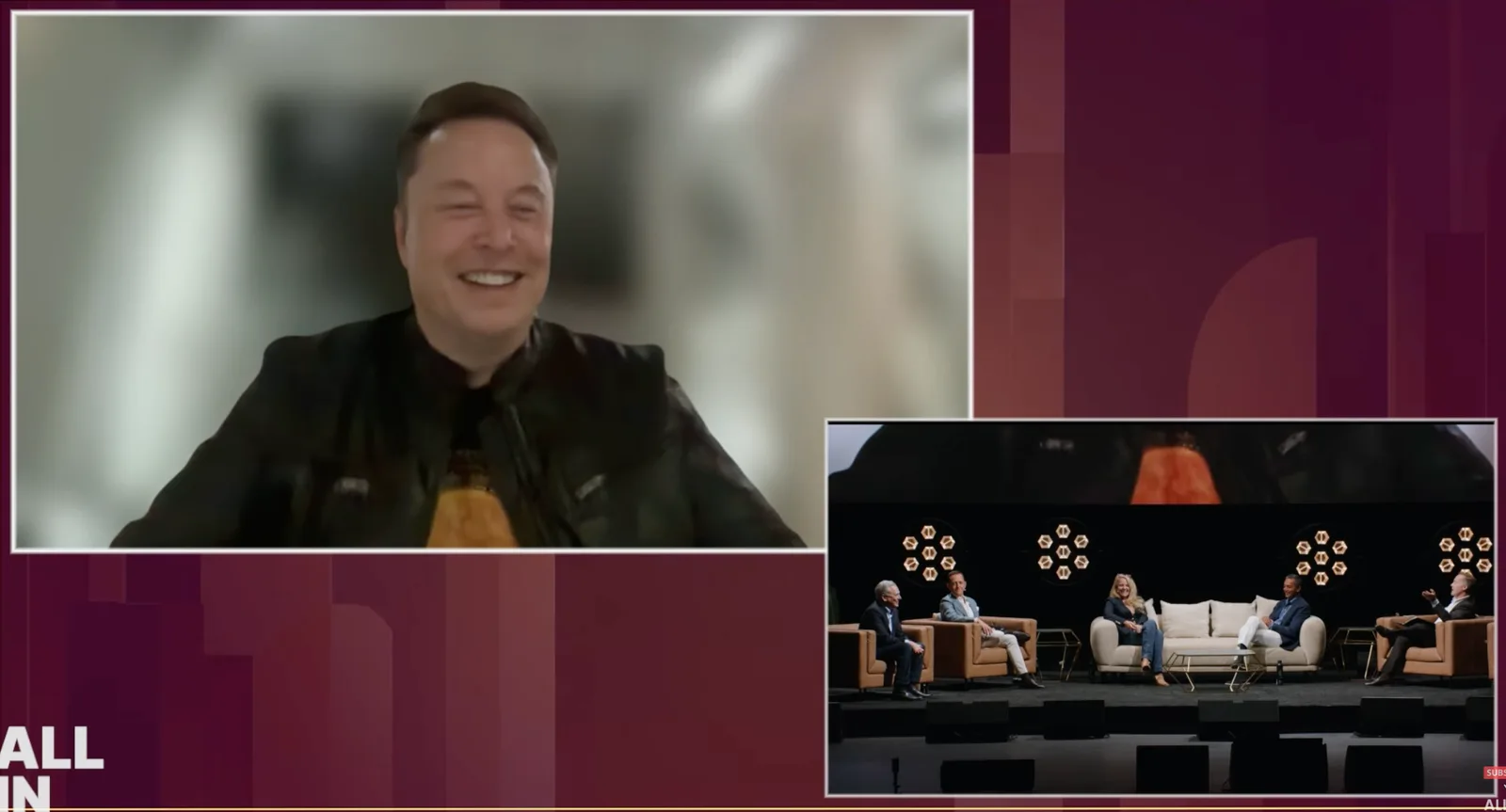
The All-In podcast episode released September 15 runs about 64 minutes. Gwynne Shotwell appears first; Musk joins at the 27:37 mark. Judged by the official chapter markers, AI risk, Starship, Terafab, and a possible Tesla-SpaceX combination look like four unrelated topics. But one question runs through the entire conversation: as AI scales up, what becomes the bottleneck?
Musk's answer isn't software alone. A model can keep getting smarter, but without chips it cannot be trained, without power it cannot run, and without land and cooling capacity for data centers it cannot scale. The AI race starts with algorithms, but past a certain size it turns into a race in semiconductors, power, manufacturing, telecom, and logistics.
The physical AI stack, as Musk frames it:
- Intelligence — xAI, autonomous driving, Optimus, agents
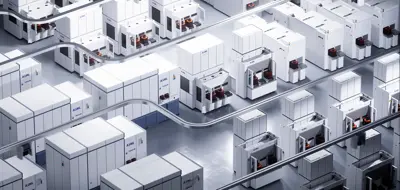
- Physical infrastructure — Terafab, data centers, batteries, manufacturing
- Distribution — Starlink, Starship, orbital computing
Each layer feeds the next. A smarter model is worthless without the chips and power to run it at scale, and that capacity is worthless without a way to distribute it, whether across a telecom network or eventually into orbit.
On AI safety, Musk pitched verification infrastructure over a pause
The most concrete proposal Musk made was for major AI companies to run identical safety tests on each other's models. If a company only evaluates its own model, it risks overfitting to a test it designed itself. The logic runs the other way if OpenAI, Anthropic, xAI, Google, Meta, and China's leading labs test each other's models from different angles: the odds of catching dangerous behavior go up.
The tests would target high-risk capabilities such as potential support for bioweapons or nuclear weapons, deliberate deception, and safeguard bypass. Musk specifically raised giving rivals API access before a launch, and a structure where a company can disclose it publicly if a competitor finds a serious flaw and ships anyway without fixing it. He argued this is more realistic than a single regulator policing every model worldwide, partly because it leaves room for China to participate too.
The proposal isn't a complete solution. Open questions remain: how much model access to give competitors, how to protect trade secrets, and who sets the bar for what counts as "dangerous." Still, compared with recent calls to slow AI development down, the contrast is clear. This is an approach that uses competition itself as the safety check, rather than trying to halt competition.
Terafab isn't really about catching Nvidia
Musk pointed directly to the risk of advanced chip supply from Taiwan being cut off as Terafab's starting point. But geopolitics is only the first reason. Over a longer horizon, the second reason is that AI servers, vehicles, and humanoid robots are all scaling up at once, and existing foundry capacity alone may not be able to keep up with the volume required.
Reading Terafab as a declaration that Tesla is entering the general-purpose GPU market is still a stretch. The more realistic read is vertical integration: as AI demand across Tesla and SpaceX grows, Musk doesn't want the most strategic component, the chip, left entirely to outside supply chains. It resembles an automaker building its own battery plant, except the object here is advanced chips, the core means of production for the AI era.
If Starship succeeds, SpaceX's business definition changes too
In the conversation, Shotwell described the bottlenecks of ground-based data centers in very concrete terms. Securing a site, waiting on grid interconnection, and procuring generators and electrical equipment can take years, while AI compute demand is needed right now. That gap is why SpaceX is looking at orbital data centers as a long-term option.
Space has no land cost, offers extended access to sunlight, and lets heat radiate away through panels. But it would be a mistake to simplify this to "space is cold, so cooling is free." A vacuum has no air, so convective cooling doesn't work there, and heat still has to be dumped through radiation. Radiation hardening, repairs, launch costs, and high-bandwidth communications all still need solving.
This is where Starship matters. Musk said that if Flight 14 goes smoothly, Flight 15 could attempt a ship catch, putting the odds of a first successful attempt at roughly 50 to 60 percent. He also said full reusability and rapid reflight are very likely achievable by 2027. That's a forecast, not a locked-in schedule. But if a system that relaunches as quickly as an aircraft actually gets built, the cost per unit of mass to orbit would fall, and space infrastructure that doesn't pencil out today could turn into a computable business.
More important than a Tesla-SpaceX merger rumor
A possible merger between the two companies came up in the conversation, but Musk didn't confirm any deal. What investors should watch more closely is that the boundary between the two companies is already blurring on the technology side. Tesla holds AI, robotics, batteries, and mass manufacturing. SpaceX holds launch vehicles, satellite communications, and space systems. Terafab and computing infrastructure are needed by both.
| Axis | Tesla | SpaceX | What it means if linked |
|---|---|---|---|
| AI | FSD, Optimus, training and inference | Autonomous satellite and space systems | A shared AI foundation for real-world autonomous systems |
| Semiconductors | Custom chips for vehicles and robots | Chips for communications and computing | Economics of vertical integration through massive in-house demand |
| Energy | Batteries, storage, power electronics | Solar power in space, launch infrastructure | Potential relief for AI computing's power bottleneck |
| Telecom and logistics | Connectivity for vehicles and robots | Starlink, Starship | A deployment network running from the ground to orbit |
Insight Times Editorial Desk