Lam Research Falls 12%: The Problem Is the Timing of AI Growth, Not Its End
Revenue up 54%, an operating margin above 40% and $3.2 billion in free cash flow were not enough. The selloff likely reflects worry that revenue arrives later than hoped.
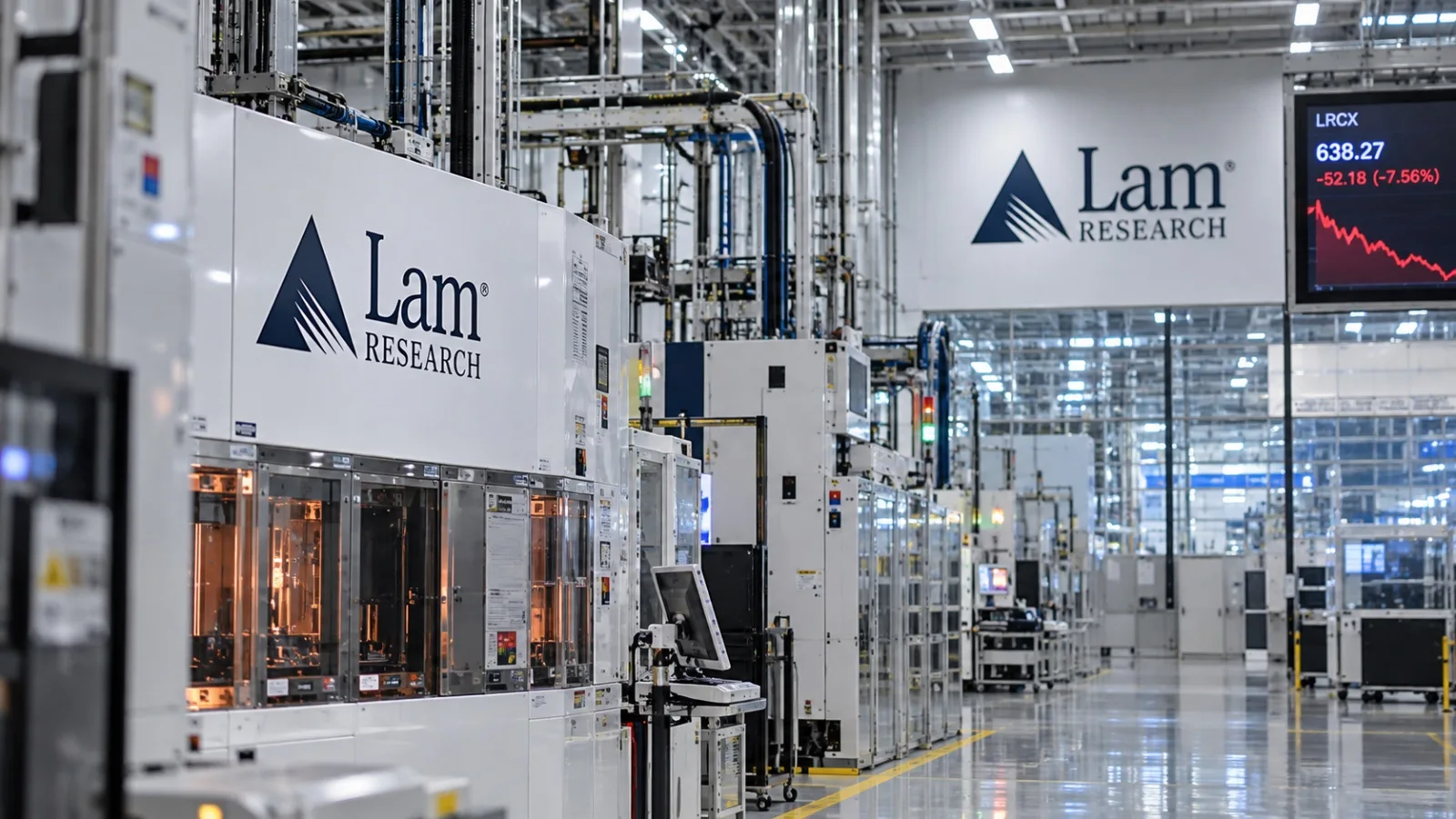
Revenue grew 54%. The operating margin topped 40%. Free cash flow reached $3.2 billion. Lam Research shares still fell 12%. The results show a gap between AI's growth potential and the way the stock market prices that growth.
Why did a good quarter send the stock down 12%?
Lam Research shares fell about 12% in US trading on Oct. 22. SOXX dropped about 6.5% and the Nasdaq fell 2.6%. Meta slid about 7% and oil prices jumped the same day, so one company cannot explain the day's tech selloff.
The numbers themselves were not bad.
| Key metric | September quarter results | December quarter guidance |
|---|---|---|
| Revenue | $8.22 billion | $8.6 billion |
| Adjusted EPS | $2.20 | $2.33 |
| Adjusted gross margin | 52.4% | 52.5% |
| Adjusted operating margin | 40.2% | 40.5% |
The September quarter is fiscal 2027's first quarter. December quarter figures are the midpoint of company guidance. EPS and margins are non-GAAP.
Revenue rose 22% from the prior quarter. The midpoint of next-quarter guidance implies growth of about 4.6%. The market has paid high prices for companies expected to grow faster, not for those doing well today. When that expectation is not met, a stock can fall even after record results.
Lost demand, or revenue pushed out?
On the conference call, management said supply chain constraints limited the revenue outlook. It also said some equipment shipments could slip from the December quarter into the March quarter.
That distinction matters.
- Demand decline: Customers cancel or cut investment. The risk is that future revenue and profit shrink.
- Supply delay: Orders stay in place but equipment deliveries slip. Revenue timing may move later.
Management's explanation so far sits closer to a supply delay. The $300 million to $400 million delay that analysts have cited is not an amount the company has confirmed.
Component shortages and customers' cleanroom space limits could also last into 2027. It is hard to say yet whether this is a temporary scheduling issue or a lasting capacity bottleneck.
A bigger shift than China: how hard chips are to make
China accounted for 35% of revenue in the September quarter. The company expects that share to fall meaningfully next quarter. Weaker investment by Chinese customers is a risk that clearly needs managing.
But Lam's long-term position cannot be explained by its China share alone.
In AI chips, the complexity of manufacturing matters as much as unit volume. High-bandwidth memory (HBM), advanced DRAM, 3D NAND and advanced packaging all require precise etch and deposition technology.
Lam said these process changes have widened its serviceable addressable market (SAM) by about 4 percentage points as a share of total wafer fabrication equipment (WFE) spending.
That suggests more than higher chip volumes. The technical value of the equipment needed to make each chip may also rise. Actual revenue growth, though, would still depend on customer adoption and a technology edge over rivals.
The industry outlook is still aggressive
| 2026 | 2027 |
|---|---|
| About $155B | $200B+ |
If 2026 comes in near $155 billion, a 2027 figure above $200 billion implies market growth of at least about 29%.
WFE is spending on wafer fabrication equipment. These are company forecasts, not confirmed results.
If the forecast holds, chip equipment and materials companies beyond Lam could benefit. But equipment spending does not by itself prove AI services are profitable.
Industry-wide profitability becomes sturdier only if three stages grow together: AI service usage, data center utilization and chip manufacturing investment.
What to watch
| Indicator | Positive sign | Warning sign |
|---|---|---|
| Equipment shipments | Shipments recover in the March quarter | Delays repeat |
| Customer investment | DRAM and foundry expansion continues | Investment is canceled or postponed |
| Operating margin | Holds around 40% | Sustained margin decline |
| China exposure | Growth elsewhere offsets it | Company-wide revenue slows |
| Free cash flow | Cash rises along with earnings | Inventory surges and cash falls |
A good company and a good stock are not always the same thing. Lam's results are still solid. The market is now asking how quickly that growth turns into cash, and how much investors should pay to wait for it.
Insight Times Editorial Desk