What Matters More Than Tesla Semi's 2,500-Truck Order
Tesla was picked as lead supplier in the largest electric Class 8 truck group order in US history. The bigger story is that the fight in electric trucking is shifting from range to charging, financing, uptime and autonomy.

The real competition starts at 230,000 trucks
Electric trucks are no longer a small, experimental market. According to the IEA, global sales of electric heavy-duty trucks reached about 230,000 units in 2025, nearly triple the roughly 84,000 sold in 2024. Add medium-duty trucks and electric truck sales topped 400,000 units, about 9% of all truck sales worldwide.
The pace differs sharply by region. China sold more than 400,000 electric trucks in 2025, accounting for over 90% of global volume. One in four trucks sold in China was electric, and battery-swap trucks alone made up about 15% of China's electric truck sales. Europe, by contrast, sold roughly 17,000 units, and North America about 20,000.
- 230,000 units - Global electric heavy-duty truck sales in 2025
- 90%+ - China's share of global electric truck sales
- 97% - Share of battery electric vehicles (BEVs) in global electric truck sales
China has cost, Europe has infrastructure, the US has operating economics
| Market | Current strength | Bottleneck | What investors should watch |
|---|---|---|---|
| China | Battery cost, supply chain, swap infrastructure | Price competition, profitability | Whether electrification speed translates into export competitiveness |
| Europe | CO2 regulation, long-haul OEMs, Megawatt Charging System (MCS) network | Speed of charging network buildout | Real-world uptime and total cost of ownership (TCO) for 700km-class models |
| US | Port and regional freight, large shipper demand | Policy, grid capacity, service networks | Whether large fleet operations can prove a cost edge over diesel |
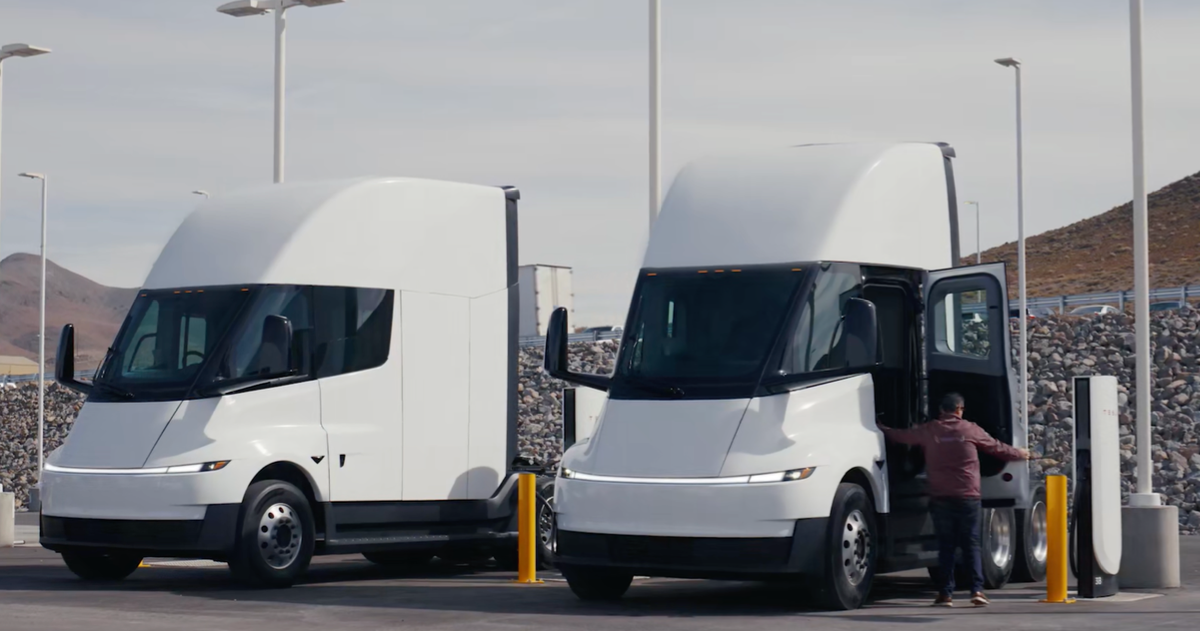
In Europe, Volvo has started production of the FH Aero Electric, which can travel up to 700 km on a charge and supports 700kW MCS charging. Tesla Semi's 500-mile (about 805 km) range and 1.2MW charging speed still lead the pack, but rivals are closing the gap fast.
The 2,500-truck order matters more as validation than as revenue
The 2,500-truck group purchase organized by ZET SCALE carries outsized symbolic weight in the US electric Class 8 market. The order is large enough to nearly double the entire current fleet of electric Class 8 trucks on US roads. Tesla was chosen as lead supplier through an open competitive bid.
Still, it would be premature to treat this as a confirmed $600 million to $700 million revenue contract for Tesla. It has not been disclosed exactly how many of the 2,500 trucks will go to Tesla, and Tesla has not published an official sale price for the Semi. The real headline here is not a revenue figure. It is that a major shipper chose the Tesla Semi as a candidate for large-scale procurement.
Tesla's automotive revenue in the second quarter of 2026 was $20.516 billion. Even if thousands of Semis are delivered, that alone is unlikely to move the company's overall earnings in the near term. What investors should watch instead is how quickly Tesla's Nevada Semi plant ramps up utilization, and how much it can bring down per-truck cost and service expenses.
The Tesla Semi's real option lies beyond the truck sale itself
Tesla's published Semi specifications call for up to 500 miles of range, energy consumption of 1.7 kWh per mile, and 1.2MW charging. If those figures hold up in actual commercial operation, they could give Tesla a meaningful edge on TCO, the single most important variable in electric trucking.
Add autonomy to the mix and the business model changes. Morgan Stanley has laid out a scenario in which Tesla could eventually charge $0.85 to $1 per mile for Semi self-driving software, estimating that with 82,000 Semis on the road by 2040, software revenue alone could reach about $17 billion. That is strictly a long-term assumption, not confirmed revenue today. It depends on regulatory approval, the safety case for driverless operation, insurance, and proof of real customer return on investment.
Insight Times Editorial Desk