AI Chips' Next Opening May Lie Beyond the GPU: What a 46% Jump in Optical Sales Says
A GPU is only as fast as the data reaching it. STMicroelectronics' results show why the links between chips matter as much as the chips.
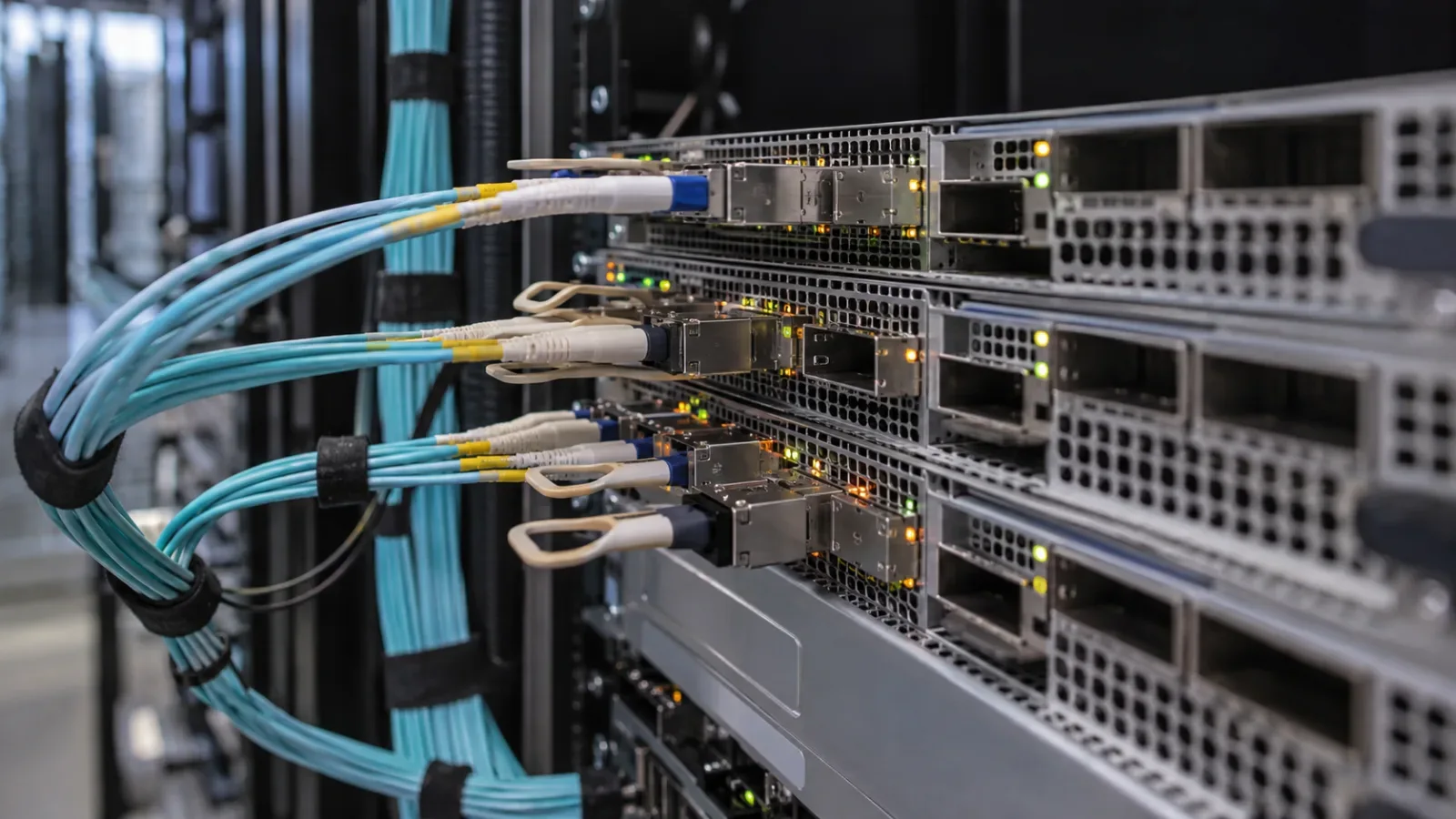
The optical business grew faster than the whole company
STMicroelectronics reported third-quarter 2026 revenue of $3.757 billion, up 17.9% from a year earlier. GAAP operating income was $367 million, up 104.5%. Gross margin was 37.3%, up 4.1 percentage points.
| Metric | Result |
|---|---|
| Company-wide revenue growth | +17.9% (Q3 2026, year over year) |
| RF and optical communications revenue growth | +46.2% (revenue of $504 million) |
| RF and optical communications operating margin | 26.2% (+9.6 percentage points year over year) |
Operating income in the RF and optical communications (RFOC) segment was $132 million, up 131.2% from a year earlier. The company guided fourth-quarter revenue to a midpoint of $4.15 billion. That is a company-wide forecast, not a forecast for the optical segment.
Growth rates inside the same company (Q3 2026, year over year): total revenue 17.9%, RF and optical communications 46.2%. The comparison is for illustration and does not reflect the size of each market.
The segment is not dedicated to AI data centers. It also includes RF and communications products for other customers, such as traditional telecom networks. The full 46.2% increase therefore should not be counted as AI demand.
What happens when you buy more GPUs but the links are slow
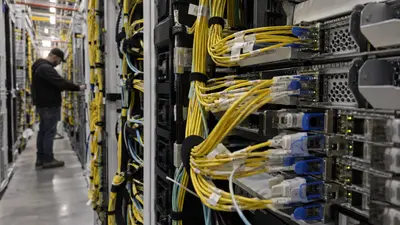
When an AI model is trained across many GPUs, they must constantly exchange calculation results and intermediate data. If one GPU finishes its work but data from another has not arrived, it waits. That is why adding GPUs does not raise system performance in proportion.
Copper vs. optical fiber
- Copper links carry data as electrical signals. Over very short distances they can win on cost and power, but as speed and distance rise, signal loss and the burden of correction grow.
- Optical links convert electrical signals to light. They suit long distances and high bandwidth, but need electro-optical conversion parts, packaging and power.
This does not mean fiber will replace copper across the board. The right choice depends on distance, power and cost, whether inside a rack or between racks.
No single peak-speed figure settles the question. In operation, bandwidth, latency, power consumption, heat and failure rates are weighed together. Optical connectivity does not replace the GPU. It is the foundation that lets the GPU deliver its rated performance.
Where do the profits in optical connectivity arise?
Optical communications is not just a fiber business. Converting electrical signals to light, restoring them at the other end and controlling the process reliably takes semiconductors and optical components working together.
The optical interconnect value chain
- DSP and electronic chips: process and correct high-speed signals.
- Lasers and transmitters: convert electrical information to light.
- Optical fiber: carries data as light.
- Photodetectors and receivers: turn light back into electrical signals.
A transceiver is a transmit-and-receive module that bundles these functions. Component mix and integration vary by product design.
Chipmakers can play a role in DSPs, driver and receiver circuits, and integrated optics such as silicon photonics. Lasers, photodetectors and module assembly may belong to other specialists. No single company captures the revenue of the whole chain.
As speeds rise, signal quality, power efficiency, manufacturing yield and customer qualification matter more. Even a technically strong product struggles to earn enough profit if mass production brings many defects or it is not compatible with customer equipment.
What does the $2 billion 2027 outlook mean?
At a management presentation in September, ST said it expects AI data center-related revenue to exceed $2 billion in 2027. It said it expects about 80% of that from fiber-connectivity semiconductors and about 20% from chips for cooling and power conversion.
This is a forward-looking figure given in September. It is neither confirmed AI revenue for this third quarter nor a breakdown of the RF and optical segment's revenue. For it to materialize, customer orders must turn into actual shipments, backed by production capacity and yield.
On Oct. 29, Reuters cited AI data center and satellite communications demand, along with a recovery across various end markets, as behind ST's improved results. That is why the growth in optical communications should not be narrowed to a single cause, AI.
Insight Times Editorial Desk