The money in AI runs two ways: one company pays for the power, the other sells it
Meta barely sells AI as a product. It recovers the value inside ad prices and time spent. Vertiv builds no models at all, and sells the power and cooling gear that keeps GPUs running. One side spends the capex. The other side books it as revenue.
Two AI winners, cash moving in opposite directions
Putting Meta and Vertiv in the same article looks like a category error.
One company runs Facebook, Instagram and WhatsApp.
The other sells UPS systems, power distribution, liquid cooling and thermal management.
Different products, different customers.
And yet if you want to read the map of AI investment, these are exactly the two companies to look at together.
Meta is on the buying side of AI infrastructure.
It pours capital into large data centers and servers. It pays for outside cloud capacity and AI tokens. Then it pushes that AI into recommendations, advertising, creative tools and new products, hoping to recover the spend through higher ad efficiency and more user engagement.
Vertiv is on the building side.
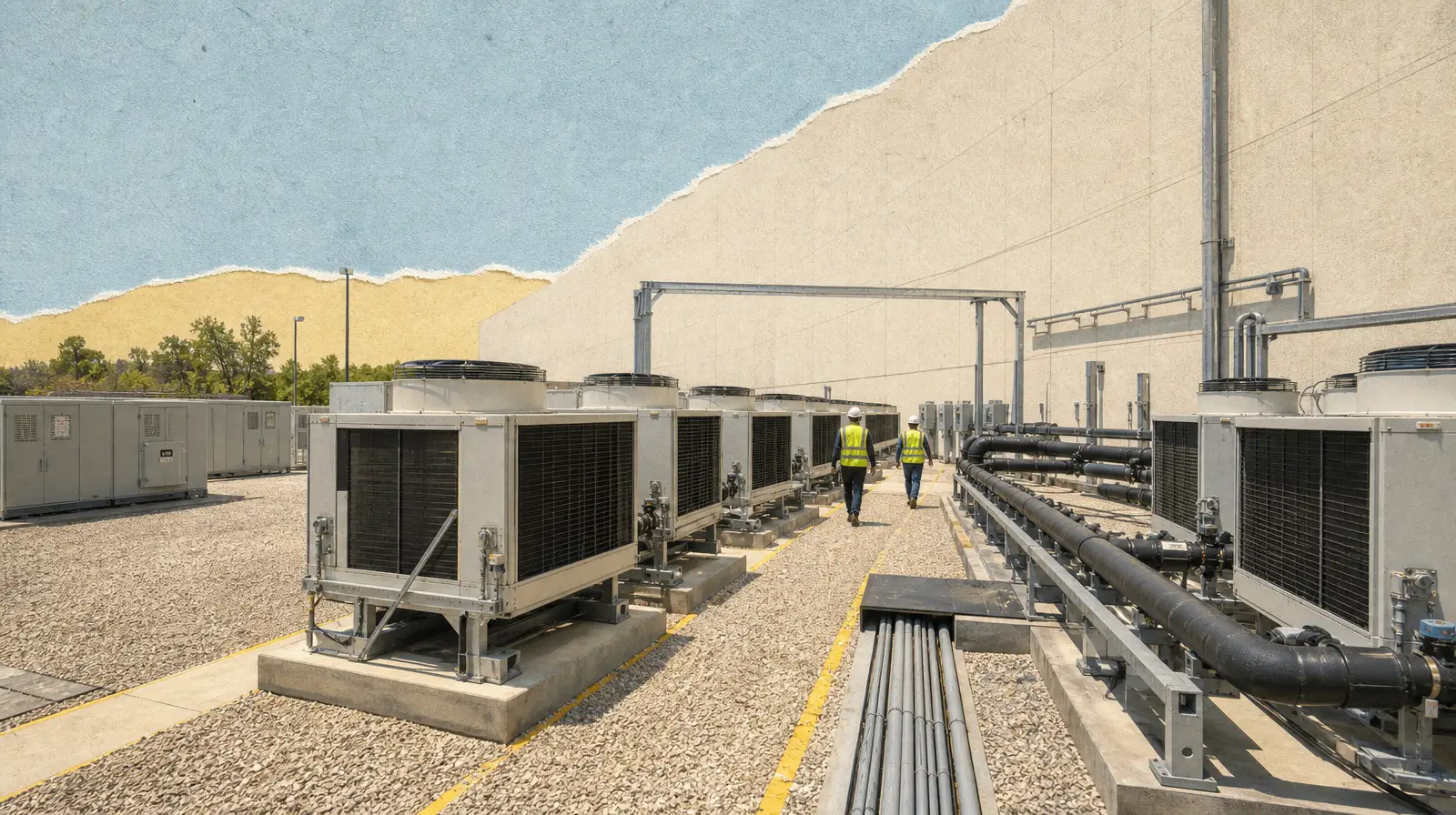
It sells the power supply, thermal management, cooling and distribution equipment a GPU needs in order to actually run.
One company's capex is the other company's revenue.
No pairing shows more clearly where the money in AI leaves from and where it arrives.
Meta's AI revenue does not appear on the income statement under the word "AI"
Microsoft discloses Copilot seats.
Cloud companies book AI usage as revenue.
At NVIDIA, GPU sales show up directly.
Meta is different.
Its AI is dissolved into the advertising and recommendation systems.
Meta's Q2 2026 revenue was 60.8 billion dollars, up 28 percent year on year.
Ad impressions across the Family of Apps rose 14 percent.
The average price per ad rose 12 percent.
Daily active people reached 3.6 billion, up 3 percent.
Read those numbers alone and Meta's AI strategy looks like it is working extremely well.
But fact and interpretation have to be kept apart.
The 14 percent rise in impressions and the 12 percent rise in ad prices are confirmed facts.
That the entire increase came from AI is not a confirmed fact.
Meta's management says AI is improving recommendations, ad efficiency and product experience, and accelerating the core business. What an investor has to check is whether that explanation and the actual advertising metrics keep moving together over a long stretch of time.
Meta sells AI not as a new product but as productivity inside old advertising
The most powerful thing about AI in Meta's business model is that it needs no separate price list.
Instagram recommendations get better.
Users watch longer.
They consume more content.
There are more chances to show an ad.
Ad targeting improves.
The same impression produces a higher conversion.
The advertiser can afford to pay a higher price.
And once AI automates the making of the ad creative itself, small advertisers can build campaigns more easily.
All of that lands inside existing advertising revenue, not in a line item called "AI revenue."
Call it internalized monetization.
It means a company can deploy AI across a platform that billions of people already use without ever selling a new AI service.
Why a 12 percent rise in ad prices matters
In the advertising business, price is a very important number.
Rising impressions mean rising inventory.
But inventory alone can push the unit price of an ad down, because supply is going up.
In Meta's Q2 2026, impressions rose 14 percent and the average price per ad rose 12 percent at the same time.
Volume and price moved up together.
That combination says advertising demand and platform monetization are both strong.
Still, the 12 percent price increase cannot be converted directly into an AI effect.
Ad demand, the macro picture, sector by sector ad budgets, currency and product mix all work at once.
To judge AI's real contribution, you have to watch conversion improvement, advertiser ROI, user engagement and the direction of advertiser count, not the ad price on its own.
The scariest number at Meta is not 60.8 billion dollars of revenue. It is 130 to 145 billion dollars of capex
There is a reason not to read Meta's AI strategy as pure upside.
It costs an enormous amount of money.
Meta's Q2 2026 capital expenditure, including principal payments on finance leases, was 31.08 billion dollars.
The company expects full year 2026 capex of 130 to 145 billion dollars.
That is what a single company plans to put into plant and equipment in one year.
With that capital Meta secures data centers, servers, networks and AI infrastructure.
The problem is that the timing of the spending and the timing of the return are not the same.
The GPUs get bought first.
The data center gets built first.
The power contract gets signed first.
Depreciation starts when the asset goes live.
But the new ad efficiency and the AI product revenue that the investment is supposed to create show up over time.
That gap is the central risk of the AI investment cycle.
Quarterly free cash flow of 784 million dollars, and why you cannot read the number literally
Meta's operating cash flow in Q2 2026 was 31.86 billion dollars.
Free cash flow was 784 million dollars.
A company with 60.8 billion dollars of quarterly revenue produced less than a billion dollars of quarterly free cash flow.
The number is startling, and it needs care.
Capex in the same quarter reached 31.08 billion dollars.
Costs also included 2.4 billion dollars tied to legal proceedings and 1.18 billion dollars related to restructuring.
So one quarter of depressed free cash flow is not Meta's normal long run cash generation.
It should not simply be waved away either.
The underlying fact is clear enough: because of AI investment, huge amounts of operating cash are going straight back out into data centers and infrastructure.
The case for owning Meta no longer closes on advertising growth alone. The question is how far normalized free cash flow comes back after the AI build.
And there is a company that books Meta's capex as revenue
Vertiv.
It builds no AI models.
It has no users.
It has no ad platform.
But to actually run an AI data center, you need a company like Vertiv.
Power has to reach the servers.
It has to be distributed reliably.
The system has to hold up through outages and momentary voltage problems.
The heat coming off the GPUs has to be removed immediately.
In high density racks, air cooling alone struggles, so liquid cooling becomes necessary.
Which means that the more Meta, Microsoft, Amazon and Alphabet raise AI capex, the larger Vertiv's addressable market becomes.
It does not sell AI's intelligence. It makes money solving AI's physical limits.
Vertiv's Q2: AI capex turning into industrial equipment results
Vertiv's Q2 2026 revenue was 3.274 billion dollars.
That is up 24 percent year on year.
Adjusted operating profit was 738 million dollars, up 51 percent.
Adjusted operating margin was 22.6 percent, 4.1 percentage points higher than a year earlier.
Operating cash flow was 1.1 billion dollars.
Adjusted free cash flow was 925 million dollars.
The company raised the midpoint of its full year 2026 revenue guidance to 14 billion dollars and organic sales growth to 31 percent.
This is concrete evidence that the AI data center boom is not staying inside semiconductor earnings. It is passing through into the orders, margins and cash flow of power and thermal management companies.
The important detail is that adjusted operating profit is growing much faster than revenue. Demand is rising and operating leverage is showing up with it.
If GPUs keep improving, why does the cooling company do even better?
Intuitively, more efficient chips should shrink the market for power and cooling.
In AI data centers, the opposite can happen.
Performance per watt improves on a single chip.
So the operator puts more accelerators into the same rack.
Compute per rack goes up.
Power density per rack goes up at the same time.
The heat concentrates.
Which calls for higher grade power distribution and liquid cooling.
Efficiency gains in AI chips do not necessarily reduce demand for physical infrastructure. They can raise the achievable compute density and demand a higher tier of power and thermal solution.
That is why Vertiv is exposed not only to the volume of data center construction but to the rising power density of AI racks.
Why Vertiv is buying a microgrid company
In September 2026, Vertiv announced the acquisition of Utility Innovation Group.
The base cash consideration is about 1.45 billion dollars, with up to 1.15 billion dollars more depending on future performance conditions. Maximum deal value is roughly 2.6 billion dollars.
UIG works in microgrid controls, specialty switchgear and power architecture.
This is more than a bolt-on deal.
It says the AI data center customer's problem does not end at cooling.
Grid connections are slow.
Getting the megawatts you need, when you need them, is hard.
So operators start thinking about microgrids that bundle utility power with onsite generation and storage.
Hence Vertiv extending from cooling and internal power management toward the design of a data center's own power supply.
It is a signal that the AI bottleneck is moving from GPUs to cooling, and from cooling to the grid and self generation.
Meta is the cause of AI demand. Vertiv is its physical consequence
The relationship between the two companies can be read as a chain.
Meta builds a better recommendation model.
That needs more AI compute.
More GPUs get deployed.
Power density rises.
The cooling load grows.
More data centers get built.
Demand for Vertiv equipment rises.
Meta's AI ambition creates Vertiv's order book.
That structure gives investors a useful lens.
In the AI industry, the highest growth rate does not always sit with the AI software companies.
The more capex the software companies commit, the more stable the cash flow can be for the second layer of companies supplying that build.
Vertiv's risk: bottlenecks do not last forever
Right now power and cooling are a clear bottleneck.
But every bottleneck pulls in high prices and investment.
Vertiv adds capacity.
Schneider Electric invests.
Eaton expands.
Delta Electronics and other competitors go after the market.
The firms building AI data centers push for standardized designs and multiple suppliers.
Supply catches up in the end.
So Vertiv's biggest risk is not only that AI demand disappears.
It is also that power and cooling supply capacity grows faster than demand, and today's pricing power and margin expansion normalize.
And if ghost demand grows, projects announced but never actually built, the quality of the backlog starts to matter as much as its size.
Which is why, with Vertiv, you watch actual revenue conversion, cancellation rates, margin and cash conversion, not just the headline backlog.
Which is the better AI investment, Meta or Vertiv?
There is no single answer, because the two offer completely different risks.
Meta is a bet on how much stronger AI can make an existing advertising economy.
The advantage is that 3.6 billion daily users and enormous ad demand are already there. A small efficiency gain from AI can be spread across the whole platform immediately.
The disadvantage is the scale of the capex, model competition, regulation and the uncertainty of new AI products.
Vertiv is a bet that AI data center construction volume and power density keep rising.
The advantage is that whichever AI model wins, the data center still needs power and cooling.
The disadvantage is the industrial equipment cycle, capacity additions by rivals and delays in customer projects.
One is an investment in AI's application layer.
The other is an investment in AI's physical layer.
They are not competitors. They are two different floors of the same value chain.
Sources
- Meta Q2 2026 Results
- Vertiv Q2 2026 Results, SEC
- Reuters, Vertiv to acquire Utility Innovation Group
Insight Times Editorial Desk