Why Elon Musk's 4% Growth Call Deserves a Serious Read
Musk says AI could double US GDP growth next year, from 2% to 4%. The number itself matters less than the idea behind it: intelligence turning from scarce labor into replicable capital. If that premise holds, the rules of economics and markets shift too.
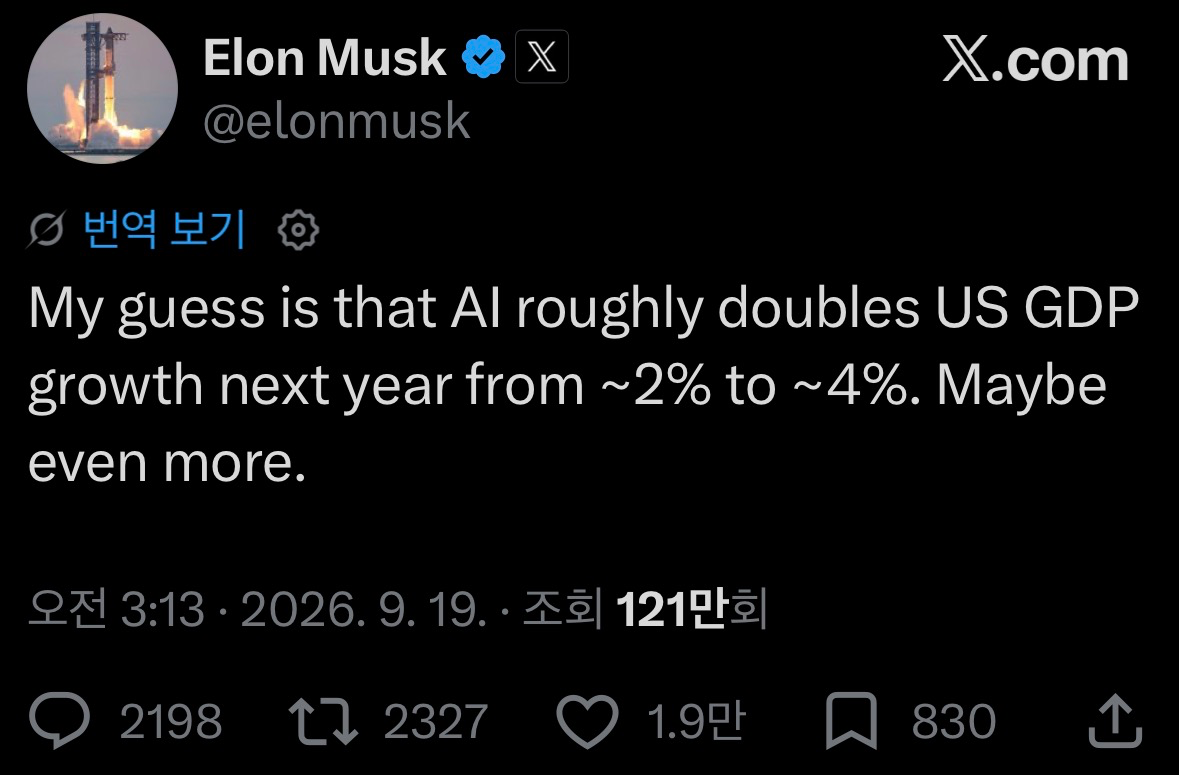
Elon Musk's latest claim was short. "My guess is that AI will roughly double the US GDP growth rate next year, from about 2% to 4%. Maybe more."
Normally this is where the story ends. "Musk went too far again." But this time it is harder to wave off, because 4% sits closer to the mainstream numbers than it looks at first glance.
The Fed's September 2026 projections put the median forecast for 2027 US real GDP growth at 2.4%. The most optimistic FOMC participant put it at 2.9%. On those numbers alone, Musk is clearly more bullish than both Wall Street and the Fed.
But the Fed also publishes how wrong its own forecasts can be. Based on historical forecast errors, the upper bound of the 70% uncertainty range for 2027 growth sits just above 4%. In other words, 4% is far from the central forecast, but it falls inside the right tail the US economy could reach if it takes a large positive supply shock.
Why 4% checks out, while 10% and 100% are an entirely different question
Line up Musk's past comments and things get confusing fast. He has suggested AI could produce double-digit economic growth within 12 to 18 months, floated triple-digit growth further out, and said AI and robots could more than double the size of the global economy within a decade.
These are not the same claim.
- 4%: 2027 US real growth rate, a tail scenario worth discussing if AI adoption and investment run hot
- 7.18%: the average annual growth rate the world economy would need to double in size within 10 years
- 100%: the annual growth rate needed for an economy to double in size in a single year, requiring an entirely different production system
Doubling the size of an economy over a decade works out to roughly 7.18% average annual growth. That is a huge number, but it is a different order of magnitude from growing 100% every year. Doubling GDP in five years would require roughly 14.9% average annual growth.
By contrast, "100% annual growth" means the entire economy doubles in a single year. That cannot be explained by simply making the current economy somewhat more efficient.
So it makes more sense to read Musk's numbers in three tiers:
- 4%: a very strong productivity and investment shock, still an extension of today's economy
- Low double digits: a regime break, where AI agents, autonomous driving and robots spread across the economy at the same time
- 100%: a recursive production economy, where AI and robots build more AI, robots, factories and energy infrastructure
Lumping 4% and 100% together as "Musk exaggerating again" misses the real distinction. The first number asks how high the current economy's ceiling can go. The second asks whether the economy's production function itself is changing.
AI already makes people more productive. The problem is the whole economy
Musk's claim ultimately boils down to one question.
Micro-level evidence already exists. A study of 5,172 customer support agents found that those using generative AI tools processed roughly 15% more work per hour on average, with the biggest gains among less experienced, lower-skilled workers.
It is tempting to conclude that AI simply needs to grow the whole economy by 15%. But that is where a massive gap opens up between the micro and the macro.
In a 2026 US Census Bureau survey, 18% of firms reported using AI in at least one business function. Weighted by employment, that rises to 32%, but even companies using AI mostly limit it to a handful of functions and tasks.
In short, AI's capability has already climbed very fast, but the economy's absorption of it is still far slower.
| Study / Institution | Measured AI Productivity Effect | What It Means |
|---|---|---|
| QJE field study | Customer support productivity up roughly +15% on average | Task-level effects are already documented |
| CBO | Total factor productivity growth +0.1 point per year, 2026-2036 | A conservative view that assumes corporate process integration takes time |
| OECD | +0.4 to 1.3 points per year in the US and other highly exposed countries | If adoption speeds up, macro effects could grow too |
| Anthropic, extreme scenario | Annual GDP growth up to roughly 15% | A thought experiment built on recursive self-improvement and rapid adoption |
The gap between the CBO and the OECD is the key point. Both agree AI raises productivity. What they disagree on is how fast it spreads.
We may be at the early stage of a productivity J-curve
New general-purpose technologies do not blow up GDP statistics the moment they appear. Electricity did not send productivity soaring the day after it reached factories.
Companies first have to change how they work: clean up their data, rebuild software, redefine employee roles, and fix management systems. These investments show up as costs first, and productivity gains come later.
Economists call this the productivity J-curve. Investment and transition costs push productivity down at first, and the gains only show up in the statistics after organizations have been redesigned around the technology.
Current Census data looks similar. Many companies have started using AI, but few have handed their core workflows entirely over to it. A company where one or two people use Copilot is economically nothing like a company where AI agents actually run accounting, customer support, software development, procurement and logistics together.
That is why 2027 matters. The question is less about how capable the AI models themselves become, and more about whether agents start changing how companies actually work.
Musk's real bet isn't the LLM. It's physical AI
From here, Musk's worldview turns far more radical than typical AI optimism.
Software AI mostly touches knowledge work: writing reports, generating code, answering customers, reviewing contracts.
But the economy has far more happening off-screen. Trucks get driven. Boxes get moved in warehouses. Parts get assembled on factory floors. Buildings get built. Batteries get made. Power plants get maintained.
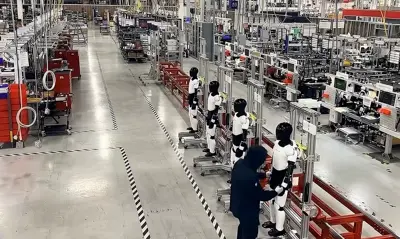
For AI to reach that territory, intelligence alone is not enough. It needs eyes, hands and legs, in other words a physical body.
That is why Robotaxi and Optimus are not just "two new Tesla businesses." They are closer to the most important experiment in Musk's macroeconomic thesis.
The reason this shift matters is simple. It takes a human decades from birth to enter the labor market. A robot, by contrast, can be produced as fast as a factory allows.
And once robots are put to work building more robot factories, data centers and power plants, an even more interesting stage opens up. Capital does not just replace labor; intelligent capital starts building more intelligent capital.
This is the only path where the growth rates Musk mentions, 10%, 15%, or even the more extreme 100%, can be examined economically rather than dismissed outright.
Boosting office productivity by 30% with a tool like ChatGPT does not produce a 100%-a-year growth economy. That requires a stage where AI automates R&D, robots replicate physical capital, and production capacity itself compounds rapidly on itself.
Anthropic's 15% growth scenario actually helps explain Musk
Interestingly, Musk is not the only one making this kind of argument.
Anthropic has published a scenario modeling the US economy in 2030 across several stages. In its most extreme case, AI is more productive than humans at most knowledge work, autonomously performs nearly all tasks, and even undergoes recursive self-improvement.
In that scenario, annual GDP growth rises to roughly 15%, and the economy's size doubles roughly every 4.5 years. By 2030, GDP is 32.4% higher than it would have been without AI.
Notably, Anthropic itself states this extreme scenario does not even include "hyper-capable robots."
In other words, automating knowledge work alone produces a 15% thought experiment. Musk adds Robotaxi and humanoid robots on top of that.
His reaction to Anthropic's 15% scenario, roughly that it becomes achievable once humanoid robots reach mass production, follows directly from his existing logic.
To be clear, Anthropic does not call this a forecast either. It is a scenario showing what kind of economy emerges under strong assumptions. Musk's long-term projections are best read the same way.
But something moves slower than AI: the power grid and the factories
That Musk's long-term thesis is technically interesting is a separate question from whether 4% arrives by 2027.
AI models are software. Software replicates fast.
But data centers have to be built out of concrete and wiring. GPUs need semiconductor fabs. Servers need cooling. Power grids need transformers and transmission lines. Humanoid robots need motors, actuators, reducers, batteries, sensors, and factories to build all of it.
The IEA expects global data center electricity consumption to more than double to roughly 945 TWh by 2030. In the US, data centers are expected to account for nearly half of the increase in electricity demand through 2030.
AI's performance curve may look close to exponential, but the buildout curves for power grids, power plants and factories do not move that way.
This physical bottleneck does not make Musk's future "impossible." It just stretches out the timeline.
Which is exactly why anyone who buys the direction of Musk's argument should take calendar risk seriously.
This may not throw out economics textbooks, but it could rewrite the definitions of labor and capital
Traditional growth models generally explain the economy through labor, capital and productivity. People supply labor, while machines and factories act as capital that raises people's productivity.
But once humanoid robots do the same work as people, the categories start to blur.
On the balance sheet, a robot is capital. Economically, it functions as labor.
The same goes for AI agents. Software running on a server is capital, but in practice it performs intellectual labor around the clock.
Push this further: if AI researches the next generation of AI, and robots run robot factories, and those robots go on to build data centers and power plants, the old boundary between labor and capital gets far blurrier.
The truly important shift here is that the old assumption that returns on capital shrink over time could weaken.
Once intelligent capital starts helping produce more of itself, the diminishing returns to capital accumulation could weaken substantially. This is the core path that makes Musk's extreme growth claims worth taking economically seriously.
Economics is not necessarily being proven wrong. Rather, the center of gravity is shifting from Solow-style models toward task-based growth models, automation models and endogenous growth models.
If AI succeeds, does inflation fall? It could rise first
AI optimism usually comes with a straight-line story:
AI → higher productivity → more supply → lower prices → lower rates.
That path is plausible enough in the long run. But during the transition, forces pull the other way just as hard:
AI investment boom → surging demand for data centers, power, chips and construction → higher cost of capital and higher power costs.
In other words, AI can drive an investment boom in the short run, lift productivity in the medium run, and expand supply capacity substantially in the long run.
When all three stages blend together, faster GDP growth does not automatically mean lower rates.
For example, if the economy grows 4% while productivity rises 4% to 5%, wages could climb quickly while unit labor costs stay stable. But if most of that 4% growth is an investment boom building data centers and power plants, and the productivity payoff arrives late, inflationary pressure could build instead.
That means the Fed in an AI era should be watching not just the headline GDP growth rate but the gap between wage growth and productivity, unit labor costs, investment demand and inflation expectations.
The bigger question isn't the growth rate. It's who owns the growth
If AI and robots really do replace labor, the economy could get much richer. But that does not mean everyone automatically gets richer.
In Anthropic's extreme scenario, labor's share of income by 2030 falls to roughly 45.2%, with capital's share rising to 54.8%. The overall economy is much larger, but a bigger slice of the growth flows to owners of capital.
The important point here is that "labor's share falls" does not automatically equal "ordinary people get poorer."
If households hold broad ownership of AI and robot capital through pensions, index funds, retirement accounts and sovereign wealth funds, capital income could offset part of the decline in labor income.
In the end, the distribution question in an AI economy may be less about "should robots be taxed" and more about "who owns the robots."
That question connects, in a roundabout way, back to Tesla. If a world arrives where AI turns labor into capital, then who owns the companies building that capital, and who owns their equity, becomes central to how the gains get distributed.
Tesla is already betting more than $25 billion on this thesis
Tesla has not yet proven Optimus is a success. But it has at least moved past the stage of being just a company that talks about it.
In its second-quarter 2026 10-Q, Tesla stated it is investing in autonomy, robotics and AI-enabled products, including FSD, Robotaxi and Optimus, along with the infrastructure behind them.
Total 2026 capital expenditure is expected to exceed $25 billion. The company cited AI compute infrastructure and data centers, expanded manufacturing and R&D production lines, and a growing base of AI-enabled assets the company operates directly.
At this scale, Musk's AI and robotics thesis is no longer just a slide in a presentation. It has entered the actual financial statements.
But that is exactly why investors need to stay clear-eyed.
| Tesla thesis | The real numbers to watch | Signal the thesis is strengthening | Warning sign |
|---|---|---|---|
| Robotaxi | Driverless paid miles, interventions, accident rate, $/mile | Mileage grows quickly without safety drivers | City expansion stalls, regulatory problems |
| Cybercab | Production volume, utilization, cost per vehicle | Unit economics improve for the purpose-built vehicle | Manufacturing ramp gets delayed |
| Optimus | Autonomous work hours, interventions per hour, cycle time, bill of materials, yield | Repetitive tasks done without human intervention, plus outside revenue | Continued reliance on teleoperation |
| AI compute | Actual monetization relative to capex | Value creation per unit of compute rises | Capex growth keeps outpacing monetization |
| Auto and Energy | Free cash flow, manufacturing efficiency, storage margin | Existing businesses self-fund the AI option | AI investment erodes core cash flow |
Optimus in particular needs to be judged on unit economics rather than demo videos.
The moment that matters is when the annual economic output of a single robot exceeds its total cost of ownership, including purchase price, power, maintenance and remote-operator costs.
From that point on, Optimus stops being a product and becomes a new source of labor supply.
Even if Musk is right, that doesn't mean all AI stocks go up
Here comes the twist that matters most for investors.
Even if AI lifts US growth to 4%, 6% or 10%, that does not mean AI-related stocks should get proportionally more expensive.
Economic growth and stock returns are not the same problem.
If AI productivity rises, corporate profits could grow. But at the same time, if investment demand for data centers, power plants and chip fabs surges, real interest rates could rise too. Higher rates raise the discount rate used to value future profits, which pressures high price-to-earnings multiples.
If AI models get commoditized quickly, the benefits of the technology could also flow to the companies and consumers buying cheap AI rather than to the model providers themselves.
So going forward, the most important question in AI investing may shift away from "who has the smartest model" and toward something closer to this:
In the end, it comes down to AI return on invested capital.
The same logic applies to Tesla. However large Optimus's future potential turns out to be, if the current stock price has already priced in too much of that future too aggressively, good technology will not necessarily make for a good investment.
The reverse is also true. Valuing Tesla purely on an auto-business discounted cash flow model, with zero chance assigned to Optimus succeeding, risks missing the direction the company is actually investing in.
Insight Times Editorial Desk