Intel Plunges 28.58% Despite an AI Boom, Its Worst Day Since 1974
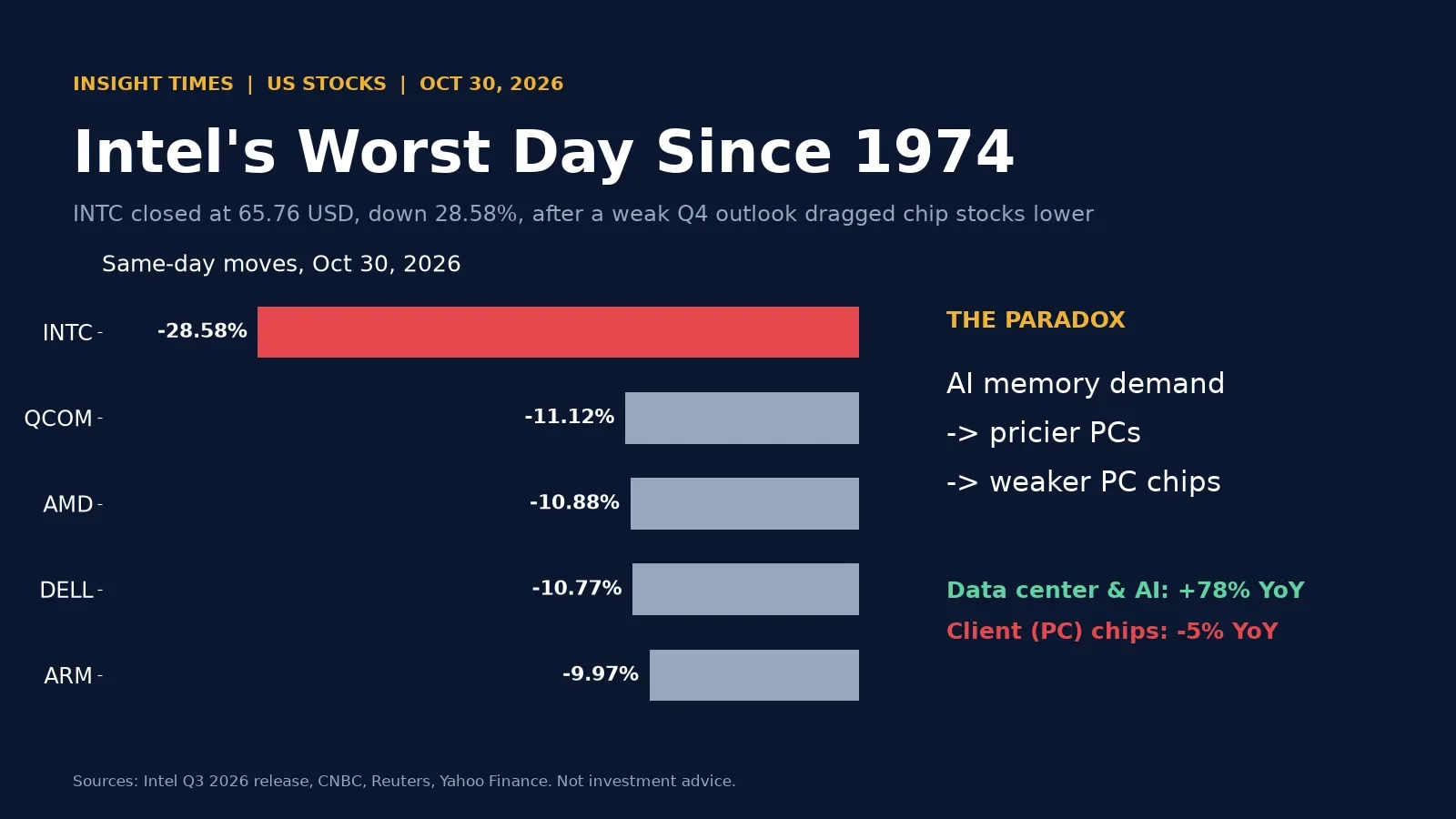
Intel's data center and AI revenue surged 78%, yet the stock fell 28.58% in a day. The culprit was a weak fourth-quarter outlook, as AI-driven memory costs squeeze the PC market.
1. Worst day since 1974, yet the stock is still up for the year
On Oct. 30, Intel (INTC) closed at $65.76, down 28.58%. About $140 billion in market value vanished in a day. It was the biggest one-day drop since a decline of roughly 30% on July 5, 1974.
One day does not explain Intel's whole 2026. Even after the plunge, the stock is up about 80% year to date. But it has fallen by more than half from its June 22 record high. Investors who bought in January and investors who bought the peak have had very different experiences with this stock.
2. The third quarter was fine. The fourth-quarter outlook broke the market
Third-quarter revenue was $16.51 billion, up 21% from a year earlier. That was essentially in line with the LSEG estimate of $16.5 billion. Non-GAAP earnings per share were $0.52, above the $0.40 expected and above $0.23 a year earlier.
The company's guidance told a different story. Fourth-quarter revenue guidance of $15 billion to $16 billion fell short of the $17.1 billion the market expected. Non-GAAP EPS guidance of $0.25 was also below the $0.43 expected.
Non-GAAP gross margin is set to fall from 44.1% in the third quarter to a guided 38.0% in the fourth, a drop of 6.1 percentage points. That includes a roughly 2-point headwind from an Israel fab shutdown. This is not a cut to earlier guidance. It is a comparison of third-quarter results with the fourth-quarter outlook.
The accident at the Fab 28 site in Israel is also expected to cost about $300 million in fourth-quarter revenue. The company said it does not expect positive cash flow this year either. The reaction likely reflects uncertainty about future profitability and cash generation more than the strong quarter itself.
3. AI up 78%, PC down 5%: two markets inside one Intel
| Q3 business metric | Revenue and growth | What it means |
|---|---|---|
| Data Center and AI (DCAI) | $7.3 billion, +78% | Fastest growth in 15 years, strong server demand |
| Client (PC) | $8.1 billion, -5% | Below expectations, PC demand under pressure |
| Foundry | $6.7 billion, +58% | Top-line growth confirmed, profitability needs separate judgment |
| AI PC | Revenue +35% | Product line growing even as the overall PC segment shrinks |
The chip industry's paradox is on display here. When AI data centers need more memory, memory supply and prices can push up PC makers' costs. Higher costs weigh on PC sales and production plans, and ultimately on demand for Intel's client chips.
AI data center memory demand rises → memory prices rise → PC build costs rise → PC market under pressure → client chip demand slows
Intel expects 2026 PC shipments to fall about 12%, with declines of more than 20% in the second half. It sees another drop of about 10% in 2027. CFO David Zinsner said he expects the PC slowdown to last at least through the first half of next year. A quick recovery looks unlikely until memory supply and prices normalize.
On the other side, Intel expects server CPU shipments to grow more than 30% in each of 2026 and 2027. The key point is that AI is neither uniformly good nor uniformly bad for Intel as a whole.
4. Was it only Intel? Chips and the PC ecosystem fell together
| Stock or index | Oct. 30 move | Reading |
|---|---|---|
| Intel (INTC) | -28.58% | Center of the outlook shock |
| AMD | -10.88% | Possible spread of CPU and PC demand worries |
| Qualcomm | -11.12% | Weaker sentiment on device chips |
| Arm | -9.97% | Chip design ecosystem weak in sympathy |
| Dell | -10.77% | Worries about PC demand and cost pressure |
| Nvidia | about -4% | AI chips hit by risk aversion too |
| Nasdaq | about -3% | Broad tech weakness |
Falling together on the same day does not mean every company's fundamentals worsened by the same amount. It does suggest that a slowing PC market and weaker tech sentiment overlapped. Bernstein's Stacy Rasgon cut his Intel price target to $75 from $110 and called the outlook "terrible." A price target is an analyst's opinion, not a fixed value for the future stock price.
5. After past Intel crashes, recovery took 165 days, or 17 years
| Date | One-day drop | Backdrop | Time to regain prior high |
|---|---|---|---|
| 1974-07-05 | about -30% | Market rout at the time | Not given |
| 1987-10-19 | -19.23% | Black Monday | About 165 trading days |
| 2000-09-22 | -22.02% | Tech shock | About 4,301 trading days, roughly 17 years |
| 2024-08-02 | -26.06% | Dividend suspended, 15% workforce cut, close of $21.48 | About 282 trading days |
| 2026-10-30 | -28.58% | Weaker Q4 outlook, PC slump worries | To be determined |
Recovery times use dividend-adjusted prices from one data source and can vary with the method. In 1987 and 2024, Intel regained its prior high relatively quickly. The 2000 case shows recovery can take very long.
A rebound after a crash is different from getting back your original investment. Investors who add on a schedule can lower their average cost, but if the company's long-term earnings power deteriorates, buying in installments does not by itself prevent losses.
6. Four things long-term investors can watch
First, PC shipment forecasts. Watch whether the roughly 10% decline expected for 2027 improves and whether memory price pressure eases.
Second, durability of data center growth. The key is whether the forecast of 30%-plus annual server CPU shipment growth turns into actual revenue and profit.
Third, gross margin. Watch whether profitability recovers from the 38.0% fourth-quarter guide, and separate temporary fab-accident costs from structural cost pressure.
Fourth, cash flow. Revenue growth and better adjusted EPS are not enough. Long-term value depends on whether the business turns into one that actually leaves cash behind.
Long-term investing and buying in installments are useful ways to curb impulsive reactions to news. But they do not mean holding every individual stock indefinitely or buying every dip. It is more reasonable to guard against both the fear and the optimism that headlines create, and to check regularly whether the original investment thesis still holds.
Insight Times Editorial Desk