ARK Sets Tesla 2031 Target at $4,400, Betting on 8.1 Million Robotaxis and Optimus
ARK Invest's new model implies a $17.5 trillion market cap for Tesla by 2031. It reads less like a forecast than a scenario that assumes robotaxis and robots earn real money.
ARK Invest's new Tesla valuation model, released Oct. 19, puts the 2031 share price at $4,400. That is about 12 times the Oct. 19 close of $368.06. The model implies a market cap of $17.5 trillion and annual revenue of $1.449 trillion.
1. Why the robotaxi share fell from 90% to 80%
In ARK's 2024 model, robotaxis explained about 90% of Tesla's 2029 enterprise value. In the new model, the share for 2031 drops to about 80%.
That does not mean ARK has given up on robotaxis. The model now counts external sales of Optimus and service revenue more fully.
The earlier model placed about 30,000 robots inside Tesla's own factories, saving roughly $3.5 billion a year in costs. The new model assumes Tesla supplies robots to outside customers and earns recurring revenue from work services, a robots-as-a-service (RaaS) business.
The key difference is less the sale of the robots than how long and how productively the robots work and earn money.
ARK's roughly 15% contribution from Optimus is a long-term business value estimate, not a confirmed market share.
2. Tesla in 2031, by the numbers
ARK V9 model output. 2025A is the comparison base; the rest are 2031 scenario projections.
| Key metric | Bear (25%) | Base (expected) | Bull (75%) |
|---|---|---|---|
| Value per share | $3,300 | $4,400 | $5,000 |
| Market cap | $13.4T | $17.5T | $20.4T |
| Enterprise value (EV) | $12.5T | $16.4T | $19.2T |
| Annual vehicle sales | 8.5M | 10.2M | 11.7M |
| Robotaxi fleet | 4.8M | 8.1M | 10.0M |
| Ride-hail net revenue | $526B | $753B | $899B |
| Annual ESS installations | 1,756 GWh | 2,278 GWh | 2,693 GWh |
| Cumulative external Optimus sales | 800,000 | 1.0M | 1.2M |
| Annual Optimus revenue | $161B | $212B | $254B |
| Annual total revenue | $1.202T | $1.449T | $1.622T |
| Annual EBITDA | $694B | $902B | $1.045T |
Source: ARK Invest, Oct. 19, 2026. The scenarios are illustrative operating cases for each percentile and do not guarantee downside or upside outcomes.
In the Base case, ride-hail net revenue of $753 billion is about 52% of total revenue. That is 2.35 times EV revenue of $320 billion. Energy storage (ESS) revenue is $163 billion and Optimus revenue is $212 billion.
2031 Base revenue mix
- Robotaxi ride-hail: $753 billion (about 52%)
- Electric vehicles: $320 billion (about 22%)
- Optimus: $212 billion (about 15%)
- Energy storage: $163 billion (about 11%)
Shares are of total revenue of $1.449 trillion. Small gaps between the line items and the total reflect rounding and other items.
ARK puts the overall EBITDA margin at about 61% in the Base case and about 65% in the Bull case. That assumes an earnings structure closer to a software or platform company than a carmaker.
Dividing the published Base figures directly, $902 billion of EBITDA by $1.449 trillion of revenue, gives about 62.2%. That does not match the stated 61% margin. The figures here reproduce the model as published, and the consistency of the detailed math needs further confirmation.
3. 8.1 million robotaxis: unit economics matter more than scale
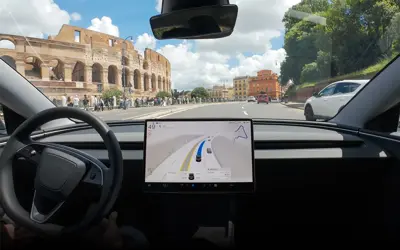
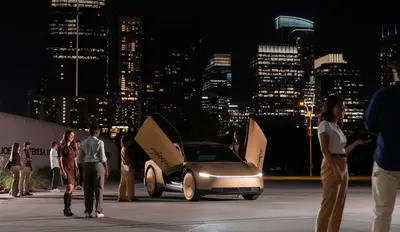
ARK says Tesla's robotaxi service, which began in Austin in June 2025, has expanded to seven U.S. cities and passed 1 million miles of unsupervised driving. It also offers a comparison: Tesla reached its first 1 million miles about four times faster than Waymo.
But the early pace cannot simply be extended to 2031. City-by-city permits, rider safety, traffic conditions, vehicle maintenance, insurance and accident response could all change the growth curve.
ARK estimates that, at the same utilization, Tesla's operating cost per mile would be about 40% below Waymo's next-generation robotaxi. It bases that on vision-based autonomy and vertical integration in vehicle manufacturing. This is ARK's estimate, not a cost advantage proven in large-scale commercial operation.
Dividing 2031 ride-hail net revenue of $753 billion by 8.1 million vehicles gives roughly $93,000 per vehicle per year. That is simple arithmetic, not actual revenue or profit per vehicle.
In judging Tesla's value, then, paid miles, fleet utilization, realized fares and total cost per mile matter as much as the number of vehicles on the road.
4. Optimus: the biggest opportunity and the hardest assumption
ARK's Base model has Tesla selling a cumulative 1 million Optimus robots to outside customers by 2031 and booking about $212 billion in robot service revenue that year.
The core technical premise is human-level skill at work. ARK estimates that with about 4 GW of AI compute and enough real-world task data, that level could be reached around 2031.
But more compute does not necessarily improve a robot's abilities in the same proportion. Fine hand manipulation, adaptation to unfamiliar settings, safety, long-hour operation and fault response all have to be proven.
ARK's mention of an "Optimus Academy" training 20,000 to 30,000 units is an attempt to address that data shortfall. Actual training scale and commercial productivity would still need continuing confirmation.
Order of checks for the Optimus thesis: task success rate, then hourly productivity, then customer profitability.
Building robots and giving customers a reason to keep paying for robot services are separate problems.
5. Terafab and $225 billion: opportunity and burden from AI infrastructure
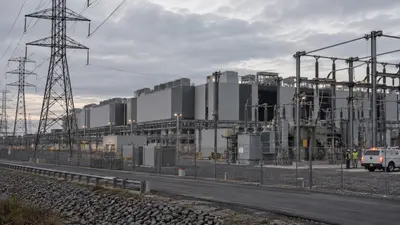
ARK assumes Tesla's cumulative AI infrastructure spending rises from about $7 billion at the end of 2025 to about $225 billion at the end of 2031, roughly 32 times as much.
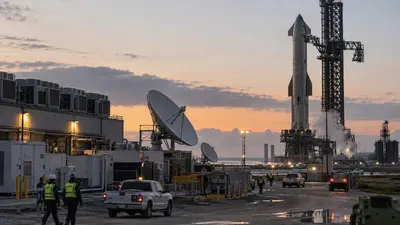
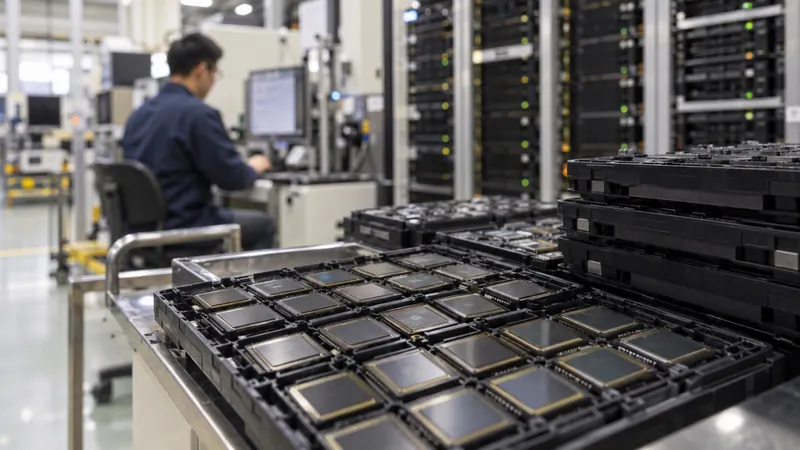
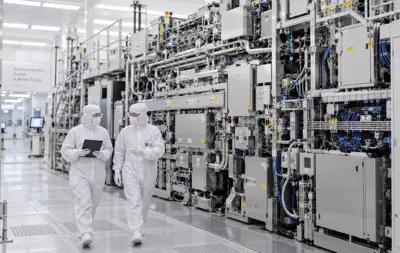
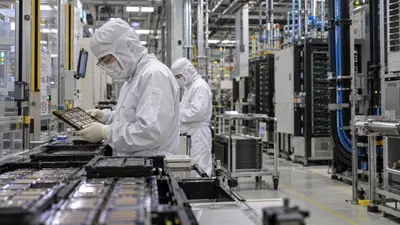
The joint Terafab project between Tesla and SpaceX is a strategy to ease chip supply constraints over the long run. SpaceX's SEC filing confirms the basic framework for the partnership. It also states that schedules, investment size and results for individual projects are subject to separate negotiation.
Terafab is therefore not a finished technological moat. Yields in large-scale chip manufacturing and the payback on the capital spent remain to be shown.
The more important question is that AI infrastructure is both fuel for growth and a possible drain on cash flow. Even if EBITDA grows, heavy capital spending and working capital needs could leave free cash flow for shareholders smaller than expected.
6. A SpaceX merger: can it be added to today's value?
ARK mentions a possible Tesla-SpaceX merger within five years as a separate scenario.
If the two companies combined, the projection is combined 2031 revenue of $3.8 trillion and EBIT of $2.7 trillion. That is not included in the $4,400 standalone Tesla price in the model.
What can be confirmed today is business cooperation and market discussion of a possible merger. A merger has not been confirmed. With the exchange ratio, minority shareholder rights, dilution and asset valuation all undecided, simply adding the two companies' values together is risky.
ARK's 2031 Tesla looks less like the future of a carmaker than a very large investment hypothesis about how far AI can economically replace physical labor and transport.
Whether it comes true will depend on actual miles driven, robot productivity, customer revenue and the cash left after investment.
ARK's projections are its own estimates, not Tesla earnings guidance.
Insight Times Editorial Desk