Box Shows AI Its Manuals, and the AI Starts Redesigning the Workflow
Box Architect, built with NVIDIA, moves AI from reading documents to designing how work gets done. It has not yet reached beta, so the real-world payoff remains to be seen.
The 20-second read
Ask AI to do the work, and it suggests changing how the work is done
Why does it take so long to onboard one new vendor?
Sales collects the vendor's details. Finance verifies the bank account. Legal reviews the contract. Someone chases missing paperwork and sends repeated emails to check approval status.
Until now, generative AI has mostly played a supporting role in this process, summarizing contracts or drafting emails. What if the AI began to ask this instead?
That question is the starting point for Box Architect, which the US enterprise content management company Box announced on Nov. 5 at BoxWorks 2026.
A user describes a business goal. The AI analyzes existing documents and procedures, proposes a workflow, and assembles the forms, AI agents and approval structure it needs.
The key difference is that it does not simply automate existing work. It tries to design a better way to reach the goal from scratch. Architect is still headed for a beta release for Enterprise Advanced customers in the fourth quarter of 2026, however. That does not mean every announced feature has been proven in a production setting.
What changes inside a real company?
Take vendor onboarding as an example.

Existing process: document intake, owner review, hand-off to each department, requests for missing materials, sequential approvals, final registration.
AI-based redesign: define goals and rules, unified intake, AI document checks (missing items, information extraction), human review of exceptions only, approval and registration.
The comparison is a conceptual example. The redesigned flow is a scenario reconstructed from product features Box has described. It is not a verified operating result from a customer.
The point is not that employees get through six steps faster. Documents that several departments each checked separately are collected once. Routine verification goes to the AI. Only legal or financial exceptions reach a person.
In the product lineup Box described, Forms takes the application and Extract pulls key information from documents. Automate routes the work, while Doc Gen and Sign support contract creation and signing. Apps shows overall progress.
Architect is designed to combine these tools around a business goal, and also to find recurring bottlenecks in operation and suggest improvements.
Why NVIDIA: the AI does not know the company's rules
Even a strong AI model has trouble designing the right procedure if it does not know a company's internal rules.
Which contracts need legal sign-off, at what amount a finance chief must approve, and how exceptions are handled all differ from company to company.
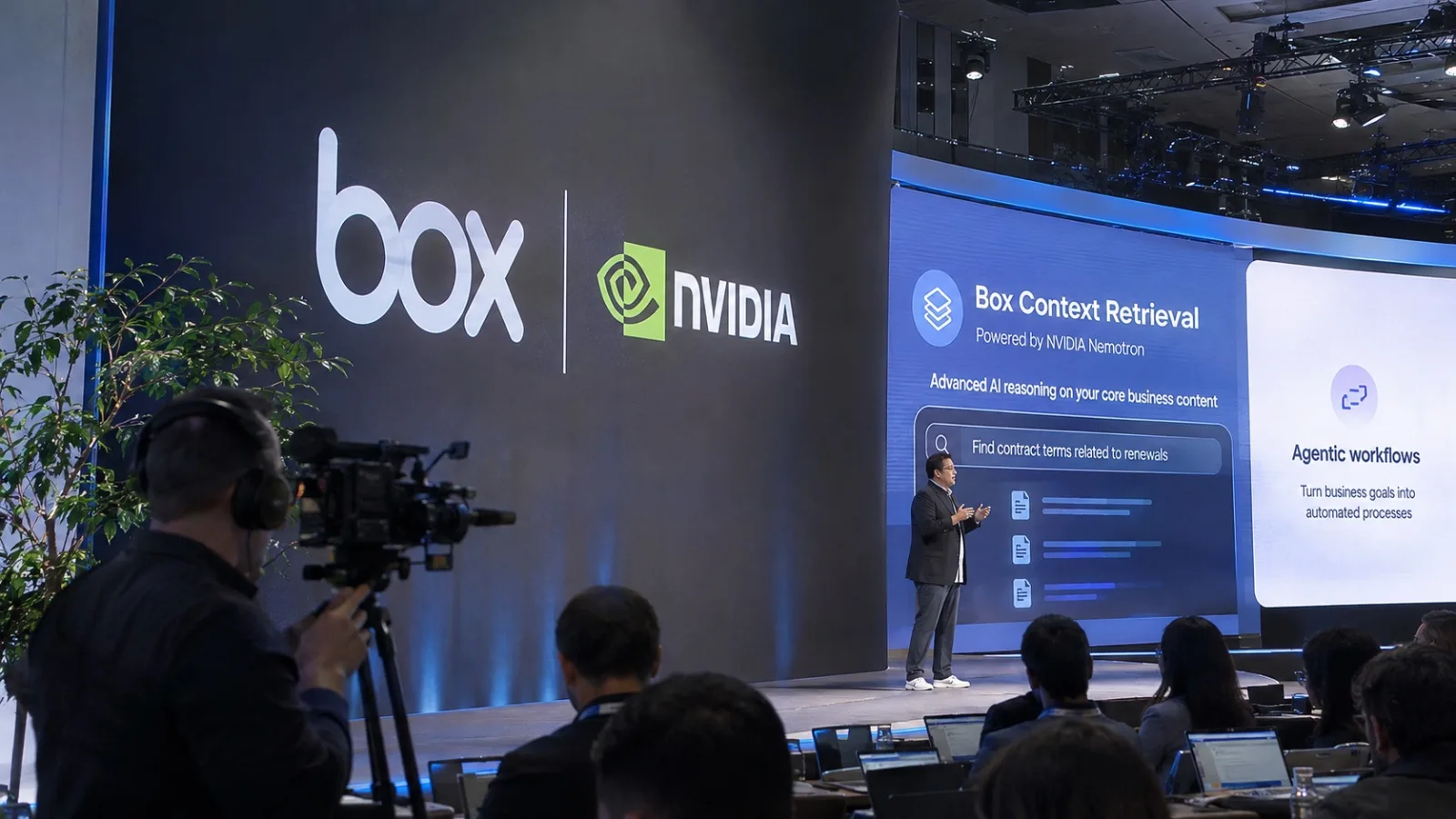
To address this, Box worked with NVIDIA to announce Box Context Retrieval. It is a search engine that uses NVIDIA's Nemotron Retriever technology to find the information a question needs in corporate documents and hand it to the AI.
Box pointed to possible gains in retrieval accuracy, fewer tokens used in AI processing, and faster responses. The figures are a 20% improvement in retrieval accuracy measured by Recall@5, a 90% cut in token use, and answers four times faster.
These are potential improvements cited by Box. They do not mean every customer's actual productivity will rise by that much. General availability of Context Retrieval is planned for early 2027.
Companies should tidy up their work before adopting AI
However smart the AI, it can produce a faulty procedure if it draws on outdated rules or conflicting manuals.
A sensible sequence in practice has three steps:
- Pick one repetitive, document-heavy process. Vendor onboarding, expense reimbursement and contract review are candidates.
- Do not tell the AI to reproduce the existing procedure. Give it the end goal, the rules that must be kept, and the conditions that require human approval, kept separate.
- Test against past cases and exceptions before going live. Measure missing-document rates, rework rates, approval errors and AI cost per task, not just processing time.
Prompt injection, where the AI treats instructions in a bad document as work orders, along with excessive access permissions and approval errors, are risks that need active management.
Box offers security controls that limit agents' access permissions and tool use. Added features to detect mass data exfiltration and account takeover are planned for later.
- Yes. However, it may require separate build-out work to consistently manage access permissions for company documents, integration with work systems, approval records, and security policies.
- No. The structure includes human review and approval. In particular, it is currently in beta release, so you need to distinguish between announced features and what is actually available.
- No. If rules are misinterpreted or exception handling is missed, costs can actually rise. You need to compare processing time, errors, and rework costs at the same level of quality and control.
- The two companies have different revenue structures. For NVIDIA, demand for AI computing and model infrastructure matters. For Box, what matters is how much AI features improve subscription revenue and customer retention. It is hard to judge which stock is more favorable based on this announcement alone.
What to watch
Insight Times Editorial Desk