Why Did Apple Cut Its Daily AI Budget From $300 to $200?

Apple's reported cap on AI tool spending may not signal retreat from AI. It may signal that companies now want to know what each result costs.
The 20-second read

1
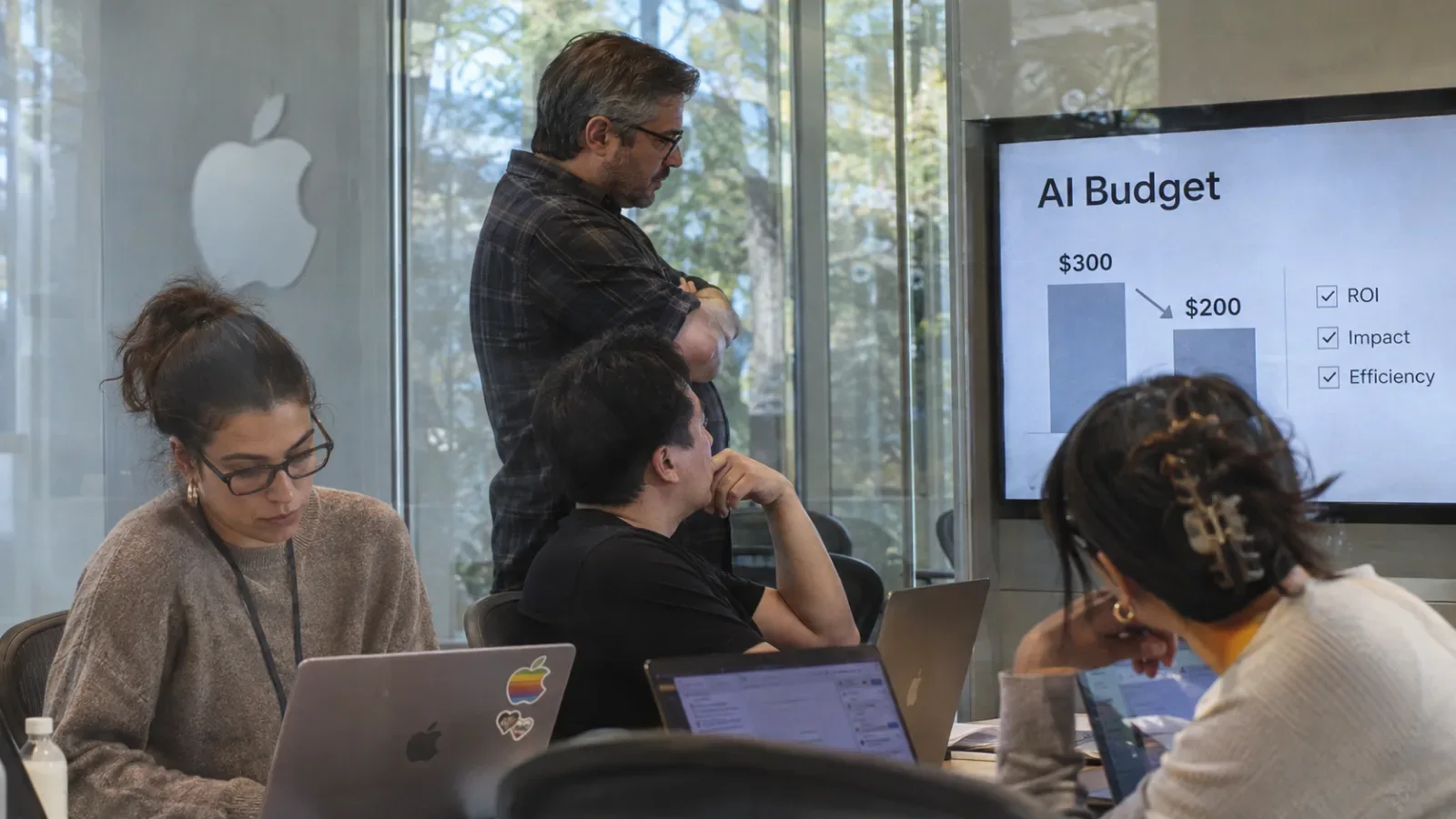
In October, Apple lowered the daily limit on AI tool use for some engineers from $300 to $200.
2
What matters is not the AI usage fee but the total cost per useful result, including verification and correction.
3
AI investors should watch rising usage together with why customers keep coming back, inference costs, and pressure to cut prices.

1. Does heavy AI use mean better work?

Companies urging employees to use AI aggressively is a familiar scene. Now a different question has appeared: "Did the results justify the cost?"

Reuters, citing Bloomberg on Nov. 4, reported that Apple cut the daily AI usage limit for some engineers in October. Some teams are weighing further cuts.

Daily limitNote
Some engineers, before$300AI tool budget
Some engineers, after$200About one-third lower

Some non-engineering groups already operate under a $100 daily limit, and a cut to $25 has been floated. Employees who need more must ask senior executives for an exception. Apple did not immediately respond to a request for comment.

As access to AI has grown, where to use it has become the more important question.

2. Work finished fast can still get expensive once it is rechecked

Say a task that took three hours is done with AI in 30 minutes. On the surface, that is a huge productivity gain. But if verifying and fixing the output takes two more hours, the time actually saved is 30 minutes.

Before: 3 hours. After: 30 minutes of AI work plus 2 hours of checking and fixing, or 2 hours 30 minutes in total.

The real time saved is 30 minutes. Efficiency only becomes clear once AI usage fees are counted as well.

The reverse can also hold. If an expensive AI model catches a critical error early and prevents major rework, the cost can be well justified. The same fee carries different value depending on the difficulty of the task and the cost of failure.

The goal is not to cut AI costs across the board. It is to lower the total cost of obtaining one useful result.

"How quickly did it generate?" is a weaker productivity measure than "How cheaply was the work finished?"

3. How companies may manage AI from here

The method is fairly simple. First, measure AI fees and verification time together for each type of task. Then assign cheaper models to easy work and higher-performance models to complex, important work. This is called model routing.

Next, set the success criteria before using AI. Results differ sharply depending on whether the aim is a first draft or a final output that passes verification. Set a default limit, but allow exceptions for work expected to deliver enough value.

There is little reason to read Apple's move as a failure of AI. It looks more like companies, once AI has spread through the organization, shifting their management focus from "how much do we use?" to "how much is left over?"

The next contest in AI adoption is not widening what employees are allowed to use. It is finding the best cost and quality for each task.
Does Apple's AI budget cut mean it is skeptical about using AI?
  • It would be wrong to conclude that. The report describes an adjustment to usage limits for some employees and teams. It can be read as an effort to manage cost and results rather than a retreat from using AI.
Will cheap AI models replace expensive ones?
  • For repetitive, easy tasks, cheaper models may have the advantage. For complex work where critical errors must be avoided, the higher cost of a high-performance model can be justified.
What should investors be wary of even when AI companies' revenue grows?
  • Even if customer usage grows, profitability can come under pressure if the price per task falls quickly or inference costs are not cut enough. Investors need to look at the cost structure along with usage.

What to watch

Why this matters to AI sellersThis shift matters for companies that sell AI too. Model companies such as OpenAI and Anthropic, and cloud companies such as Microsoft and Google, are all competing for customers' AI spending.
Usage growth is no longer enoughUntil now, rising usage was a good sign of growth. But once business customers start weighing spending efficiency, the questions change. Why does the customer keep using this service? How much does a single task cost?
Inference cost and model routingCompanies that lower inference cost, meaning the cost of generating an answer, may gain an edge in price competition. Technology that automatically picks the right model for each task also becomes important, because it can lower the customer's total cost while protecting the service company's profitability.
Total cost per taskDoes productivity still improve when the cost of human verification and correction is added to the AI usage fee?
Repeat customer useAfter the trial period, do businesses have a reason to keep choosing the same service?
Inference cost and priceCan AI providers keep profitability while cutting costs and facing pressure to lower prices?
Apple's AI cap is likely less a retreat from AI than a push to ask whether the money spent produced results.

Insight Times Editorial Desk

More by topic

Starting with this story's topics, then what readers are following now

Investor psychology, decision-making and books on investing

AAPL

This story's topic13 storiesSee all →

Brent at $109, the 10-year at 4.94%: the discount rate is beating the AI trade

Stocks fell for a fourth straight session on Sept. 10 as producer prices and energy costs pushed long yields toward 5%. After the close, Oracle showed AI demand is converting into signed contracts. The question is no longer demand. It is what multiple the market can pay for it.

Tech

AI's Next KPI Isn't Token Price. It's Cost Per Successful Task
Apple is cutting the cost of where inference happens, Anthropic is cutting the cost of running its models, and Snorkel AI shows money flowing into the data and evaluation layer that reduces failed attempts. All three point to one shift: AI competition is moving from bigger models to cheaper successful outcomes.

Tech

AI Was Supposed to Live in the Cloud. Apple Is Bringing It Back to the Desktop.

Four Mac Studios running a trillion-parameter model matters less than the economics behind it: heavy, repeated AI use can make owning compute cheaper than renting it by the token.

Tech

Why the iPhone Fold's Crease Barely Shows in the Middle

Apple's foldable engineering makes sense once you think about bookshelves, matte wallpaper, and window screens. Apple didn't erase the crease. It tricked force, light, and the camera into hiding it.

Tech

Apple's Real AI Bet Isn't a Chatbot. It's Siri Running Your Apps

Apple has stepped back from the race to build a smarter chatbot than ChatGPT. Instead it is building an "OS agent" that connects Mail, Photos, Calendar and hundreds of thousands of apps to actually finish tasks. 2026 is the first year that strategy gets tested as a product, not a keynote promise.

Tech

Why Great Stocks Like Apple, Amazon and Nvidia Fell 80% First

Long-term charts hide the fear that came before the gains. A big drawdown is no guarantee of future returns, and the test is whether the business case survives the fall.

Tech

Higher Rates Don't Break Big Tech's Business. They Reprice Its Future.

Microsoft, Alphabet, Apple and Nvidia are sitting on more cash than debt. What rates actually change is the discount rate applied to cash flows a decade out, and whether a cut is a soft landing or a recession signal.

Tech

HBM

75 storiesSee all →

Memory stacked next to the GPU.

AI Chip Peak Check: Demand Still Rising, Risk Building in 2027-2029 Supply and Funding

DRAM and NAND contract prices are still climbing and HBM suppliers hold the edge. Power shortages, AI financing costs and simultaneous memory expansion are the risks for later years.

Investing

The Real ASML Number Isn't the 3% Pop, It's the 30% Capacity Hike

ASML's rally isn't just an AI trade. Customers are already locking in 2027 tool slots, and ASML is raising Low-NA EUV capacity by roughly 30% to keep up.

Investing

Has Memory Peaked? Prices Are Cooling, but the Shortage Looks Set to Run to 2028

Price growth has slowed and consumer demand is already breaking. Server and HBM supply remains short, and Micron says more than 75% of its 2027 volume is already committed to customers.

Tech

2027 Isn't the End: Citi's Case for a Memory Supercycle Running to 2031

Citi says the memory shortage timeline is stretching again. If AI shifts from "train once" models to continual learning, HBM, server DRAM and enterprise SSDs could all fall short at the same time.

Tech

AI Chips Haven't Peaked. The Real Risk Sits in 2028 Supply

HBM and server DRAM shortages are now spreading into enterprise SSDs. The question isn't today's strength, it's how much new capacity these prices are pulling in and when it lands.

Investing

2027 Investing Needs Alignment, Not Prediction

A new investing book argues the hard part was never picking the next winner. It's staying aligned with where value and bottlenecks are moving while keeping old human weaknesses in check.

Investor Mind

The Next AI Chip Race Is About How Chips Connect

Applied Materials will lift its stake in Dutch equipment maker BESI from about 9% to 20%. The bet is less about control than about a new way to link chips.

Tech

A building that houses servers and networking gear and supplies them with powe…

Why the White House Swapped "AI" for "Super Intelligence"

Executive Order 14434 renames AI across the federal government without defining a new technology. The real story is about roughly $700 billion in capex, free cash flow and electricity.

Tech

US AI Data Centers Are Headed for 90GW. Gigawatts Now Matter More Than Dollars

Goldman Sachs expects US data center capacity to grow from 64GW at the end of 2026 to 90GW at the end of 2027. The AI race is moving from buying GPUs to building power plants and transmission lines alongside them.

Tech

AMD Crossed $1 Trillion, and the Market Started Looking at CPUs Again

AMD's stock topped a $1 trillion market cap for the first time. The rally isn't just about being an Nvidia alternative. It reflects a reassessment of AMD as a full-stack AI infrastructure vendor, one that bundles CPUs, GPUs and networking, as AI shifts from chatbots to agents and reignites data center demand for CPUs.</deck> <parameter name="oneline">As AI moves from chatbots to agents, the market has started counting the CPU sitting next to the GPU again.

Tech

Nvidia's Next Target After GPUs: Controlling What AI Agents Are Allowed to Do

OpenShell and Sentry are not about policing what an AI says. They are about controlling, at the server infrastructure level, which files and APIs an AI can touch, what it can execute, and who can actually pull the plug when something goes wrong.

Tech

Why Nebius Is Keeping Some 2027 AI Capacity Off the Shelf

Nebius mixes long-term contracts, short-term premiums and auctions. Holding back capacity pays only if the servers stay busy, and it is not yet clear the pricing will last.

Tech

DeepSeek's $15 Billion Raise: Model Makers May Feel It Before Nvidia Does

China's DeepSeek is closing a round about twice its original target. For US investors, the question is less the size of the check than where the money goes and whose profits it could erode.

Tech

Why Nvidia Is Happy to Help Make AI Models Nearly Free

Falling model prices can squeeze model makers. For Nvidia, the number that matters is the total volume of tokens generated worldwide and the compute that produces them.

Tech

NVDA

88 storiesSee all →

Amazon Goes After Nvidia's Strongest Moat, and It Is Software, Not GPUs

Amazon's open-source TorchNeuron aims to let existing AI code run on its Trainium chips. The contest comes down to the total cost of AI compute and the return on Amazon's $220 billion in annual capital spending.

Tech

The US-China Summit Didn't Erase Taiwan Risk for Chip Stocks

Washington's Taiwan policy held, but roughly $14 billion in arms sales is still on hold. For AI chip investors, the summit reads less like risk removed and more like a fragile balance extended.

Macro

AI's Next Bottleneck Is Money, Not Chips

Broadcom is lending Anthropic up to $42 billion, and Nvidia wants to build a $500 billion market for loans backed by GPUs. The AI race may turn on what rate buyers pay to borrow.

Tech

ASML Is Discussing 2030 Orders. How Long Can the AI Chip Supercycle Last?

Despite bubble worries, ASML sees equipment shortages through 2028. Investors should watch future production capacity, not just today's orders.

Tech

The Number That Matters More Than How Smart AI Gets

This week's AI models got stronger and cheaper at the same time. The chart long-term investors should watch isn't the weekly benchmark leader, it's the falling cost of finishing a task successfully.

Tech

AI Data Centers' Next Bottleneck: Getting Power From the Grid to the GPU

Securing a gigawatt of power does not mean a gigawatt reaches GPU compute. The next fight in AI infrastructure is happening inside the data center, over how little electricity gets wasted before it reaches the chip.

Tech

AI Raises Prices While It Is Being Built, and Lowers Them Only Once It Is Used

The buildout is pulling in chips, power, land and construction labor all at once, and that pushes prices up. The disinflation shows up later, if the tools actually change how work gets done.

Macro