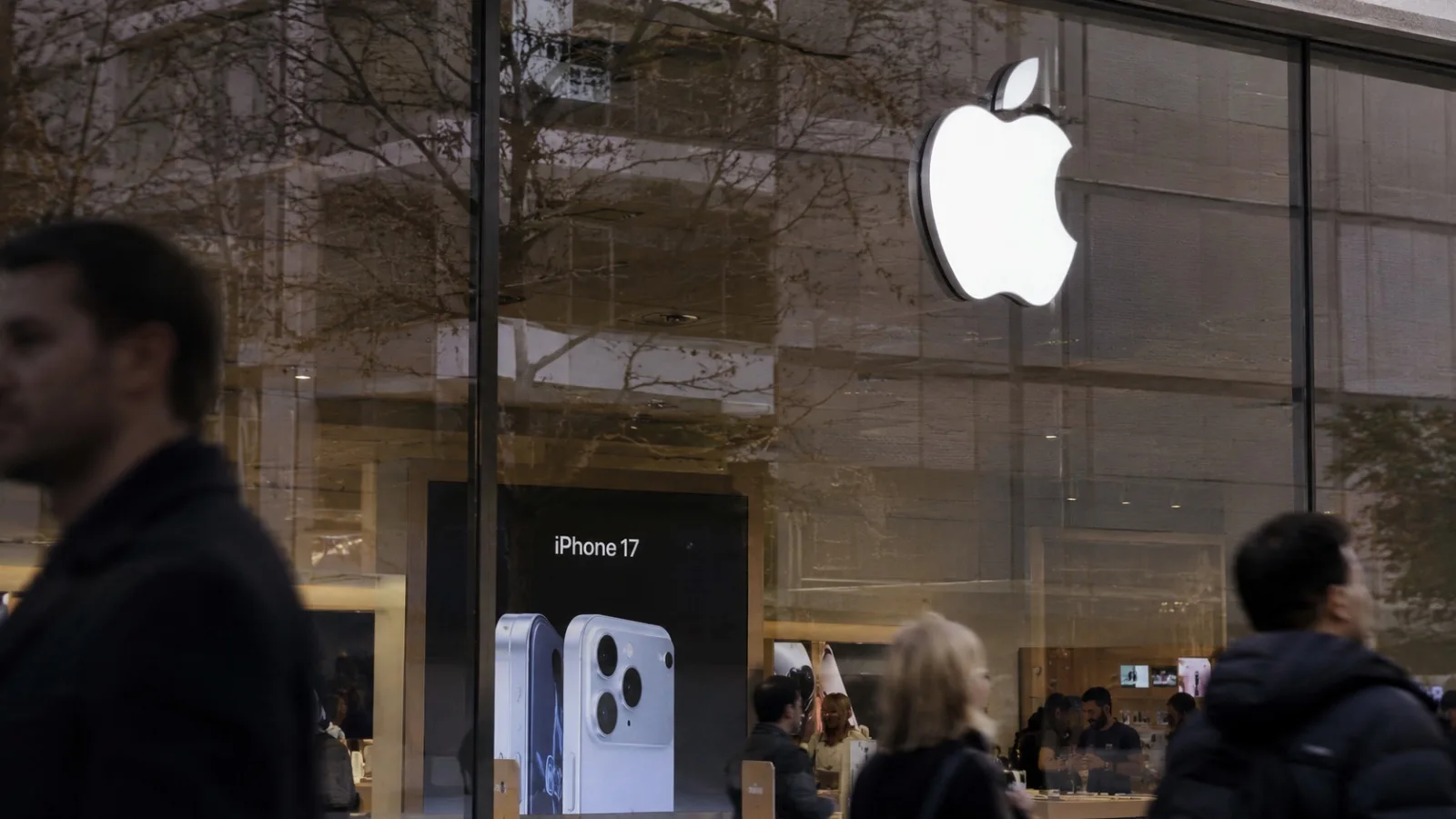
Apple Beat on iPhones. The Stock Fell Nearly 4% Anyway.

Revenue rose 12%, EPS topped estimates and China sales climbed 21%. Wall Street cared more about how much profit Apple keeps next quarter than about the growth it just posted.
The 20-second read

1
The results were strong. Apple's fiscal fourth-quarter 2026 revenue was $114.48 billion, up 12% from a year earlier. iPhone and Mac led the growth, and services revenue hit a record high.
2
The problem was margins. Gross margin was 47.9% this quarter, but the outlook for next quarter is 45% to 46%. Even excluding the tariff refund effect, further erosion in profitability is expected.
3
The yardstick for investment decisions has changed. As important as iPhone unit sales is how much of the rise in memory prices Apple can absorb, and how much of its Siri AI spending it can turn into actual profit.

Why Wall Street was disappointed by a good report

Apple topped market expectations in its fiscal fourth-quarter 2026 results, reported Nov. 2.

Revenue was $114.48 billion and earnings per share were $2.10. Both beat consensus estimates of about $113.4 billion in revenue and $1.99 in EPS.

iPhone revenue was about $57.58 billion, up 17% from a year earlier. Mac sales grew about 24%. China revenue rose 21% to about $17.5 billion. Despite worries that the China business was shrinking, sales there were recovering.

But China revenue fell short of the market's expectation of about $18.8 billion. iPad and wearables also were weak. Growth was strong, but not every business grew at once.

From 47.9% to 45.5%: the number the market watched

The most important figure in this report was not revenue. It was gross margin.

Apple gross margin comparison

MeasureGross margin
Fourth quarter, as reported47.9%
Excluding tariff refund effect46.9%
Midpoint of next-quarter guidance45.5%

The midpoint is 2.4 percentage points below the reported figure. The 46.9% is a simple calculation that removes a tariff refund effect of about 1 percentage point. The 45.5% is the midpoint of guidance for the next quarter.

The $2.10 in EPS includes $0.05 from a tariff refund. Without it, EPS was $2.05, still a solid result.

The problem is next quarter. Apple guided to a gross margin of 45% to 46% for October to December. The 45.5% midpoint is 1.4 percentage points below this quarter's margin excluding the refund.

Rising memory chip prices and AI-related costs are pressuring profitability. As a simple illustration, on $100 billion of revenue, a 1 percentage point drop in margin cuts gross profit by $1 billion.

For a company as large as Apple, a small change in margin means billions of dollars in profit.

Can services and AI offset higher costs?

Apple's services revenue hit a record of about $31.6 billion. But guidance for next-quarter services growth was 8% to 9%, below the roughly 10.7% the market had expected.

Services carry higher margins than hardware. If memory costs weigh on iPhone profitability, faster services growth could cushion the blow. This guidance did not show that kind of acceleration.

Siri AI operating and development costs add to the pressure. If AI drives iPhone upgrades and higher services usage, it could become a long-term growth engine. If costs rise first and monetization is delayed, profit growth could lag revenue growth.

Were Apple's results bad?
  • Both revenue and EPS beat market expectations.
  • The main concern is not last quarter's results but the profitability outlook for next quarter.
Excluding the tariff refund, were results worse than expected?
  • EPS excluding the refund effect was about $2.05.
  • It is unclear how much of the refund effect was built into the consensus, so comparing against a separate estimate calls for caution.
How much do rising memory prices hurt Apple?
  • Higher costs weigh on hardware margins.
  • The actual impact depends on component purchase contracts, inventory, product prices, and the share of premium products.
Isn't expanding AI investment good for Apple's long-term value?
  • It is positive if AI increases customers' device upgrades and services spending.
  • What matters is less the rise in spending itself than whether it generates additional revenue and profit.
Now that Apple's stock has fallen, is it a chance to buy the dip?
  • The quality of the earnings and the price of the stock should be judged separately.
  • It is worth comparing changes in the future EPS outlook, the bottom in margins, and the price-to-earnings ratio (P/E) together.

What to watch

Gross margin of 45% to 46%Check whether next quarter's actual margin comes close to the top of the guidance range.
Services revenue growth of 8% to 9%Judge whether the slowdown in this high-margin business is temporary.
Memory costs and product pricesWatch how much of the rise in component costs is absorbed through premium product sales and pricing policy.
China revenue and iPhone growthCheck whether China's 21% recovery and iPhone's 17% growth continue through the year-end peak season.
Monetizing Siri AICheck whether wider use of AI features leads to device upgrades and paid services revenue.
Apple's quarter was strong, but the market weighed next quarter's margin, hit by memory prices and AI costs, more heavily.

Insight Times Editorial Desk
More by topic

Starting with this story's topics, then what readers are following now

Investor psychology, decision-making and books on investing

Earnings Report

This story's topic36 storiesSee all →

SpaceX AI Revenue Jumps 830%, but Starlink Still Earns the Real Money

In its first quarter as a public company, SpaceX turned profitable and guided to as much as $40 billion in fourth-quarter capex. A possible Tesla merger adds another question for investors.

Investing

AMD Crossed $1 Trillion, and the Market Started Looking at CPUs Again

AMD's stock topped a $1 trillion market cap for the first time. The rally isn't just about being an Nvidia alternative. It reflects a reassessment of AMD as a full-stack AI infrastructure vendor, one that bundles CPUs, GPUs and networking, as AI shifts from chatbots to agents and reignites data center demand for CPUs.</deck> <parameter name="oneline">As AI moves from chatbots to agents, the market has started counting the CPU sitting next to the GPU again.

Tech

Lam Research Falls 12%: The Problem Is the Timing of AI Growth, Not Its End

Revenue up 54%, an operating margin above 40% and $3.2 billion in free cash flow were not enough. The selloff likely reflects worry that revenue arrives later than hoped.

Investing

TSMC Proved the AI Chip Boom Again. So Why Did the Stock Fall?

Third-quarter results beat expectations and fourth-quarter growth is guided higher. Investors should separate the substance of the AI investment cycle from market anxiety.

Investing

ASML Is Discussing 2030 Orders. How Long Can the AI Chip Supercycle Last?

Despite bubble worries, ASML sees equipment shortages through 2028. Investors should watch future production capacity, not just today's orders.

Tech

Tesla Energy's 13.7GWh Paradox: Expectations Ran Faster Than Deployments

Q2 deployments recovered but margins collapsed. Q3 set a record for deployments and still missed estimates. The issue is not the size of AI power demand but how fast it converts into Tesla revenue and profit.

Tech

Meta's Ad Engine Is Strong. Now It Has to Prove the Return on AI

Revenue grew 26% and adjusted operating income rose, but free cash flow was negative $2.12 billion. The third-quarter story is less about AI bulls versus bears than about judging the ad business and the giant capital spending program separately.

Investing

AAPL

This story's topic12 storiesSee all →

Brent at $109, the 10-year at 4.94%: the discount rate is beating the AI trade

Stocks fell for a fourth straight session on Sept. 10 as producer prices and energy costs pushed long yields toward 5%. After the close, Oracle showed AI demand is converting into signed contracts. The question is no longer demand. It is what multiple the market can pay for it.

Tech

Apple's $299 HomeView Is Unlikely to Move the Needle. The Services Math Might

Even 10 million units a year would add less than 1% to Apple's revenue. The real test is whether the smart display deepens iCloud+ and other recurring revenue.

Tech

AI's Next KPI Isn't Token Price. It's Cost Per Successful Task

Apple is cutting the cost of where inference happens, Anthropic is cutting the cost of running its models, and Snorkel AI shows money flowing into the data and evaluation layer that reduces failed attempts. All three point to one shift: AI competition is moving from bigger models to cheaper successful outcomes.

Tech

AI Was Supposed to Live in the Cloud. Apple Is Bringing It Back to the Desktop.

Four Mac Studios running a trillion-parameter model matters less than the economics behind it: heavy, repeated AI use can make owning compute cheaper than renting it by the token.

Tech

Why the iPhone Fold's Crease Barely Shows in the Middle

Apple's foldable engineering makes sense once you think about bookshelves, matte wallpaper, and window screens. Apple didn't erase the crease. It tricked force, light, and the camera into hiding it.

Tech

Apple's Real AI Bet Isn't a Chatbot. It's Siri Running Your Apps

Apple has stepped back from the race to build a smarter chatbot than ChatGPT. Instead it is building an "OS agent" that connects Mail, Photos, Calendar and hundreds of thousands of apps to actually finish tasks. 2026 is the first year that strategy gets tested as a product, not a keynote promise.

Tech

Why Great Stocks Like Apple, Amazon and Nvidia Fell 80% First

Long-term charts hide the fear that came before the gains. A big drawdown is no guarantee of future returns, and the test is whether the business case survives the fall.

Tech

HBM

75 storiesSee all →

Memory stacked next to the GPU.

Has Memory Peaked? Prices Are Cooling, but the Shortage Looks Set to Run to 2028

Price growth has slowed and consumer demand is already breaking. Server and HBM supply remains short, and Micron says more than 75% of its 2027 volume is already committed to customers.

Tech

AI Chip Peak Check: Demand Still Rising, Risk Building in 2027-2029 Supply and Funding

DRAM and NAND contract prices are still climbing and HBM suppliers hold the edge. Power shortages, AI financing costs and simultaneous memory expansion are the risks for later years.

Investing

US AI Data Centers Are Headed for 90GW. Gigawatts Now Matter More Than Dollars

Goldman Sachs expects US data center capacity to grow from 64GW at the end of 2026 to 90GW at the end of 2027. The AI race is moving from buying GPUs to building power plants and transmission lines alongside them.

Tech

2027 Isn't the End: Citi's Case for a Memory Supercycle Running to 2031

Citi says the memory shortage timeline is stretching again. If AI shifts from "train once" models to continual learning, HBM, server DRAM and enterprise SSDs could all fall short at the same time.

Tech

AI Chips Haven't Peaked. The Real Risk Sits in 2028 Supply

HBM and server DRAM shortages are now spreading into enterprise SSDs. The question isn't today's strength, it's how much new capacity these prices are pulling in and when it lands.

Investing

Memory Chip Supercycle: Not at Peak Yet, But 5 of 6 Warning Signs Are Flashing

Memory prices are still climbing, but the pace is slowing and PC and smartphone demand is starting to crack under the weight of higher chip costs. This looks less like a price peak and more like a profit plateau building toward the next supply cycle.

Investing

2027 Investing Needs Alignment, Not Prediction

A new investing book argues the hard part was never picking the next winner. It's staying aligned with where value and bottlenecks are moving while keeping old human weaknesses in check.

Investor Mind

A building that houses servers and networking gear and supplies them with powe…

Why the White House Swapped "AI" for "Super Intelligence"

Executive Order 14434 renames AI across the federal government without defining a new technology. The real story is about roughly $700 billion in capex, free cash flow and electricity.

Tech

Nvidia's Next Target After GPUs: Controlling What AI Agents Are Allowed to Do

OpenShell and Sentry are not about policing what an AI says. They are about controlling, at the server infrastructure level, which files and APIs an AI can touch, what it can execute, and who can actually pull the plug when something goes wrong.

Tech

Why Nebius Is Keeping Some 2027 AI Capacity Off the Shelf

Nebius mixes long-term contracts, short-term premiums and auctions. Holding back capacity pays only if the servers stay busy, and it is not yet clear the pricing will last.

Tech

DeepSeek's $15 Billion Raise: Model Makers May Feel It Before Nvidia Does

China's DeepSeek is closing a round about twice its original target. For US investors, the question is less the size of the check than where the money goes and whose profits it could erode.

Tech

Why Nvidia Is Happy to Help Make AI Models Nearly Free

Falling model prices can squeeze model makers. For Nvidia, the number that matters is the total volume of tokens generated worldwide and the compute that produces them.

Tech

The Number That Matters More Than How Smart AI Gets

This week's AI models got stronger and cheaper at the same time. The chart long-term investors should watch isn't the weekly benchmark leader, it's the falling cost of finishing a task successfully.

Tech

AI Data Centers' Next Bottleneck: Getting Power From the Grid to the GPU

Securing a gigawatt of power does not mean a gigawatt reaches GPU compute. The next fight in AI infrastructure is happening inside the data center, over how little electricity gets wasted before it reaches the chip.

Tech