TSMC's August number that matters is not 53%. It is September's threshold
TSMC posted its first month above NT$500 billion. The useful reading is not the growth rate but what September revenue has to be to hit the top of third-quarter guidance, and whether AI demand is still alive on the factory floor.
The number that matters is September's threshold, not 53.3%
TSMC's August revenue came in at NT$514.806 billion, the first time the contract chipmaker has cleared NT$500 billion in a single month. Add July's NT$467.580 billion and the two-month total is NT$982.386 billion.
TSMC's guidance for the third quarter is US$44.6 billion to US$45.8 billion. Applying the company's own exchange rate assumption of US$1 = NT$32, that works out to NT$1.4272 trillion to NT$1.4656 trillion. So September revenue of roughly NT$444.8 billion clears the bottom of the range, and roughly NT$483.2 billion reaches the top.
That gap is the story. September revenue could fall about 13.6% from August and TSMC would still meet the low end. To reach the high end, it has to hold at a level only about 6.2% below August. Calling a beat on the top end essentially locked in would be premature. But the risk of a miss has dropped sharply, and the path to the upper bound is wide open.
What Wall Street is reading is whether AI orders turn into actual production
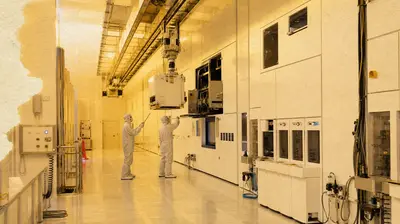
On its second-quarter call, TSMC said AI-related demand remained very strong and raised its 2026 dollar revenue growth outlook to slightly above 40% year on year. The August monthly number confirms that this outlook is not sitting in an order book. It is moving through fabrication and shipment.
It would be a stretch, though, to read the record as an AI story alone. Analysts in Taiwan have pointed to second-half smartphone shipments alongside AI and high-performance computing demand as drivers of the August figure. This number is what an AI demand cycle and a new mobile product cycle look like when they overlap.
A moderate positive for AI sentiment, a limited one for the wider market
The most useful thing an investor can do with this data is grade the strength of the signal. For TSMC itself, it is a direct positive that raises visibility into third-quarter results. For AI compute chip designers that rely on TSMC's leading-edge nodes, including Nvidia, AMD and Broadcom, it is supply chain confirmation. For ASML, Applied Materials and Lam Research, it reinforces the argument that advanced nodes and capacity expansion still need to be built out.
For HBM makers such as SK hynix, Micron and Samsung Electronics, it is an indirect positive. If AI accelerator shipments keep rising, HBM demand is supported alongside them. But one month of TSMC revenue cannot explain a recovery across commodity semiconductors, let alone a broad rally in US equities.
The proof came quickly. In US premarket trading on September 10, TSMC's ADR was weak despite the strong monthly revenue. That same day the market was dealing with much larger discount rate variables: Brent crude above US$100 and the US 10-year yield in the 4.8% range. Good fundamental news and a good same-day share price reaction are not the same thing.
INSIGHT TIMES VIEW
The investment value of this number lies less in the headline 53.3% growth than in the fact that the downside to results has narrowed.
For the AI bubble thesis to hold, production-side signals would eventually have to appear: order cancellations, slowing utilisation, softening leading-edge revenue, easing packaging bottlenecks. What is visible right now is the opposite. TSMC still sees strong demand for advanced nodes, and monthly revenue has set a new high.
Valuation is a separate question. If strong demand is already largely priced in, a good number is not a catalyst for the share price. It is material that defends the existing thesis.
Confidence level: medium to high. Confidence is high that AI infrastructure demand is holding up at the production stage. It is much harder to use this data alone to call growth rates out to 2027, or to judge how much further individual AI stocks can run.
What to Watch
FAQ
No. AI and HPC are the core growth axis, but new smartphone shipments and inventory building contributed as well.
No. Downside risk has fallen sharply, but hitting the top of guidance requires roughly NT$483.2 billion in September. That is well within reach, and the actual September number is still to come.
The direction is positive. TSMC does not break out revenue by customer, however, so Nvidia demand cannot be isolated from the monthly figure.
This data point alone is not enough. It raises confidence in the fundamentals, but it has to be read together with current valuation, interest rates, oil prices and the next round of guidance.
Insight Times Editorial Desk