SMH vs. SOXX: Which Chip ETF Suits Monthly Buying?
SMH leans on Nvidia and TSMC. SOXX spreads the weight. Both still carry the semiconductor cycle and rich valuations.
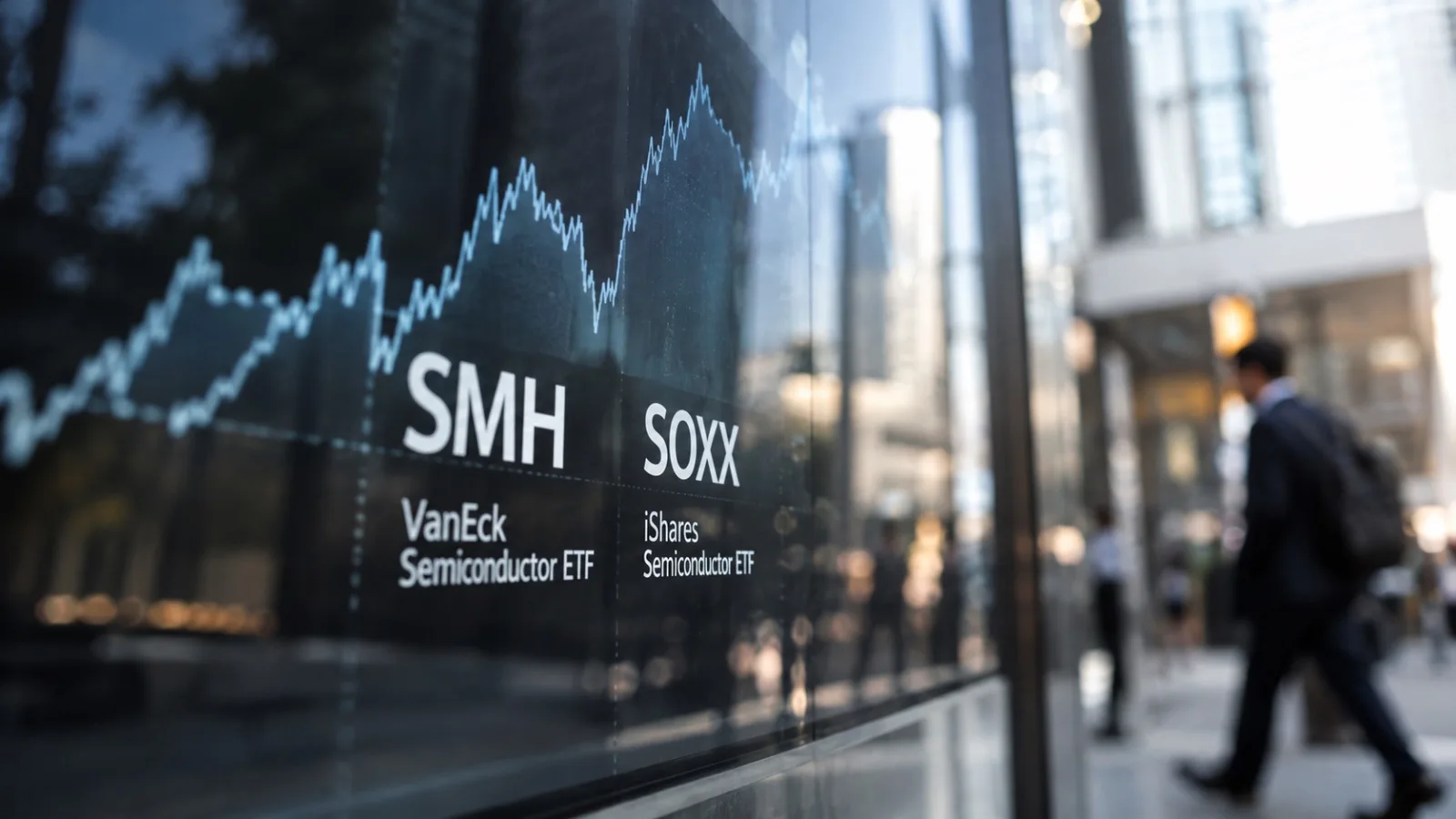
Buying the whole semiconductor industry instead of a single chip company cuts risk, but only by about half. The risk that one company fails shrinks. Exposure to the chip cycle and to high valuations stays.
Why SMH and SOXX are not the same chip ETF
SMH tracks the MVIS US Listed Semiconductor 25 Index. In its holdings as of Oct. 26, 2026, Nvidia was 20.57% and TSMC 9.66%, together 30.23%. The fund is relatively sensitive to the results of AI accelerators and advanced foundry work.
SOXX tracks the NYSE Semiconductor Index, which applies weight limits to top holdings and to the rest. Large-cap concentration is therefore lower. But the fund also holds cyclical names such as AMD, Micron and Intel. Diversification does not automatically mean defense.
| Item | SMH | SOXX | SOXQ |
|---|---|---|---|
| Index | MVIS US Listed Semiconductor 25 | NYSE Semiconductor | PHLX Semiconductor Sector |
| Annual expense ratio | 0.35% | 0.33% | 0.19% |
| Character | Concentrated in mega-caps | Diversified with weight caps | Access to the SOX index |
| Watch for | Dependence on key companies | Sector-wide declines | Different index from SOXX |
SOXQ is a cheaper alternative, but it is not a lower-fee version of SOXX. SOXX now follows the NYSE Semiconductor Index, not the Philadelphia Semiconductor Index. Even among semiconductor ETFs, index construction and stock weights differ.
Which ETF could fare better in 2027 to 2030
If AI server spending, high-bandwidth memory (HBM) and advanced packaging expansion hold up more strongly than expected in 2027 and 2028, SMH's concentration could help. If the pace of AI infrastructure spending slows, or expectations for Nvidia's stock cool faster than its earnings growth, SMH could also see a deeper pullback.
There is no basis for asserting that 2029 and 2030 will bring a memory glut and a clear payoff from SOXX's defensiveness. Falling memory prices would also hurt related companies inside SOXX. SOXX's relative advantage could grow only if a recovery spreads broadly across the industry. No path is a settled future.
What dollar-cost averaging does and does not solve
Suppose an investor buys $100 at a price of $100 and another $100 at $60. That comes to 2.667 shares. If the price recovers to $80, the holding is worth about $213.33, a 6.7% gain. Investing the full $200 at the first $100 price would leave $160. If prices had kept rising, though, investing everything up front would have won.
Vanguard's long-term research also found that when a lump sum is already available, investing it at once beat staged buying in about two-thirds of cases. Monthly investing out of each paycheck is different from deliberately delaying a lump sum already in hand. And an unsourced "200,000-run simulation" cannot establish a five-year return for dollar-cost averaging.
Four things to watch
- Big Tech AI capital spending: whether slower growth in spending turns into fewer orders.
- HBM supply and memory prices: how added supply affects prices and margins.
- Advanced foundry utilization: whether AI chip demand turns into real production and revenue.
- ETF concentration and valuation: changes in top-holding weights, P/E ratios and earnings forecasts.
Insight Times Editorial Desk