Same AI Boom, Three Different Ways to Make Money
NVIDIA defends a platform standard, Broadcom builds custom silicon for a handful of giant customers, and Micron converts a memory bottleneck into margin. Growth rates say less than how long each kind of scarcity lasts.
The illusion that all three are in the same business
NVIDIA, Broadcom and Micron are all AI chip winners.
But judge all three by the same logic and you will almost certainly miss what matters.
NVIDIA's customers buy a general-purpose AI computing platform.
Broadcom's customers buy custom accelerators and networking tuned to their own AI workloads.
Micron's customers buy the memory bandwidth that GPUs and ASICs need in order to perform at all.
The three share the same demand. They do not occupy the same place in the value chain.
NVIDIA owns the standard and charges a premium for it.
Broadcom co-designs with a small number of enormous customers and sells bespoke economics.
Micron converts the scarcity of constrained HBM and DRAM supply into price.
So the most important question when comparing the three is not the growth rate.
What kind of scarcity does each one hold?
How hard is that scarcity for a competitor to replicate?
And how long does it survive as margin?
Those three questions come first.
NVIDIA: still king, and the reason is the platform, not the GPU
NVIDIA's current numbers remain overwhelming.
FY2027 second-quarter revenue was $96.2 billion.
That is up 106% year on year.
Data center revenue was $89.0 billion.
Up 117% year on year.
GAAP gross margin was 75%.
On those figures alone, NVIDIA is still the most direct beneficiary of the AI supercycle.
But explaining NVIDIA's moat purely through GPU performance falls short.
CUDA.
NVLink.
Spectrum-X.
Rack-scale systems.
Inference software.
AI libraries.
Simulation.
Robotics.
All of it is connected.
What NVIDIA sells is not a single GPU. It is the de facto standard that says: build and run your AI on top of this.
While that standard holds, a rival cannot shake NVIDIA by shipping one cheaper chip.
What the customer would have to replace is not the chip. It is the development environment, the network, the operating tools and the entire data center design.
A 75% gross margin is not a trophy, it is a test
NVIDIA's 75% gross margin is a critical number.
For a semiconductor company to nearly double revenue while holding a margin like that means customers are still accepting a high premium.
But from an investor's seat, that figure reads less like a boast and more like an exam paper.
The margin is high not only because of technical advantage and an ecosystem moat, but because supply scarcity, urgent customer capex and high switching costs are all working at once.
So the first thing to watch from here is not the growth rate. It is the structural direction of gross margin.
Does it hold in the mid-70s once demand normalises?
Or does the price premium erode as custom ASICs, rival accelerators and in-house designs multiply?
NVIDIA's most important risk may not be AI demand disappearing.
The more realistic risk is that AI keeps growing while NVIDIA's economic share of it shrinks.
Vera Rubin is not a product refresh, it is a system shift
In its FY2027 second-quarter announcement, NVIDIA said the Vera Rubin platform had entered full production.
Racks are running at partners including CoreWeave, Google Cloud, Microsoft Azure, Oracle Cloud Infrastructure and Nebius.
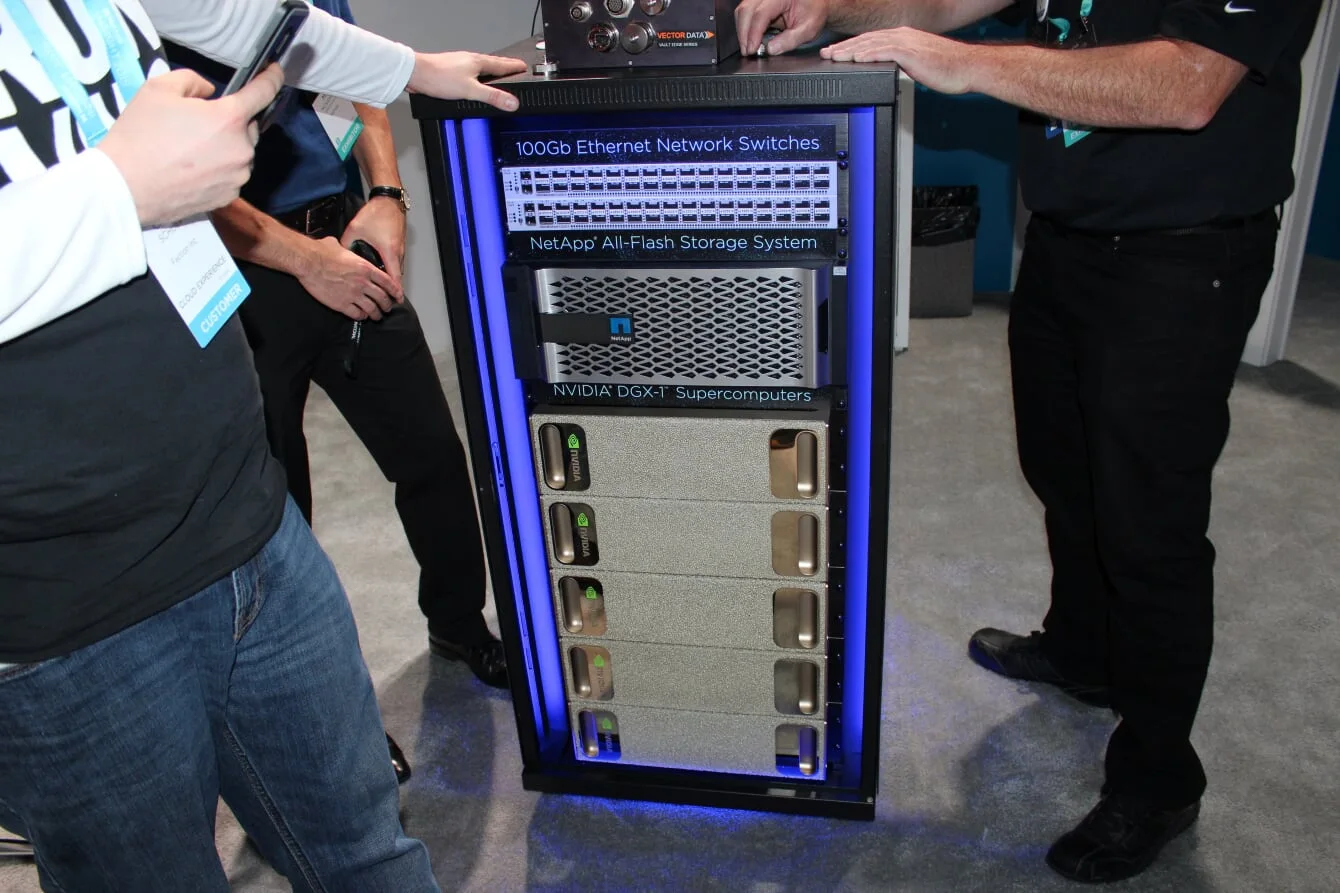
This matters because NVIDIA's unit of competition is moving up from the chip to the rack and the data center system.
GPU.
CPU.
NVLink.
Networking.
Optics.
Power.
Cooling.
Software.
The more tightly these are bundled into one system, the more the customer looks past the price of individual components and at the whole AI factory's time-to-deploy and cost-to-token.
If the strategy works, NVIDIA captures a far wider slice of the value chain than a chip supplier ever could.
Run it the other way, and rising system complexity also raises the incentive for customers to peel off some workloads into their own ASICs and an Ethernet ecosystem.
Vera Rubin widens NVIDIA's moat. It is also the platform that tests how high a system premium NVIDIA can keep charging.
Broadcom: not the company that beats NVIDIA, the company that expands the work NVIDIA is not needed for
Calling Broadcom an NVIDIA competitor is half right.
Broadcom's FY2026 third-quarter AI semiconductor revenue was $16.7 billion.
That is up 221% year on year.
It rose 54% from the previous quarter.
The company guided fourth-quarter AI semiconductor revenue to $21.7 billion.
The core of the business is custom AI accelerators and AI networking.
Hyperscalers have no reason to run every workload on a general-purpose GPU.
A specific model.
A specific recommendation system.
A specific inference service.
If a workload is stable and repeats billions of times a day, optimising the silicon around the job can win on both power and cost.
That is exactly where Broadcom is strong.
It co-designs with the customer.
It supplies not only the chip but the networking silicon.
So Broadcom's growth does not mean the AI market is abandoning NVIDIA.
It means the AI market is getting bigger, workloads are fragmenting, and the industry is entering a phase where not every job has to run on one kind of GPU.
Broadcom's real moat is the chip it builds with the customer
The custom ASIC business has a powerful advantage.
Once a design is embedded in a customer's large-scale AI infrastructure, swapping it out is hard.
The chip.
The software.
The network.
The data center layout.
Model optimisation.
All of it interlocks.
Broadcom runs that process alongside large hyperscalers.
So a successful project can generate very high economic value.
Broadcom's total FY2026 third-quarter revenue was $29.59 billion, with free cash flow of $13.7 billion.
That is 46% of revenue.
For the fourth quarter it guided total revenue of about $34.8 billion and a non-GAAP operating margin of about 66%.
Those numbers show Broadcom is not a low-margin commodity chip supplier.
But a strong moat comes bolted to a strong risk.
There are few customers.
Each project is large.
So a schedule change or a design shift at a single hyperscaler can swing results hard.
The most important risk indicator at Broadcom is not a rival's market share. It is customer concentration and the durability of design wins.
Why the GPU versus ASIC winner-take-all debate is the wrong argument
One question keeps coming up in AI silicon.
Will GPUs win?
Will ASICs win?
The question itself is too simple.
In computing, the optimal answer depends on the workload.
You need to develop new models fast.
The algorithms keep changing.
Generality and the software ecosystem matter.
In that environment, GPUs are strong.
Now flip it. The workload is stable.
Usage volume is enormous.
Power cost and cost per token have to be driven down to the floor.
In that environment, ASICs can win.
So the long-run structure looks less like GPU or ASIC and more like a division of labour between GPU and ASIC.
That is why NVIDIA and Broadcom can both grow as this market expands.
The investor's question should shift too: not who wins, but which workloads migrate to which architecture.
Micron: AI is rewriting the price tag on memory
Micron runs on entirely different logic.
FY2026 third-quarter revenue was $41.46 billion.
Set against $23.86 billion the previous quarter and $9.3 billion a year earlier, that is an explosion.
The Cloud Memory Business Unit posted revenue of $13.77 billion at a gross margin of 83%.
The Core Data Center Business Unit posted revenue of $11.52 billion at a gross margin of 87%.
For the fiscal fourth quarter the company guided revenue of about $50 billion at a gross margin of about 86%.
Those are hard numbers to believe from a memory company.
AI sits at the centre of the shift.
AI systems do not only increase compute volume.
To cut the time a GPU spends waiting for data, they demand far wider memory bandwidth.
HBM is no longer simple storage. It has become a component that determines AI computing performance itself.
Why HBM economics differ from ordinary DRAM
HBM is harder to build than conventional DRAM.
Multiple DRAM dies are stacked vertically.
They are connected with TSVs.
Packaging complexity is high.
Yield and thermal management are difficult.
Customer qualification takes a long time.
So you cannot explain this market through bit supply alone.
What customers want is not just capacity.
Bandwidth.
Power efficiency.
Packaging fit.
Qualification with the GPU.
All of it counts.
Which is why the supplier base cannot expand quickly.
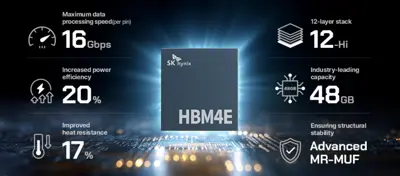
Micron is currently in high-volume shipment of HBM4 to major customer platforms and is supplying qualification samples to several customers.
HBM4E is in development, targeting mass production in 2027.
If each HBM generation raises the technical bar, some of memory's traditional commodity character may soften.
And yet Micron is still the most cyclical of the three
Here is the trap to watch.
Looking at an 86% gross margin and concluding that the memory industry has fundamentally changed.
High margins call in supply.
Micron expands capacity.
SK hynix expands capacity.
Samsung expands too.
Customers, meanwhile, want to diversify their suppliers.
Given time, supply grows.
Micron's roughly 86% gross margin outlook for the fiscal fourth quarter is a remarkable figure, but the company also expects the pace of price increases to moderate.
Full-year FY2026 capex is expected at about $27 billion.
In other words, the seeds of a classic cycle, in which high profitability manufactures new supply, are being planted at the same time.
Rather than concluding that AI has abolished the memory cycle, it is more realistic to say HBM has sharply raised the price band and the margin ceiling of that cycle.
The three moats erode at different speeds
NVIDIA's moat comes from software and system standards.
Once formed, that kind of moat weakens relatively slowly.
Broadcom's moat comes from co-design and design wins with hyperscalers.
The customer relationships run deep, but the business is sensitive to change in any single project.
Micron's moat comes from leading-edge process, HBM technology, production yield and qualification.
The technical barrier is high, but as capacity expansion proceeds the price premium can shrink quickly.
So even among identical-looking AI growth stocks, margin durability is not the same.
For NVIDIA, the platform premium is the crux.
For Broadcom, design wins and customer concentration are the crux.
For Micron, the balance of price and supply volume is the crux.
That is why an investor should not compare the three on the same P/E or the same growth rate.
What matters more than the revenue growth line
As of 2026, all three sets of numbers are strong.
NVIDIA data center growth of 117%.
Broadcom AI semiconductor growth of 221%.
Micron quarterly revenue more than four times the year-earlier figure.
None of those rates lasts forever.
Which makes the structure after growth the more important thing now.
Can NVIDIA hold a gross margin in the 70s once growth slows?
Can Broadcom add new custom accelerator customers and dilute its concentration in a few?
Can Micron sustain structurally high HBM margins after the capacity build-out lands?
The answers to those questions will probably do more to set long-term shareholder returns than the headline growth.
Who is safest, and who has the biggest upside
Picking one of the three as "the best" is meaningless.
The investment cases are different.
NVIDIA is a bet that the platform standard holds.
Broadcom is a bet that hyperscalers keep raising the share of their own silicon.
Micron is a bet that AI memory demand grows faster, for longer, than capacity expansion.
Of the three, the strongest economic moat today sits with NVIDIA.
The fastest new growth axis is Broadcom's custom AI silicon.
The highest cycle leverage sits with Micron.
And the risks do not line up in exactly that order.
For NVIDIA, valuation and the durability of the platform premium are what matter.
For Broadcom, customer concentration matters.
For Micron, the supply cycle matters most.
So in a portfolio these should not sit in one "AI semiconductor" basket. They are three assets with three different risk factors.
Sources
- NVIDIA FY2027 Q2 Results
- Broadcom FY2026 Q3 Results
- Micron FY2026 Q3 Results
Insight Times Editorial Desk