AI's next bottleneck is not silicon. It is electricity
GPUs were scarce, then HBM and advanced packaging. Now the constraint is power delivered to the right place at the right time, and the ability to pull heat out of racks drawing more than 100kW.
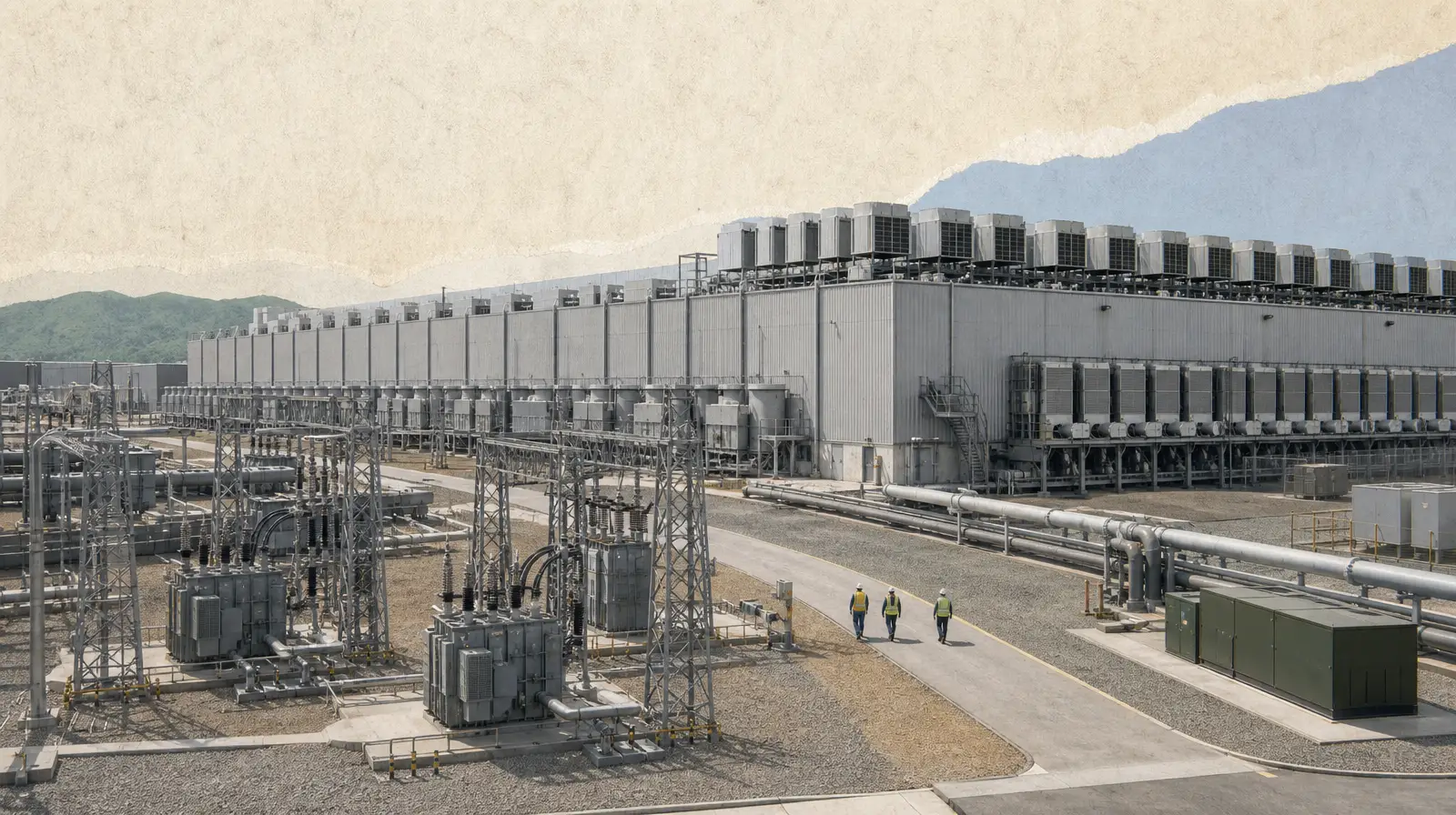
The bottleneck never sits still
Watch the AI industry long enough and you notice the constraint keeps moving.
In 2023 the problem was GPUs. How many NVIDIA H100s a company could get its hands on determined how fast it could grow.
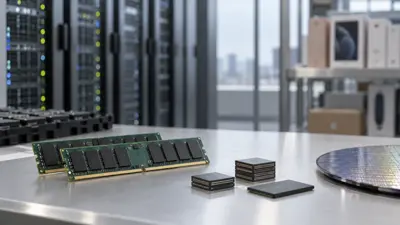
Then came HBM and advanced packaging. Having the GPU was not enough if memory and packaging supply ran short.
Now, in 2026, the words that come up far more often are power and cooling.
The point is not the lazy version of the story, that America is running out of electricity.
Power can exist and still fail to arrive at the right location, at the right moment, at the right quality.
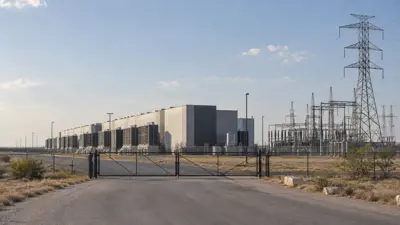
An AI data center wants tens of megawatts. Large projects want hundreds of megawatts, or gigawatts. Transmission upgrades, new substations, transformer procurement and interconnection approvals can each take years.
So the new bottleneck is less about total energy than about time to power: when the electricity actually shows up.
Better GPUs make the power problem worse, not better
Intuitively, more efficient chips should ease the strain.
In AI systems, the opposite happens.
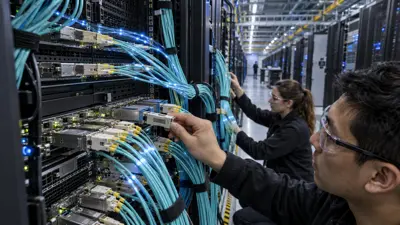
Each GPU gets more powerful, more accelerators are packed into a single rack, and high-speed interconnects tie them together. Power density per rack climbs fast.
According to Schneider Electric, a traditional data center rack typically ran somewhere around 10 to 20kW. AI systems have already passed 100kW. GB200-based designs sit at roughly 132kW, GB300 at roughly 142kW, and the newest Vera Rubin generation pushes requirements as high as about 246kW.
Those numbers are not just bigger numbers.
They mean pushing close to ten times the power into the same floor area as before.
And almost all of that power ends up as heat.
The problem of getting electricity in and the problem of getting heat out grow together.
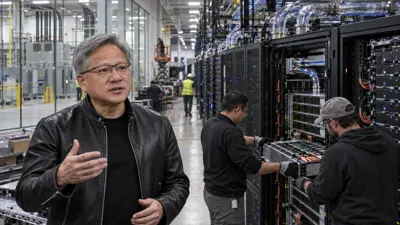
Which is why an AI data center is no longer a building that holds a lot of servers. It is a power and thermal management system that happens to contain computers.
Why air cooling runs out of road
Conventional data centers were built around air. Cold air in, hot air out.
Past roughly 100kW per rack, air alone cannot move the heat.
Hence the rapid spread of direct-to-chip liquid cooling, which brings coolant close to the silicon and pulls heat away at the source. Liquid carries heat far more effectively than air does.
The catch is that liquid cooling is not a box you bolt on.
Piping. CDUs. Pumps. Heat exchangers. Water chemistry. Leak detection. Facility controls. Integrated operation of power and cooling together.
The whole design of the building changes.
In AI infrastructure, cooling is no longer an accessory hanging off the back of a server. It is production equipment, because it determines how much compute you can actually place in a rack.
Power is capacity, not a cost line
In a traditional data center, electricity was mostly an operating expense.
In an AI data center it means something else.
However many GPUs you own, you cannot produce tokens without power.
So the megawatts and gigawatts an operator has secured are not just the size of a utility contract.
They are future AI production capacity.
The analogy is wafer capacity in semiconductors.
A company that can reliably draw 100MW and a company that can draw 1GW differ, over time, in the sheer volume of AI output they can generate.
Seen this way, the core assets of the industry change too.
GPUs. HBM. Networking. Land. Substations. Grid interconnection. Generation. Cooling infrastructure.
These become a single integrated production system.
Which is why the idea that a great model is all you need to win keeps looking less realistic.
The IEA numbers point to local bottlenecks, not a global shortage
The IEA projects global data center electricity consumption reaching about 945TWh by 2030, roughly double the 2024 level.
That is about 15% annual growth.
Within it, power consumption by AI-accelerated servers is expected to grow about 30% a year.
Read alone, those figures make it sound as if data centers will swallow the world's electricity.
But in the IEA's base scenario, data centers account for a little under 3% of global electricity consumption in 2030.
So framing this as "the world is running out of power" gets it wrong.
The real issue is concentration.
Virginia. Texas. Ohio. Arizona. Established hubs such as Northern Virginia.
Grids do not operate on national averages. When large AI campuses cluster in one region, that region's substations, transmission lines and generation plans come under pressure quickly.
The essence of the AI power problem is regional grid availability, not global energy supply.
And in 2026, you also have to verify the demand is real
As the power constraint tightened, a new problem appeared: ghost demand.
Developers file large interconnection requests with several grids at once, then build only some of the projects.
Reuters reported in September 2026 that US data center interconnection requests had swelled past 700GW nationwide, more than ten times current estimated total US data center power use.
Texas eventually paused new data center connections and tightened its process for verifying a project's actual financing and ownership structure.
That shift matters.
If utilities mistake phantom or duplicated requests for real demand and build generation and transmission against it, the cost lands on consumers.
So when you look at AI power demand from here, the announced gigawatt figure is the least useful number. Look instead at committed capital, confirmed interconnection, site control, equipment orders and construction progress.
In AI infrastructure as elsewhere, announced demand and operating demand are different things.
Vertiv's results show how far power and cooling have come
Vertiv is one of the main suppliers of power and cooling infrastructure to AI data centers.
Second-quarter 2026 revenue was $3.274 billion, up 24% year on year.
Adjusted operating profit rose 51%, with an adjusted operating margin of 22.6%.
The company raised its full-year 2026 organic sales growth guidance to roughly 31%.
That is not a growth rate that looks like a traditional industrial equipment company.
It means AI server investment is flowing straight through into orders for power and thermal management gear.
The more telling signal is the M&A.
In September 2026 Vertiv agreed to acquire Utility Innovation Group for up to $2.6 billion. The target works in microgrids, power controls and specialty switchgear.
Why does a cooling company buy a microgrid company?
Because customers no longer ask for a cooling unit.
They want to secure power, connect on-site generation and batteries, and integrate distribution and cooling inside the building, all so they can switch on sooner.
It is about as direct a piece of evidence as you will find that the bottleneck is moving from cooling to the grid, and from the grid to self-supply.
Why Eaton became an AI stock
Eaton looks more like a conventional industrial.
Switchgear. Distribution equipment. Power management. Electrical safety. The various power infrastructure that ties into UPS systems.
It is not the name that shows up in glossy AI investment coverage.
But every new data center needs this equipment.
Eaton's second-quarter 2026 revenue was $8.5 billion, up 21% year on year. Organic growth was 14%. Backlog in the Electrical segment rose 43% year on year. The company names data centers as one of its core growth drivers.
Here is the interesting part of the AI story.
It began as a software revolution, and the money is landing in transformers, distribution gear and cooling systems.
That is the classic pattern of an industrial buildout. The biggest beneficiaries are rarely only the most visible technology companies.
The AI data center is turning into something between a utility and a factory
As high-density AI campuses scale, the operating model changes.
Relying on the grid alone gets shakier, because interconnection can take three or four years while the building itself goes up faster than that.
So the options arrive all at once.
On-site gas turbines. Fuel cells. Battery storage. Solar plus storage. Microgrids. Long-term power purchase agreements. The conversation about nuclear and SMRs.
The data center stops being a passive consumer of electricity and starts designing its own energy system.
Push that further and a large AI campus looks less like a building full of servers and more like a small industrial park.
Generation. Transformation. Distribution. Cooling. Compute.
All integrated on one site.
Which means one measure of a hyperscaler's competitiveness may soon be not its headcount of software engineers but its ability to procure energy and execute infrastructure projects.
Power infrastructure may stay short longer than semiconductors do
GPU supply can rise if you build more fabs.
HBM capacity arrives in time as well.
Grids move differently.
Large transformers. High-voltage transmission lines. Substations. Power plants. Regulatory approval. Local consent. Environmental review.
These projects take years, sometimes more than a decade.
An AI chip's product cycle is one to two years. The investment cycle for power infrastructure is far longer.
That mismatch of timelines is the whole story.
AI companies want to deploy more powerful GPUs every year. The grid does not change at that speed.
So over the medium term, the harder question may not be whether you can get GPUs, but whether you can plug them in and actually turn them on.
When people say the bottleneck in the AI supply chain is moving from semiconductors to power infrastructure, this timeline gap is what they mean.
The production function has to include electricity
Until now, analyzing an AI company meant looking at model performance, GPU counts and user numbers.
Those variables are no longer enough.
Megawatts that can actually run compute. The date those megawatts become available. Power density per rack. PUE. Cooling method. Power cost. Utilization. Share of self-generated power.
These numbers determine AI production capacity.
The production function is no longer GPUs times model.
It is power times grid times cooling times compute times model times demand.
Drop any one term and the system stops.
The larger the industry grows, the more physical infrastructure matters relative to software.
AI appears to live in the cloud. Underneath the intelligence sit transformers, copper, coolant and generators.
To see the next bottleneck, look away from the screen and outside the data center.
Insight Times Editorial Desk