AI's Bottleneck Isn't One Chip Anymore
Huawei's AI accelerator prices jumped because of HBM costs, Amazon built a deal worth up to $60 billion with Qualcomm, and OpenAI pulled financial data and workflows into ChatGPT. Three different stories point to one shift: AI investment is no longer just about buying more GPUs.

The 20-second brief
It wasn't the GPU that pushed AI chip prices up. It was memory.
The clearest signal came out of China. According to Reuters, Huawei raised the customer quote for its Ascend 950DT accelerator card, due to launch in the fourth quarter of 2026, to 250,000 yuan, or roughly $37,255 and up. That is 20 to 50 percent higher than a quote given just two months earlier, depending on contract terms. Cambricon's next-generation 690 chip saw a 20 to 30 percent price increase as well, and MetaX and Iluvatar CoreX made similar moves.
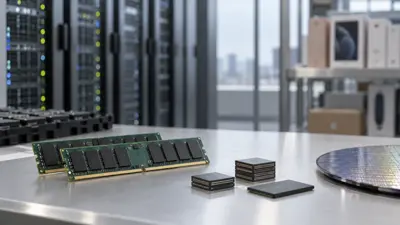
The cause is not a sudden leap in chip design performance. It is the cost of sourcing HBM, or high bandwidth memory. Because of US export controls on advanced HBM, Chinese chipmakers have come to rely on unofficial distribution channels for some of their supply, and Reuters reporting found cases where buyers pay several times the normal overseas procurement price through those channels. Reading the 20 to 50 percent increase seen in China as a global HBM price trend would be a mistake.
The more important shift lies elsewhere. Memory used to be a component you attached as needed. HBM today is a system resource a GPU must secure to perform at its rated capacity. As AI models grow larger, context windows lengthen, and the number of inference tokens and concurrent users rises, how fast you can feed data to a chip matters as much as how fast the chip computes.
That is also why SK Hynix, citing the possibility of tight memory supply through 2030, is investing more than $4 billion in Indiana to prepare next-generation HBM mass production for the second half of 2029. Micron is already mass-producing 36GB, 12-layer HBM4 for Nvidia's Vera Rubin platform. Memory is once again a cyclical industry, but this cycle turns on the volume and bandwidth of memory packed into a single AI system, not on PC or smartphone shipment volumes.
Amazon isn't dropping Nvidia. It's expanding its computing menu.
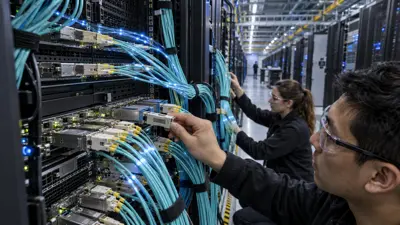
The second signal is the partnership between Qualcomm and Amazon. Qualcomm has structured a deal under which Amazon could purchase up to $60 billion worth of AI data center chips and related products under a long-term agreement. The two companies will develop custom silicon for AI inference across multiple generations, and will also work together on 1.6T optical interconnect technology that moves data inside data centers.
The conclusion that "the Nvidia era is ending" is premature. Amazon continues to supply Nvidia GPUs while also growing its own silicon lineup, including Trainium, Graviton and Nitro. Amazon has disclosed that its custom silicon business already has an annualized revenue run rate above $25 billion. That figure covers the entire business, including CPUs and networking gear, not just pure AI accelerators.
That is precisely the point. As the AI infrastructure market grows, it becomes uneconomical to run every task on the most expensive general-purpose GPU. Training, large-scale inference, real-time response, agentic tasks, CPU processing and data movement each carry different cost structures. Hyperscalers are trying to place each workload on the cheapest, most efficient chip available for that job.
So the total addressable market for AI semiconductors is broader than "how many GPUs get sold." ASICs, CPUs, HBM, switches, optical transceivers, interconnects and advanced packaging are bundled into a single system. Nvidia remains at the center, but as the market itself widens, the periphery is growing into independent businesses worth tens of billions of dollars.
The money spent on infrastructure has to eat into professional labor hours to pay itself back
The third signal did not come from hardware. It came from finance. On September 10, OpenAI unveiled ChatGPT for Financial Services. Morgan Stanley and Evercore participated as design partners, and premium data from LSEG News, PitchBook and Daloopa is built into the product by default. The target tasks are specific: company analysis, LBO modeling, screening acquisition candidates, earnings analysis and building pitch books.
This shift matters far more than "a financial firm is using ChatGPT." Until now, generative AI has functioned mostly as a general tool that modestly boosts a single employee's productivity. Vertical AI does the opposite. It embeds an industry's data, regulations, document formats and approval processes directly into the product. That expands the budget line AI draws from, beyond generic software subscriptions and into research data, analytics tools, junior staff's repetitive work, and outsourcing costs.
The central question for AI infrastructure investment shifts here too. It is no longer "how many more GPUs will sell" but "whose costs will the tokens that GPU produces replace." In industries like finance, where labor costs run high, data is expensive, and repetitive document work is abundant, that answer is coming into sharper focus.
Insight Times Editorial Desk