The Maturity Wall: Why 2027 Is When Cheap Corporate Debt Comes Due
Trillions in pandemic-era bonds refinance into a higher-rate world starting in 2027, and the AI buildout is riding the same wave of debt.

High rates hit stock prices first. They hit earnings later.
When rates rise, the discount rate on growth stocks rises with them, and P/E multiples fall. That part of the story is familiar. But it's only half of what higher rates actually do.
Companies aren't borrowing all their money at today's market rate. A company that issued 2-3% long-term fixed-rate bonds during the pandemic and the era of near-zero rates keeps paying that same coupon even if market rates top 5% in 2026. That's why many companies can hold up better than expected in the early stages of a high-rate cycle.
The problem is maturity. According to a Reuters analysis of LSEG data, roughly $4.3 trillion in US non-financial corporate bonds come due between 2027 and 2031. Annual maturities climb from about $572 billion in 2027 to roughly $1.03 trillion in 2030. If market rates stay elevated, cheap old debt gets replaced with expensive new debt, year after year.
2027-2031 maturities: $4.3 trillion in US non-financial corporate bonds.
2027 maturities: $572 billion.
2030 maturities: $1.03 trillion — the year annual maturities cross the trillion-dollar mark.
What happens when $10 billion at 3% becomes $10 billion at 6%
$10 billion x 3% = $300 million a year. $10 billion x 6% = $600 million a year.
Even if revenue, products and operating income stay exactly the same, annual interest expense rises by $300 million. Pretax income and free cash flow fall by the same amount. This is refinancing risk in its plainest form.
What matters is that this shock doesn't arrive all at once. Companies with long, laddered maturity schedules buy themselves time. Companies with heavy short-term and floating-rate exposure get hit fast. That's why looking at a single number like "$50 billion in total debt" tells you less than looking at how much comes due in 2027, how much in 2028, and how much in 2029.
Stage 1: Valuation Compression. Market rates rise, discount rates rise, the present value of future cash flows falls, and P/E multiples get squeezed.
Stage 2: Earnings Compression. Low-rate debt matures, gets refinanced at higher rates, interest expense rises, and EPS and free cash flow get squeezed.
Not all debt is created equal, and the gap is widening
Not every company faces the same shock. Reuters reports that high-yield bond maturities jump from about $68.5 billion in 2027 to $314.1 billion in 2029. Investment-grade maturities also rise over the same period, from $437 billion to $512.6 billion, though the increase is far more moderate.
PIMCO's view: most investment-grade and high-yield issuers should be able to absorb higher refinancing costs, but the lowest-rated borrowers could face far more pressure. Its analysis found that CCC-rated bonds maturing in 2027-2028 could see coupons roughly double if refinanced at current market yields.
| What to watch | Why it matters | The favorable direction |
|---|---|---|
| Debt maturity schedule | Shows exactly when higher rates hit the income statement | Less concentration in near-term maturities is better |
| Net debt / EBITDA | Measures debt load against cash-generating power | Lower is more defensive |
| Interest coverage | Shows how many times operating income can cover interest | Higher means a wider safety margin |
| Average interest rate | Gauges how much cheap legacy debt remains | Slower increases are better |
| FCF and capex funding | Distinguishes self-funded investment from debt-funded investment | Higher share of internal cash cuts rate sensitivity |
AI's second act may be a financing problem, not a technology problem
The main investors in AI's first act were cash-rich giants: Microsoft, Alphabet, Amazon and Meta. They could fund much of their GPU and data center spending out of operating cash flow and strong balance sheets.
But as AI infrastructure scales up, funding is shifting toward data center developers, neoclouds, utilities, private credit, project financing and corporate bonds. Goldman Sachs expects total debt issuance by hyperscalers — including Amazon, Alphabet, Meta, Microsoft and Oracle — to reach $420 billion in 2027, a 60% increase over its 2026 estimate.
Bond markets are already pricing this differently. Reuters reports that spreads on AI-linked issuers run around 115 basis points, versus roughly 78 basis points for the broader investment-grade market. That gap doesn't necessarily signal an imminent credit blowup. It more likely reflects bond investors demanding extra compensation as supply grows very fast while visibility on returns gets harder to pin down.
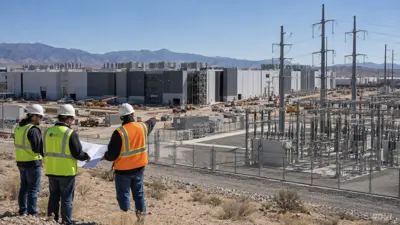
Project Jupiter illustrates the structure. A data center in New Mexico leased by Oracle is tied to roughly $18 billion in loans. As concerns grew over power supply and permitting delays, that loan traded below face value. When a data center's launch slips, rental income and revenue recognition get pushed back too, but the cost of capital doesn't wait.
Insight Times Editorial Desk