September or December? The Fed's next hike is bigger than one CPI print
August payrolls came in strong and July's job losses vanished in revision. The Fed's problem is no longer a collapsing labor market. It is how much to trust the recent cooling in prices.
Inflation is still not at 2 percent
- Trump's pressure for rate cuts and the November midterms are real political variables. But there is not enough basis to declare that "the Fed will avoid the October meeting because it sits right before the election." What the Fed actually watches is not the political calendar but the balance of policy risk created by inflation, employment, inflation expectations and financial conditions.
The outlook for US interest rates has turned difficult again. Only a few days ago, the case for a September hold was alive. Fed Governor Christopher Waller said he leaned toward keeping rates unchanged in September if prices kept cooling, and the market-implied probability of a hike slid toward 50 percent.
Then the August employment report, released on September 4, shook the board again.
Nonfarm payrolls rose by 162,000. That was nearly three times the roughly 56,000 the market expected. The unemployment rate held steady at 4.1 percent and the labor force participation rate rose to 61.6 percent. Average hourly earnings rose 0.3 percent from the previous month and 3.1 percent from a year earlier.
On the surface this is the combination of "strong jobs, no overheating in wages." For the Fed, those are the most awkward numbers of all. The reason to avoid a hike out of recession fear has shrunk, but nothing here says wage-driven inflation has exploded.
The more important number is not the headline 162,000.
July payrolls were originally reported as a decline of 23,000. In this report they were revised to a gain of 21,000. June and July combined were revised up by 55,000. The narrative that existed a month ago, that the labor market had suddenly buckled, has largely disappeared.
That revision changes what the September meeting is about.
The reason for the Fed not to raise rates now has to shift from "employment is weak" to something closer to "the recent cooling in prices is convincing enough that we can wait a little longer."
The July PCE price index, the Fed's preferred gauge, rose 3.7 percent from a year earlier. Core PCE, which strips out food and energy, was 3.3 percent. On a monthly basis, both headline and core rose 0.2 percent.
The key point is that the monthly numbers and the annual numbers are telling different stories.
Look only at the past month or two of monthly rates and you can build an argument that inflation is settling. But on a 12-month basis, prices are still clearly above the Fed's 2 percent target. Chair Warsh in particular cited the 3.7 percent PCE figure directly at Jackson Hole and judged that "inflation is still too high."
The standard he set out was equally clear. He needs confidence that underlying inflation is moving toward the target "clearly and fast enough." If it is not, the logic runs, the Fed has more work to do.
That makes the next CPI print very important. But framing it as "one CPI report decides everything" is far too simple.
In the same speech, Warsh said policymakers should not rely on isolated data points and that the trend matters most. The September decision is likely to be a meeting that bundles the August CPI and PPI, the upward revisions to employment, energy prices, inflation expectations and financial conditions into a single judgment.
Immediately after the August jobs release, fed funds futures priced the probability of a 25 basis point hike in September at roughly 60 percent. Expectations had jumped to the mid-60s right after Jackson Hole, fell back toward 50 percent on Waller's comments, and have now rebounded.
The mechanics are simple.
When employment is weak, the Fed has to worry about a downturn even while tolerating high inflation. When employment comes in stronger than expected, that constraint loosens. The policy cost of adding another 25 basis points to bring prices down becomes relatively smaller.
Energy prices have re-entered the picture as well. Brent crude posted a large weekly gain on Middle East tensions and closed at $92.68 a barrel on September 4. Vessel traffic through the Strait of Hormuz has fallen sharply, and the risk of supply disruption has not been fully cleared.
The combination the Fed hates most is strong demand plus high energy prices plus underlying inflation above 2 percent. The US economy is drifting back toward exactly that mix.
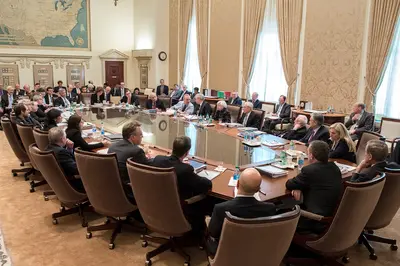
The remaining scheduled FOMC meetings are September 15 to 16, October 27 to 28, and December 8 to 9.
Three scenarios are the most natural.
First, a September hike. This happens if the August CPI and PPI run hot again, or if there is confirmation that the disinflation has stalled. Strong employment and high energy prices have already built much of the case.
Second, a hold in September followed by a hike later in the year. This is the path if inflation is not bad but not reassuring either. The Fed can take another month or two of data and decide again in October or December.
Third, no further hike this year. For that, one soft CPI print is not enough. Monthly inflation would have to slow across multiple gauges, energy prices would have to come down, and underlying price pressure and inflation expectations would both have to settle.
One thing here needs correcting. The claim that "the Fed will likely avoid the October meeting because it falls just before the midterms" is a possible political reading, not a confirmed fact.
The 2026 US midterm elections are on November 3, and the October FOMC runs on the 27th and 28th. Measured from the end of the meeting, that leaves only six days before the vote. It is true that the political controversy could be loud. But the moment you assume the Fed delays a rate decision because of an election, a much bigger question about central bank independence opens up.
The Trump variable deserves the same treatment.
On September 4, President Trump applied heavy pressure, suggesting he could cut off trade with some partner countries if the Fed does not lower rates. That does not automatically mean a hold.
If anything, Warsh may have the opposite incentive. Because Trump appointed him, any monetary policy decision carries the risk of being read politically. In that case the Fed is more likely to strengthen the economic rationale behind its decision than to dodge a particular date on the calendar.
The market's real question right now is not "will the Fed hike once this year." It is "where is the threshold at which the Fed judges inflation to be back in the danger zone."
The employment data lowered that threshold. More important than the 162,000 gain in August is the fact that July's negative print disappeared. The Fed now has less reason to buy recession insurance.
At the same time, Waller's argument for giving disinflation more time is still alive. Wage growth is under control, and recent monthly inflation has not blown out.
So the most accurate statement is this.
A September hike has become a realistic base case. But it is not a game decided by one CPI report. The core question is whether the inflation data ahead confirms the recent cooling or tilts the weight toward strong employment and the energy shock.
What to Watch
If monthly core inflation climbs back to the 0.3 to 0.4 percent range, the case for a September hike strengthens. If it holds steady around 0.2 percent, the hold argument revives.
Watch whether higher energy and transport costs spread into producer prices. If PPI jumps again, it is a leading warning for consumer prices ahead.
It matters whether oil pushes higher from the $90s and whether shipping traffic normalizes. The longer the energy shock runs, the harder it is for the Fed to dismiss it as temporary.
In the June dot plot, 9 of 18 officials put the year-end policy rate at 3.875 percent or above, higher than the current level. How much more hawkish the September dots shift will show the path into year-end.
This is the market gauge that reflects Fed expectations fastest. If the 2-year yield and year-end futures rates rise together, the market has started to price not one more round of tightening but two.
No. Employment only reduced the obstacles to a hike.
Wage growth of 0.3 percent month on month and 3.1 percent year on year was not at overheating levels.
The inflation data released before the September meeting is still the decisive input.
Not anymore.
July nonfarm payrolls, first reported at minus 23,000, were revised up to plus 21,000.
So the argument that the Fed must wait because of a collapse in hiring is weaker than it was a month ago.
It is possible, but it cannot be stated as fact.
A decision right before an election could amplify the political controversy.
But there is also little basis for the claim that the Fed postpones decisions because of the political calendar. If the data is strong enough, October is a policy option too.
Not necessarily.
What matters more is the signal that the Fed will keep rates high for a long time beyond year-end.
If long-term yields and real rates rise together, valuation pressure grows on stocks whose value sits in distant future cash flows, such as AI and big tech names.
Employment has moved a step toward a hike.
Inflation is still far from 2 percent.
The next CPI matters, but it is not the sole decider.
A September hike is realistic, and even with a hold, the possibility of further tightening by year-end remains.
Insight Times Editorial Desk