Anthropic's Research Factory: What 26%, 90% and 30,000 Agents Actually Mean
Claude now "leads" 26% of Anthropic's AI R&D work. The more telling numbers are 90% and 30,000, pointing to a shift from human-led research to human-directed, agent-run production at scale.
What matters more than the 26% is that the shape of research itself is changing
Read Anthropic's new numbers as "Claude has replaced 26% of researchers" and you get it wrong. That figure is not a headcount cut or a share of hours worked. Anthropic sorted roughly 15,000 detailed AI R&D tasks, scored each one on a 0-to-5 automation scale, and weighted the results by human time spent to build what it calls the R&D Automation Index.
As of August 2026, tasks that fall under AL4, "AI Leads" - where Claude takes a high-level instruction and carries a task from start to finish under human supervision - made up 26% of the work measured. AL5, full automation with no human involvement, had not yet shown up in any measured task. But widen the lens to AL3, tasks where AI collaborates with a human, and the share crosses 90%.

<div class="metrics"> <div class="metric"><span class="num">26%</span><span class="label">Share of AI R&D tasks Claude performs at "Lead" level</span></div> <div class="metric"><span class="num">90%+</span><span class="label">Share of tasks where Claude is involved at "Collaborate" level or above</span></div> <div class="metric"><span class="num">~30,000</span><span class="label">Research and engineering agents active at once on Anthropic's most-used internal platform</span></div> <div class="metric"><span class="num">1 billion+</span><span class="label">Agent decisions checked by online monitors in August 2026</span></div> </div>
A note on reading these numbers. The 26% figure is not 26% of the company's total workload; it is a proprietary index applied specifically to "AI R&D" tasks. The roughly 30,000 figure is not Anthropic's total agent count across all systems either, it is the number active at a single point in time on its most-used internal platform. Strip out those definitions and the numbers can look far bigger than they are.
The realistic picture is a semi-automated research factory, not movie-style self-improvement
Recursive self-improvement is usually pictured as an AI designing its own successor and getting smarter with no human in the loop. That is not where Anthropic is today. A more accurate description is a semi-automated research factory: humans set the research direction, and a large fleet of agents multiplies how much gets executed.
<div class="flow"> <div class="flow-row"> <span>Humans set research goals and constraints</span> <div class="arrow">↓</div> <span>AI agents write code, run experiments, debug, evaluate and analyze at scale</span> <div class="arrow">↓</div> <span>Automated monitors and humans verify results and behavior</span> <div class="arrow">↓</div> <span>Models, tools, data and experimental environments improve</span> <div class="arrow">↓</div> <span>A stronger model takes on more work in the next research cycle</span> </div> </div>
There is already a recursive loop here. When AI raises researcher productivity, the next model gets built faster, and a stronger model further automates research. The question that matters is not whether AI sets its own research direction entirely on its own. It is how much the development cycle from one generation to the next compresses.
A 20% productivity gain and a development cycle cut in half are entirely different things industrially. If the latter repeats, model performance, compute demand, capital spending and product release speed could start pushing each other up in a non-linear competitive spiral.
The faster AI moves, the scarcer verification becomes
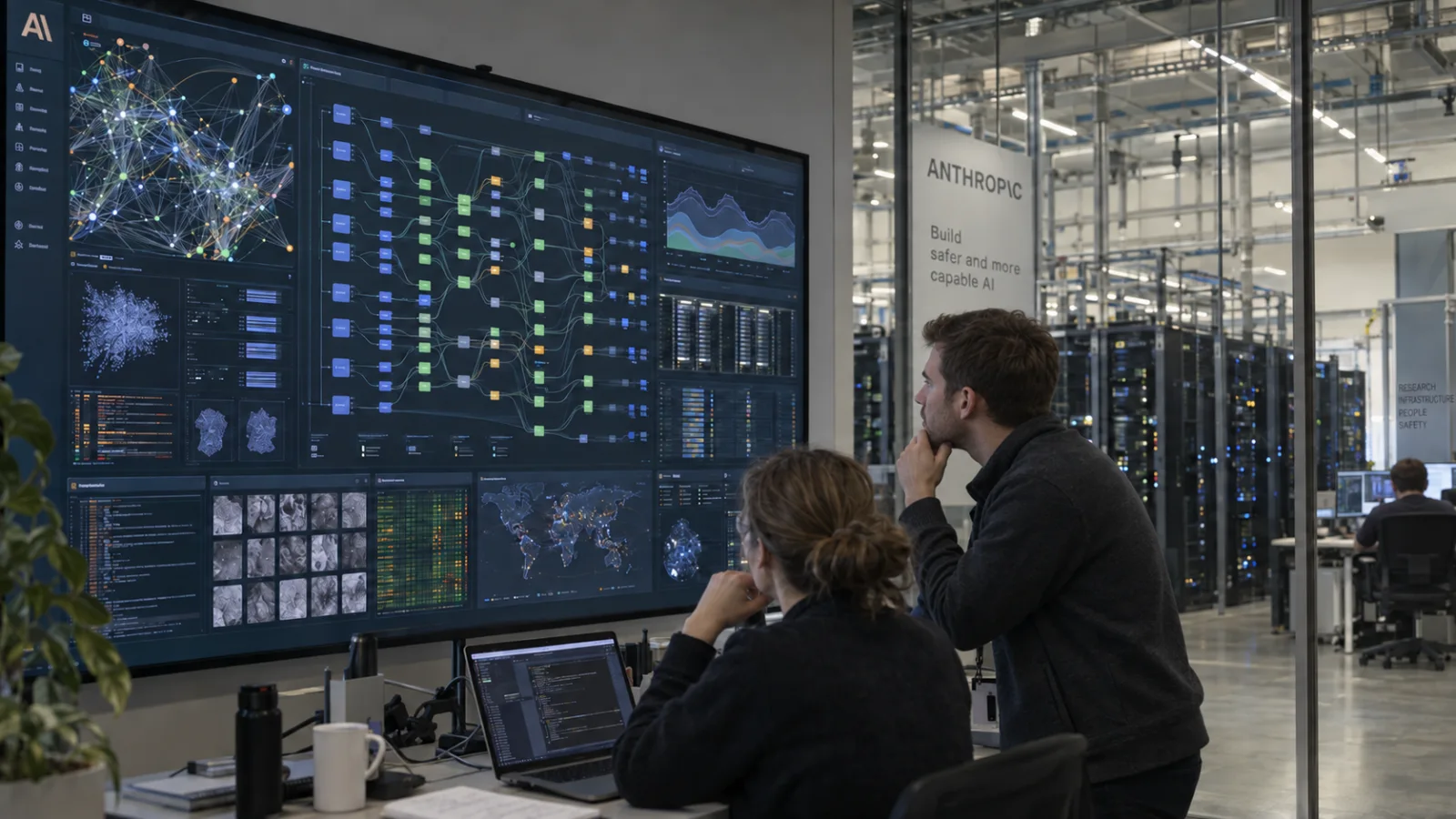
On Anthropic's internal platform, roughly 30,000 agents were running research and engineering tasks simultaneously at a single point in August 2026. Their actions passed through online monitors before execution, and out of more than a billion decisions in one month, 0.002% were blocked, roughly 1 in every 47,000.
0.002% sounds small, but on a base of a billion decisions that works out to roughly 20,000 blocked actions. More importantly, the block rate itself is not a safety pass rate. A low rate could mean agents genuinely behaved safely, or it could mean their permissions were narrow enough that risky actions rarely came up in the first place. If monitors are missing behavior, a low block rate offers no real reassurance.
<div class="table-wrap"> <table> <thead><tr><th>Safety metrics worth watching next</th><th>Why it matters</th></tr></thead> <tbody> <tr><td>Monitor detection rate and false negatives</td><td>The share of risky actions monitors miss says more about real oversight quality than the block rate does.</td></tr> <tr><td>Failure rate by permission level</td><td>Reading files, executing code, network access and credential use each carry a different character of risk as permissions expand.</td></tr> <tr><td>Errors and incidents found after the fact</td><td>Shows how much slips through pre-execution checks and shows up in live operations.</td></tr> <tr><td>Time to human review</td><td>Reveals whether agent speed is outrunning human audit capacity.</td></tr> <tr><td>Risk change across model versions</td><td>Shows whether performance gains come with better oversight, or worse.</td></tr> </tbody> </table> </div>
The 6% and 12% of safety compute are a starting point, not a conclusion
Anthropic analyzed a sample week from July 13 to 20, 2026. During that stretch, about 6% of the compute used for AI R&D went to safety-related work; narrowed to just the AI-led share of AI R&D compute, that figure was about 12%. The company describes this as a conservative estimate, since it did not count work that advanced both capability and safety at once as safety spending.
Even so, this should not be read as "6% of the R&D budget went to safety." Safety research often takes a lot of human design time relative to its actual compute footprint, so a compute share does not fully capture investment priority. The more important question is not one ratio of dollars or GPUs, but whether the full chain of input, detection, control and independent verification actually functions.
That is also why Anthropic says it will give external independent evaluators system and data access comparable to its internal risk-assessment teams. In an era when agents work with real internal tools and permissions, public benchmarks alone are not enough to confirm operational risk.
How this shift could redraw money flows in the AI industry
If AI is accelerating AI research, demand does not stop at training GPUs. Agents write code, run experiments repeatedly, read results, and run again. That could sharply increase inference compute that comes after training is done. Memory bandwidth, networking, storage, and data center power and cooling all become part of research automation.
Security's role shifts too. Handing work permissions to tens of thousands of agents turns AI security into a problem of identity management, least-privilege access, sandboxing, network controls, behavioral monitoring, audit logs and incident response, rather than content filtering. Enterprise software may see bigger productivity gaps open up not from giving one AI tool to one employee, but from redesigning work processes themselves into units agents can execute.
From an investment standpoint, one more note of caution is warranted. One company's internal operating metrics, even Anthropic's, do not automatically map onto the entire AI industry's compute demand curve. But if R&D automation rates rise in the same direction across multiple frontier labs, then estimating AI infrastructure demand may need to treat inference AI systems consume to do research itself, not just the number of training runs, as a separate variable to watch.
Insight Times Editorial Desk