Big Tech Is Earning Record Cash. It Is Returning Much Less of It.

The cause is not weak profits. Heavy AI data center spending is changing how the largest tech companies allocate cash.
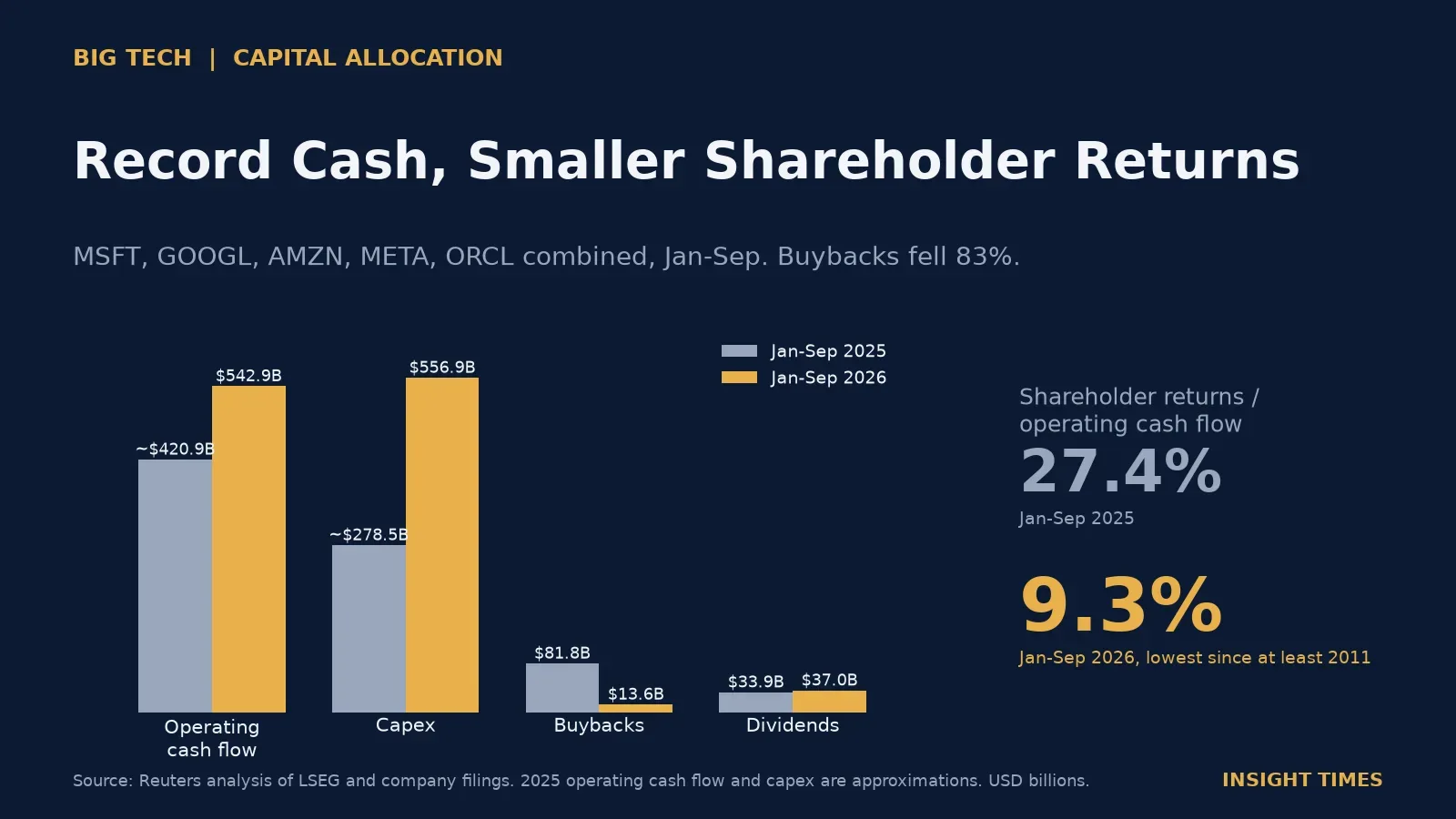
Dark navy cover. Grouped bars comparing Jan-Sep 2025 vs 2026 for five Big Tech firms combined: operating cash flow ~$420.9B vs $542.9B, capex ~$278.5B vs $556.9B, buybacks $81.8B vs $13.6B, dividends $33.9B vs $37.0B; shareholder returns fell from 27.4% to 9.3% of operating cash flow.

The 20-second read

1
The five Big Tech companies' operating cash flow rose 29% from a year earlier to $542.9 billion.
2
Capital expenditures came to $556.9 billion, and share buybacks fell 83%.
3
What matters most is not the cut in shareholder returns itself, but the future return on AI investment.

1. Cash is up, shareholder returns are down

Microsoft, Alphabet, Amazon, Meta and Oracle generated a combined $542.9 billion in operating cash flow from January to September 2026. That is up 29% from a year earlier and a record. But capital spending over the same period reached $556.9 billion, more than operating cash flow.

Buybacks fell 83%, from $81.8 billion to $13.6 billion. Dividends rose from $33.9 billion to $37.0 billion, but total shareholder returns still dropped from $115.7 billion to $50.6 billion. Shareholder returns as a share of operating cash flow fell from 27.4% to 9.3%, the lowest in the analysis period, which begins in 2011.

2. How the cash moved

ItemJan-Sep 2025Jan-Sep 2026
Operating cash flowabout $420.9 billion$542.9 billion
Capital spendingabout $278.5 billion$556.9 billion
Free cash flow+$143.5 billion-$14.0 billion
Buybacks$81.8 billion$13.6 billion
Dividends$33.9 billion$37.0 billion
Total shareholder returns$115.7 billion$50.6 billion
Shareholder returns / operating cash flow27.4%9.3%

Combined figures for the five companies. Some 2025 numbers are approximations back-calculated from growth rates. Apple and Nvidia are not included. Fiscal years and capex structures differ by company, so the combined result cannot be applied directly to any single firm.

3. What fewer buybacks mean for EPS

A company with $10 billion in net income and 1 billion shares earns $10 per share. If it buys back and retires shares, cutting the count to 900 million, EPS rises about 11.1% to roughly $11.11, even with no change in net income.

According to ING, Alphabet cut its share count by 9.5% through buybacks from the end of 2020 to the end of 2025. In 2026, though, Alphabet and Meta have not repurchased shares. The two companies bought back a combined $66.5 billion in January to September 2025 alone.

If buybacks stay low, future EPS growth may depend more on actual growth in net income. At the same time, spending on GPUs and servers for AI data centers could translate into heavier depreciation. The key question is whether added revenue and profit offset it.

4. Smaller payouts do not automatically destroy value

Cutting buybacks makes sense if a company can reinvest at returns above its cost of capital. If the cost of capital is 10% and new investment earns 20% over the long run, reinvestment may raise shareholder value. If returns fall short of the cost of capital, the larger the spending, the more value could be lost.

So the 83% drop in buybacks is not, by itself, a reason for optimism or pessimism. What matters is how much additional profit and future cash flow the AI data center spending produces.

5. What long-term, regular investors can check

  • Operating cash flow and capex: Whether investment keeps exceeding the cash earned from operations.
  • Free cash flow: Whether cash generation recovers while heavy spending continues.
  • EPS and share count: Whether EPS growth comes from net income growth or from buybacks.
  • Depreciation and return on investment: Whether AI infrastructure earns more than it costs.

For investors who buy in installments, the durability of the investment case matters more than one day's price move. Revenue growth alone is not enough. It helps to look at where the cash goes and how likely it is to come back.

Does EPS necessarily fall when buybacks decline?
  • No. If actual net income grows, EPS can rise even when buybacks shrink. However, the extra boost that a shrinking share count provided may weaken.
Did dividends fall too?
  • No. The five companies' combined dividends rose from $33.9 billion to $37.0 billion. The item that fell sharply was share buybacks.
Do these figures apply to every Big Tech company?
  • No. They are combined results for Microsoft, Alphabet, Amazon, Meta and Oracle. Apple and Nvidia are excluded.
Is bigger AI capital spending bad for long-term shareholders?
  • The return matters more than the spending itself. If the long-term return on investment exceeds the cost of capital, it can be positive for shareholder value. If it does not, it can become a burden.

What to watch

Free cash flowWatch whether the combined number for the next quarter turns positive again from -$14 billion in January to September 2026.
Shareholder returns vs. operating cash flowWatch whether the ratio rises from 9.3%. It was 27.4% in January to September 2025.
Alphabet and Meta buybacksNeither made buybacks in 2026 so far. Check in the next earnings reports whether they resume.
Depreciation burden and earningsAs depreciation from AI server investment grows, watch whether additional revenue and profit offset it.
Big Tech is pouring its cash into AI data centers, buybacks have dropped, and the key question is whether that spending comes back as profit.

Insight Times Editorial Desk
More by topic

Starting with this story's topics, then what readers are following now

Investor psychology, decision-making and books on investing

Share Buybacks

This story's topic5 storiesSee all →

EPS

This story's topic5 storiesSee all →

HBM

77 storiesSee all →

Memory stacked next to the GPU.

Memory Is Still Short, but Less Short: Checking for the Peak This Week

Citi trimmed its 2027 DRAM and NAND shortage forecasts together. Server pricing remains strong, while consumer markets show weakness. This week's numbers show where the memory boom may peak.

Investing

The Real ASML Number Isn't the 3% Pop, It's the 30% Capacity Hike

ASML's rally isn't just an AI trade. Customers are already locking in 2027 tool slots, and ASML is raising Low-NA EUV capacity by roughly 30% to keep up.

Investing

A 3x P/E is not a discount. It is a verdict on how long memory profits last

Nomura's buy case on Samsung Electronics and SK Hynix does not stop at higher memory prices. It argues that if AI has turned memory from a cyclical component into strategic infrastructure, the formula the market uses to value both companies has to change too.

Investing

2027 Isn't the End: Citi's Case for a Memory Supercycle Running to 2031

Citi says the memory shortage timeline is stretching again. If AI shifts from "train once" models to continual learning, HBM, server DRAM and enterprise SSDs could all fall short at the same time.

Tech

AI ran out of memory before it ran out of GPUs

The HBM bottleneck is spreading into DRAM prices, server costs and the price of the next laptop or phone.

Tech

Has Memory Peaked? Prices Are Cooling, but the Shortage Looks Set to Run to 2028

Price growth has slowed and consumer demand is already breaking. Server and HBM supply remains short, and Micron says more than 75% of its 2027 volume is already committed to customers.

Tech

AI Chip Peak Check: Demand Still Rising, Risk Building in 2027-2029 Supply and Funding

DRAM and NAND contract prices are still climbing and HBM suppliers hold the edge. Power shortages, AI financing costs and simultaneous memory expansion are the risks for later years.

Investing

A building that houses servers and networking gear and supplies them with powe…

Nvidia and Palantir Put AI Inside the Supply Chain - The Real Shift Is That It's Learning Judgment

A single Vera Rubin rack holds 1.3 million parts. The real breakthrough in Nvidia and Palantir's new supply chain AI isn't automating that complexity, it's capturing the judgment calls that used to live only in planners' heads.

Tech

Is Space Cooler for AI? Why Musk Wants Data Centers in Orbit

The next limit on AI may be power and cooling, not GPUs. Elon Musk is looking to Earth orbit for an answer, but the test is cost per hour of compute.

Tech

Musk Sees the Next Phase of AI Infrastructure: Who Can Switch GPUs On, Fast

If neoclouds struggle under financial pressure, AI demand may not shrink. It may simply favor the few operators with the capital and execution to serve it, a shift that could matter for SpaceX and Tesla.

Tech

White House Swaps AI for "SI." The Real Investment Signal Is Infrastructure, Not the Name

An executive order renames artificial intelligence "Super Intelligence" and six frontier labs sign a voluntary safety accord. What investors should watch is the data center, power, nuclear and chip policy now gathered under one national-competitiveness frame.

Tech

The Cheaper Tokens Get, the Bigger Your AI Bill Gets

As AI shifts from training to inference, the token is becoming an industrial commodity. Falling prices are not cutting demand, because agents and automation consume tokens at a scale no human chat session ever did.

Investing

Marvell's $115 Billion Lumentum Deal: Is AI's Next Bottleneck Light, Not Chips?

Marvell's purchase of Lumentum points to a contest beyond GPU speed, in data transfer and power efficiency. Whether the price is right is not yet confirmed.

Tech

Workers in hard hats beside a communications equipment cabin, with a Starship rocket on its launch tower at dusk in the background

SpaceX Forecast at About $730 Billion in 2028 Revenue: The Bigger Opportunity Musk Sees

Sequoia Capital made a bold forecast, and Elon Musk replied, "I think we can do better." The future SpaceX is looking at is far bigger than the rocket launch business. The plan is to link satellite communications, AI data centers and orbital computing into one giant business.

TechEXPLAIN