Meta Is Building a Humanoid Robot. Why Is Zuckerberg Entering Tesla's Turf?
Meta has built a humanoid robot prototype with China's Fourier. The bigger question is whether the money in robotics goes to the best robot makers or to whoever supplies the brains for many robots.
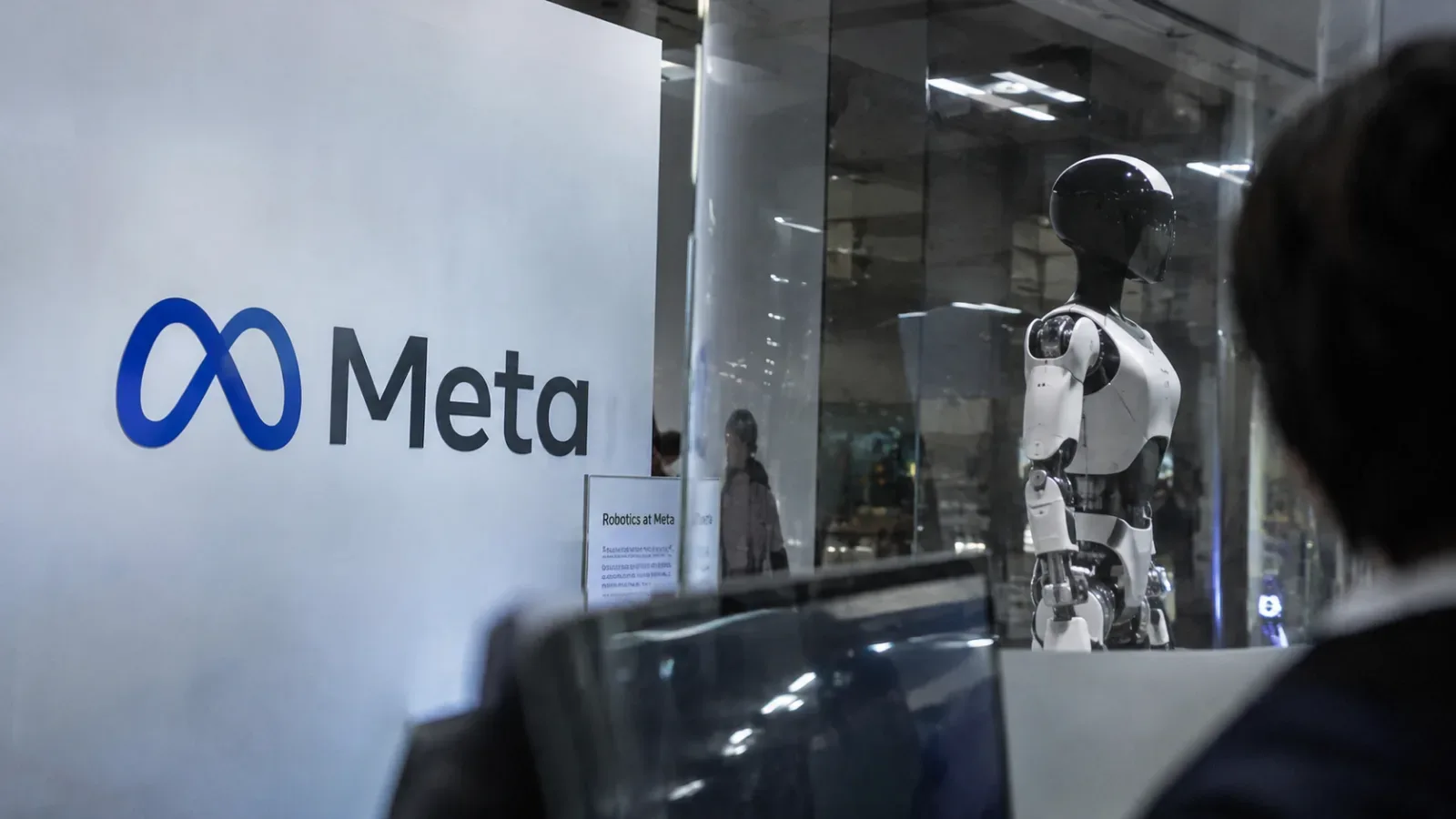
Meta, the owner of Facebook and Instagram, has started building humanoid robots. For Tesla, developing Optimus is a natural step. It already has cars, batteries and factories. But why would a social media company study the body of a robot? Follow that question and a larger contest in the humanoid industry comes into view. Will the money go to the company that builds robots best, or to the one that supplies the brains for countless robots?
1. Meta really did build a humanoid robot
On Oct. 31, Reuters, citing The Information, reported that Meta had built a humanoid robot prototype in partnership with Chinese robotics company Fourier. A second version is also in development.
Meta's robotics effort did not appear overnight. In 2025 it created a robotics group inside Reality Labs. In 2026 it acquired a robot intelligence startup, Assured Robot Intelligence.
The technology Meta wants is the ability for a robot to understand human behavior, find and handle objects in complex spaces, and move to suit the situation.
Say you tell a robot, "Clear the dinner table." It has to tell cups from plates. It has to grip fragile items gently. It has to change its movements when a person walks by.
This is AI moving from understanding language to acting in the real world.
Key insight: Meta studies the robot body to develop intelligence that understands the world and acts in it.
2. Tesla targets the whole robot, Meta targets the brain
Tesla and Meta are eyeing the same humanoid market, but their approaches differ.
Tesla's Optimus integrates AI, the drivetrain, batteries, manufacturing and real robot motion into one system. The drivetrain means the motors and related parts that move a robot's arms and legs. Tesla aims to connect everything directly, from what the robot decides to how it moves to how it is mass produced.
Meta can take a different path. It could develop the AI software that serves as a robot's eyes, brain and decision-making, and supply it to many robot makers.
Think of the smartphone industry. Apple integrated iPhone hardware and operating system. Google supplied the Android operating system to many phone makers.
A similar structure could form in humanoids. If Tesla is the Apple of the robot era, Meta could aim to be its Google.
Robots are not phones, though. They grip real objects and move next to people. Dexterity, real-time control, safety and liability for failures all come into play. How independently a robot's body and brain can be designed will shape the industry's structure.
Key insight: Tesla competes on the polish of an integrated robot. Meta may find its opening in an intelligence platform that can extend across many manufacturers.
3. The ability to accumulate experience may matter more than the body
People learn to hold a cup by dropping it a few times. Robots are similar. To become skilled, a robot has to act in real environments, fail and correct itself.
What this process produces is robot learning data. How an object was grasped, how much force was used, how the robot reacted to an unexpected obstacle: all of it becomes learning material.
This is where the Tesla-Meta contest gets interesting. Tesla seeks a structure in which it improves hardware and AI together through the Optimus robots it builds itself.
If Meta supplies intelligence to many makers, it could grow into a platform that accumulates learning experience across different robots and environments.
Both strategies have real potential. Tesla can optimize body and intelligence together. Meta is not tied to one robot product and can expand across a broader ecosystem of manufacturers.
The key question does not end with how many robots are built.
Competitiveness may depend on who secures more real-world action data and turns it into better robot capability.
4. Add Nvidia, and the picture sharpens
Viewing the humanoid market as a Tesla-Meta duel misses one important company: Nvidia. Nvidia provides an AI platform for robots.
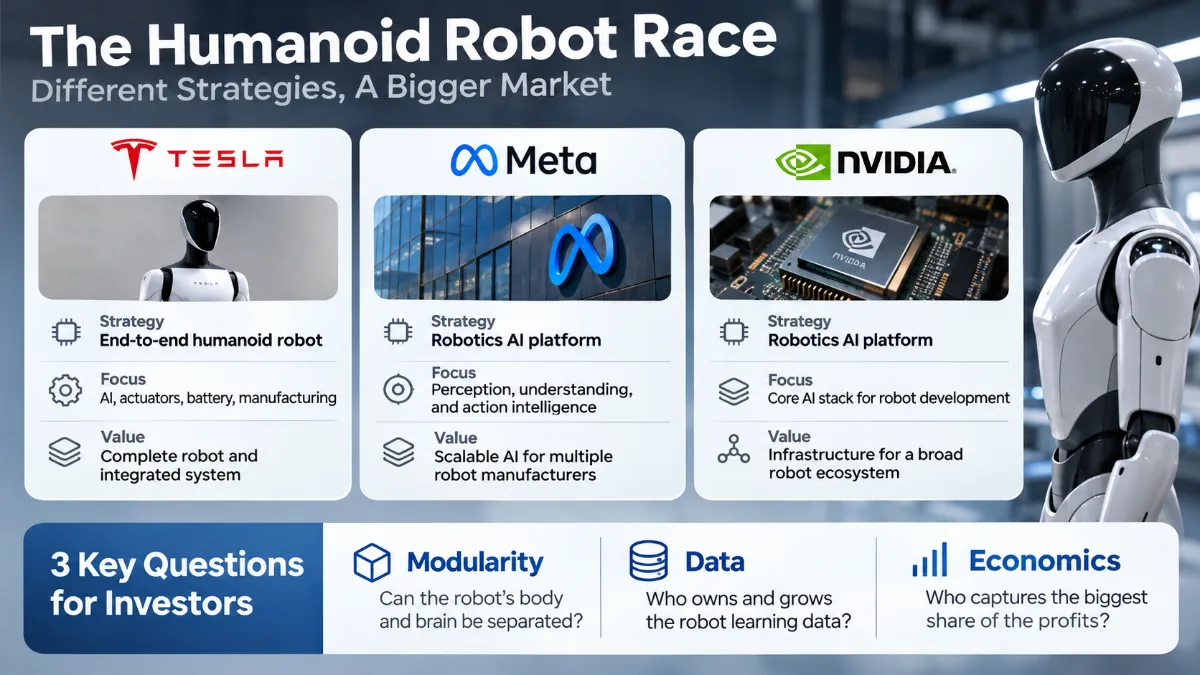
The industry can now be split into three business models.
| Company | Core strategy | Where economic value arises |
|---|---|---|
| Tesla | Integrates robot body, AI and manufacturing | Sales of finished robots and the integrated system |
| Meta | Develops robot perception and action intelligence | An AI platform it could supply to many manufacturers |
| Nvidia | Provides an AI platform for robots | Foundational technology for the robot development ecosystem |
The most interesting point is that all three could succeed. Tesla could produce many robots, Meta's intelligence could be adopted by other makers, and Nvidia's platform could be used across many kinds of robots.
But the economic gains are unlikely to be split evenly. Finished-robot makers earn the gap between product price and production cost. AI platform companies can pursue economies of scale by supplying technology to many customers.
Conversely, the more tightly a robot's body and intelligence are bound together, the more a company like Tesla that integrates every technology could benefit.
Key insight: The humanoid industry may have several winners, not one. Investors should look at which part of the value chain each company controls.
5. Investors should watch these three things, not unit sales
The most visible number in evaluating humanoids is unit sales. But sales alone do not show who will take the industry's profits. Three questions matter going forward.
First, can a robot's body and brain be separated?
If robots from many makers use a common AI platform, the opportunity grows for platform companies such as Meta and Nvidia. If each robot's body and intelligence must be finely matched, Tesla's integrated strategy becomes stronger.
Second, who accumulates the data robots learn from?
A company that gathers a lot of real work data and uses it to improve intelligence can build a competitive edge over time.
Third, when one robot is sold, who captures the most profit?
Robot makers could secure high margins. Or core AI platform providers or drivetrain suppliers could have stronger pricing power.
These three questions let investors assess Tesla's manufacturing capability, the scalability of Meta's intelligence platform and the strength of Nvidia's development ecosystem.
Key insight: Unit sales show the size of the market. Control of technology and data shows who takes the profit.
Insight Times view: Who will be the Apple and Google of the robot era?
The most important part of the news that Meta is building a humanoid robot is not that a new competitor has appeared.
It is that a contest for control of hardware and software has begun in robotics too.
Tesla aims to design and build the whole robot through Optimus. Meta could expand toward supplying the intelligence that lets robots understand and act in the world to many manufacturers. Nvidia provides the AI platform that robot development requires.
The contest resembles the smartphone industry but is far more complex. A phone's operating system runs apps on a screen. A robot's intelligence moves objects in the real world and shares space with people.
So the more standardized the robot brain becomes, the more it favors platform companies. The more precise integration of body and brain matters, the stronger the finished-robot makers' position.
For investors, the point is not to declare a winner in advance. It is to track Tesla's real work performance and manufacturing efficiency, the scalability of Meta's AI technology and its adoption by manufacturers, and the reach of Nvidia's platform together.
The biggest investment opportunity in humanoids may lie with the company that builds the most robots, or with the one that supplies the intelligence many robots share.
Meta's robot development is an interesting signal that this contest is getting under way.
Insight Times Editorial Desk