Anthropic's $1.4 Trillion IPO: Who Pays for AI Growth?

The headline valuation is not the number to watch. The cash Anthropic actually raises, and its ability to honor huge compute commitments, matter more for investors in Anthropic and in Nvidia.
Anthropic's $1.4 Trillion IPO: Who Pays for AI Growth?

The 20-second read

1
Valuation of up to about $1.4 trillion. Anthropic has set an IPO price range of $70 to $78 per share. However, the $1.4 trillion figure is on a fully diluted basis. On a conventional outstanding-shares basis, the valuation is about $1 trillion.
2
Revenue is growing explosively, but spending commitments are also enormous. Third-quarter revenue was about $16.96 billion, and future compute commitments come to about $900 billion. That is why growth sustainability and the ability to raise funds have to be judged together.
3
This IPO matters for Nvidia too. If AI companies raise fresh capital, it could help chip demand. But what ultimately determines lasting purchasing power is the cash generated by AI services.

Anthropic's IPO is more than one giant AI company listing on the stock market. It signals that the AI industry is moving beyond private funding and Big Tech backing to raise large amounts of growth capital in public markets.

The shift matters for Nvidia and AI chip investors as well. How much the AI industry grows, who pays for that growth, and who ends up keeping the profits are three separate questions.

1. The number that matters more than a $1.4 trillion valuation

Anthropic plans to offer 825 million shares at $70 to $78 each. At the top of the range, the offering comes to about $64.35 billion.

On top of that, strategic investors including Nvidia, Microsoft, Google, AMD, Broadcom, TSMC and Micron have made separate investment commitments totaling $26 billion.

Three numbers need to be kept apart.

ItemAmountWhat it actually means
Fully diluted valuationUp to about $1.4 trillionEquity value including potential shares
IPO offering sizeUp to about $64.4 billionTotal offering, including shares sold by existing holders
Strategic investment$26 billionSeparate equity stakes from major tech companies

The $1.4 trillion is not money going into the company. Even the offering amount has to be reduced by shares sold by existing holders and by issuance costs before the cash reaching the company is known.

The first thing to separate in this IPO is the price attached to the company from the cash the company actually secures.

2. Revenue is growing fast, but the money has to be spent earlier

Anthropic's third-quarter 2026 revenue was about $16.96 billion, up 47% from the prior quarter. Its annualized revenue run rate reached about $81 billion as of late October.

Investors should also look at another figure: roughly $895.4 billion in long-term spending commitments tied to compute and infrastructure.

This should not be read as debt due immediately. These are contractual obligations to be fulfilled over many years. Still, there is a gap between when revenue arrives and when costs must be paid.

Customers can cut their AI usage, but Anthropic may keep paying for compute capacity it has already contracted to secure.

If demand grows as expected, infrastructure secured early becomes a competitive edge. If demand slows, or AI service prices fall quickly, long-term contracts could squeeze profitability.

The key is not revenue growth alone. It is how much compute cost each additional dollar of revenue requires, and how much cash is left as revenue rises.

3. Nvidia's reasons to invest differ from an ordinary shareholder's

It is a positive for the industry that tech companies such as Nvidia, Microsoft and Google are investing strategically in Anthropic.

But it need not be taken as a signal that the offering price is fair.

Beyond returns on the stock, strategic investors can expect business benefits: more cloud usage, chip sales, customer relationships and influence in the AI ecosystem.

A chip supplier, for example, could earn separate economic benefits from long-running chip orders even if Anthropic shares return less than hoped.

Ordinary investors get no such business reward.

Even at the same share price, the economic value to a strategic investor and to a retail investor may not be the same.

4. Anthropic may be a good company. Is it a good stock?

Simply annualizing third-quarter revenue against the $1.4 trillion fully diluted valuation gives about $67.8 billion. That puts equity value at roughly 20.6 times annualized revenue.

This is not actual annual revenue or an EV/sales multiple. It is a rough comparison to help understand the current price.

Working backward from the price to future earnings:

AssumptionAnnual result required
$1.4 trillion valuation, 30x P/ENet income of about $46.7 billion
20% net marginRevenue of about $233.3 billion
10% net marginRevenue of about $466.7 billion

These are assumptions to understand the valuation, not earnings forecasts.

Even if Anthropic reached that level of profit, an investor buying now would see limited stock gains if the valuation then were the same as today's. Once the return an investor demands after waiting years is included, a much higher future valuation would be needed.

Strong growth in the AI industry does not make every stock in that industry a good investment.

5. What should Nvidia investors take from this?

For AI chip investors, the IPO matters not because of Anthropic's share price itself. It matters because the way AI infrastructure buyers fund themselves is changing.

How AI investment money flows

  1. Public-market and strategic investors supply capital to AI companies.
  2. Anthropic and other AI service companies buy compute and data centers.
  3. Nvidia, cloud and infrastructure suppliers ship products and book revenue.
  4. Fees that businesses and consumers pay for AI services are the ultimate source of cash that sustains the long-term investment.

If the listing succeeds, Anthropic's ability to raise capital strengthens, which could help chip and cloud suppliers.

But if much of that funding keeps depending on money raised from investors, AI infrastructure demand could also be affected when financial market conditions worsen.

Conversely, if paid AI usage by businesses and consumers grows and service profitability improves, AI infrastructure spending would be supported more by the business's own cash generation than by outside capital.

Long-term Nvidia investors should check customers' cash-generating ability as closely as the size of orders.

Four things to watch

  • Anthropic's gross margin: shows whether falling inference costs are offsetting price competition.
  • Operating cash flow and cash burn rate: a basis for judging whether existing commitments can be met without another round of financing.
  • How fast compute contracts are actually executed: the degree to which contract size turns into real infrastructure demand.
  • Nvidia's data center revenue and customers' capacity to invest: shows whether order growth rests on sustainable cash spending.
If the Anthropic IPO succeeds, will Nvidia's stock rise too?
  • A successful fundraising could be positive for AI infrastructure demand, but it does not guarantee a rise in Nvidia's stock price.
  • What matters more is the timing of chip orders, actual deliveries, Nvidia's market share, and how much of the expectation is already priced into the stock.
Does $1.4 trillion mean a valuation 40% higher than $1 trillion?
  • No. They are valuations of the same company calculated on different share counts.
  • The fully diluted basis counts potential shares such as options and restricted stock. It is important to use the same basis as the companies you compare it with.
Is the $900 billion in compute commitments debt the company cannot handle?
  • The total amount of commitments does not immediately mean financial debt or cash due right away.
  • You need to look at the payment schedule, termination terms, actual usage, and when revenue will cover the costs.
If I am confident in AI growth, wouldn't it make sense to hold Anthropic for the long term?
  • Industry growth is only the starting point of a long-term holding thesis.
  • You also need to work out future profit margins, the chance of additional share issuance, the current valuation, and your target return.
Is this IPO evidence of an AI bubble?
  • A mega IPO does not by itself prove a bubble.
  • What matters is how much sustainable profit the raised capital produces. If revenue and cash flow improve faster than investment, a high valuation could be justified.

What to watch

Anthropic gross marginThis number shows whether falling inference costs offset revenue lost to price competition.
Operating cash flow and cash burn rateThis is a basis for judging whether the company can meet its existing commitments without another fundraising.
Pace of compute contract executionEach quarter, check how much of the $895.4 billion in commitments turns into actual infrastructure demand.
Nvidia data center revenueLook at this together with customers' capacity to invest, to see whether order growth rests on their ability to generate cash.
In Anthropic's IPO, look first at the cash the company actually secures and its ability to generate cash to meet its commitments, not at the $1.4 trillion price tag.

Insight Times Editorial Desk
More by topic

Starting with this story's topics, then what readers are following now

Investor psychology, decision-making and books on investing

Valuation

This story's topic36 storiesSee all →

Measuring where a share price sits relative to the company’s results.

A 3x P/E is not a discount. It is a verdict on how long memory profits last

Nomura's buy case on Samsung Electronics and SK Hynix does not stop at higher memory prices. It argues that if AI has turned memory from a cyclical component into strategic infrastructure, the formula the market uses to value both companies has to change too.

Investing

Anthropic's IPO: The Number That Matters More Than $100 Billion Is $2 Trillion

Claude-maker Anthropic is growing at a stunning pace, but the real question for investors is not how fast, only how long, and how much cash is left after GPUs and data centers.

Tech

Oil at $110, 10-Year Yield at 5%: The Discount Rate on Growth Stocks Is Rising Again

Brent crude spiked to $109.97 intraday and the US 10-year Treasury yield tested the 5% threshold. What matters is not the numbers themselves but that oil-driven inflation fears are pushing bond yields higher across the globe at once.

Macro

Marvell's $115 Billion Lumentum Deal: Is AI's Next Bottleneck Light, Not Chips?

Marvell's purchase of Lumentum points to a contest beyond GPU speed, in data transfer and power efficiency. Whether the price is right is not yet confirmed.

Tech

The S&P 500 Looks Fine. So Why Do Most Stocks Hurt?

The index sits near its high, yet most of its members are down 20% to 30% or more from their own peaks. A look at the "stealth bear market" and the numbers long-term investors should watch.

Investing

Is This AI Memory Supercycle Really Different? The Valuation Trap for Long-Term Investors

Memory is reshaping around AI through 2030. But a good industry and a good entry price are separate questions.

Investing

2027 Investing Needs Alignment, Not Prediction

A new investing book argues the hard part was never picking the next winner. It's staying aligned with where value and bottlenecks are moving while keeping old human weaknesses in check.

Investor Mind

IPO

This story's topic20 storiesSee all →

Anthropic Started Late but Took the Lead in Enterprise AI Revenue

Claude Code changed the game. But understanding the $2 trillion IPO story means looking past explosive revenue growth to $518 billion in compute commitments and customer concentration.

Tech

Anthropic Posts a Profit, but Investors Are Uneasy About the $2 Trillion Question

Reported third-quarter revenue of $16.8 billion and an adjusted profit show AI can make money. Slowing growth and $518 billion in long-term commitments are the open questions.

Tech

Editorial chart cover: illustrative 18-year growth of one SpaceX (SPCX) share in a Trump account, comparing 7% vs 10% returns and 5-20% share growth scenarios.

Why Musk wants to give 72 million US children a share of SpaceX
Elon Musk says he will gift one SpaceX share to every American child. The plan is not yet detailed, and the bigger driver of a child's wealth may be 18 years of steady saving.

Investing

Anthropic's IPO Filing Raises the Next AI Question: Who Keeps the Profit?

Revenue is growing exponentially, but the accounting loss and actual cash flow look very different. Growth rate alone will not decide the winners in AI.

Investing

SK hynix Shelves Solidigm IPO, but the Funding Question Remains

SK hynix dropped a plan to raise up to $15 billion in a Solidigm US listing. Dilution fears eased, but the cost of new US NAND and SSD capacity now lands back on the parent's balance sheet.

Investing

Anthropic's $80.7 Billion Loss Is Mostly Non-Cash. Its Compute Bill Is Not.

About $72 billion of the first-half loss came from revaluing convertible instruments, according to a draft IPO filing reviewed by Reuters. Compute and infrastructure spending, up about 291%, is the separate question.

Tech

AI's Next Bottleneck Is Money, Not Chips

Broadcom is lending Anthropic up to $42 billion, and Nvidia wants to build a $500 billion market for loans backed by GPUs. The AI race may turn on what rate buyers pay to borrow.

Tech

HBM

77 storiesSee all →

Memory stacked next to the GPU.

Memory Is Still Short, but Less Short: Checking for the Peak This Week

Citi trimmed its 2027 DRAM and NAND shortage forecasts together. Server pricing remains strong, while consumer markets show weakness. This week's numbers show where the memory boom may peak.

Investing

The Real ASML Number Isn't the 3% Pop, It's the 30% Capacity Hike

ASML's rally isn't just an AI trade. Customers are already locking in 2027 tool slots, and ASML is raising Low-NA EUV capacity by roughly 30% to keep up.

Investing

2027 Isn't the End: Citi's Case for a Memory Supercycle Running to 2031

Citi says the memory shortage timeline is stretching again. If AI shifts from "train once" models to continual learning, HBM, server DRAM and enterprise SSDs could all fall short at the same time.

Tech

AI ran out of memory before it ran out of GPUs

The HBM bottleneck is spreading into DRAM prices, server costs and the price of the next laptop or phone.

Tech

Has Memory Peaked? Prices Are Cooling, but the Shortage Looks Set to Run to 2028

Price growth has slowed and consumer demand is already breaking. Server and HBM supply remains short, and Micron says more than 75% of its 2027 volume is already committed to customers.

Tech

AI Chip Peak Check: Demand Still Rising, Risk Building in 2027-2029 Supply and Funding

DRAM and NAND contract prices are still climbing and HBM suppliers hold the edge. Power shortages, AI financing costs and simultaneous memory expansion are the risks for later years.

Investing

AI Chips Haven't Peaked. The Real Risk Sits in 2028 Supply

HBM and server DRAM shortages are now spreading into enterprise SSDs. The question isn't today's strength, it's how much new capacity these prices are pulling in and when it lands.

Investing

A building that houses servers and networking gear and supplies them with powe…

Nvidia and Palantir Put AI Inside the Supply Chain - The Real Shift Is That It's Learning Judgment

A single Vera Rubin rack holds 1.3 million parts. The real breakthrough in Nvidia and Palantir's new supply chain AI isn't automating that complexity, it's capturing the judgment calls that used to live only in planners' heads.

Tech

Is Space Cooler for AI? Why Musk Wants Data Centers in Orbit

The next limit on AI may be power and cooling, not GPUs. Elon Musk is looking to Earth orbit for an answer, but the test is cost per hour of compute.

Tech

Musk Sees the Next Phase of AI Infrastructure: Who Can Switch GPUs On, Fast

If neoclouds struggle under financial pressure, AI demand may not shrink. It may simply favor the few operators with the capital and execution to serve it, a shift that could matter for SpaceX and Tesla.

Tech

White House Swaps AI for "SI." The Real Investment Signal Is Infrastructure, Not the Name

An executive order renames artificial intelligence "Super Intelligence" and six frontier labs sign a voluntary safety accord. What investors should watch is the data center, power, nuclear and chip policy now gathered under one national-competitiveness frame.

Tech

The Cheaper Tokens Get, the Bigger Your AI Bill Gets

As AI shifts from training to inference, the token is becoming an industrial commodity. Falling prices are not cutting demand, because agents and automation consume tokens at a scale no human chat session ever did.

Investing

Workers in hard hats beside a communications equipment cabin, with a Starship rocket on its launch tower at dusk in the background

SpaceX Forecast at About $730 Billion in 2028 Revenue: The Bigger Opportunity Musk Sees

Sequoia Capital made a bold forecast, and Elon Musk replied, "I think we can do better." The future SpaceX is looking at is far bigger than the rocket launch business. The plan is to link satellite communications, AI data centers and orbital computing into one giant business.

TechEXPLAIN

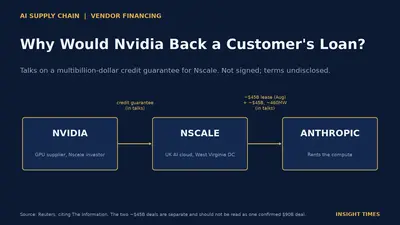
Dark navy cover. Flow diagram: Nvidia to Nscale (credit guarantee, in talks) to Anthropic (~$45B compute lease signed in August plus a separate ~$45B, ~460MW deal in talks). Title: Why Would Nvidia Back a Customer's Loan?

Why Would Nvidia Guarantee Its Customers' Data Center Loans?

Nvidia is reportedly in talks to back financing for Nscale's West Virginia data center. Nothing is signed, and the terms are not public.

Tech