Apple and Palantir Beat Estimates, but Two Questions Remain
Apple has to show how much of its revenue turns into profit. Palantir has to show how long its explosive growth can last.
The 20-second read
1. Apple: What a $114.5 billion quarter says about its real strength
Apple's fiscal fourth-quarter 2026 revenue rose 12% from a year earlier to $114.477 billion. Earnings per share rose 14% to $2.10. Full-year revenue reached $478.8 billion.
Growth gets harder to sustain as a company gets bigger. Apple already runs one of the largest consumer technology businesses in the world, yet it is still growing both revenue and profit. Its installed base of active devices also hit a record.
The key issue is less how many iPhones Apple sells than how long the devices keep generating recurring revenue.
| Metric | Figure |
|---|---|
| Products gross margin (iPhone, Mac and other hardware) | 37.2% |
| Services gross margin (services revenue of $31.57 billion) | 76.0% |
Calculated from business-segment revenue and cost of sales in Apple's SEC filings.
Services account for about 28% of revenue but about 44% of gross profit. They are the core of Apple's earnings.
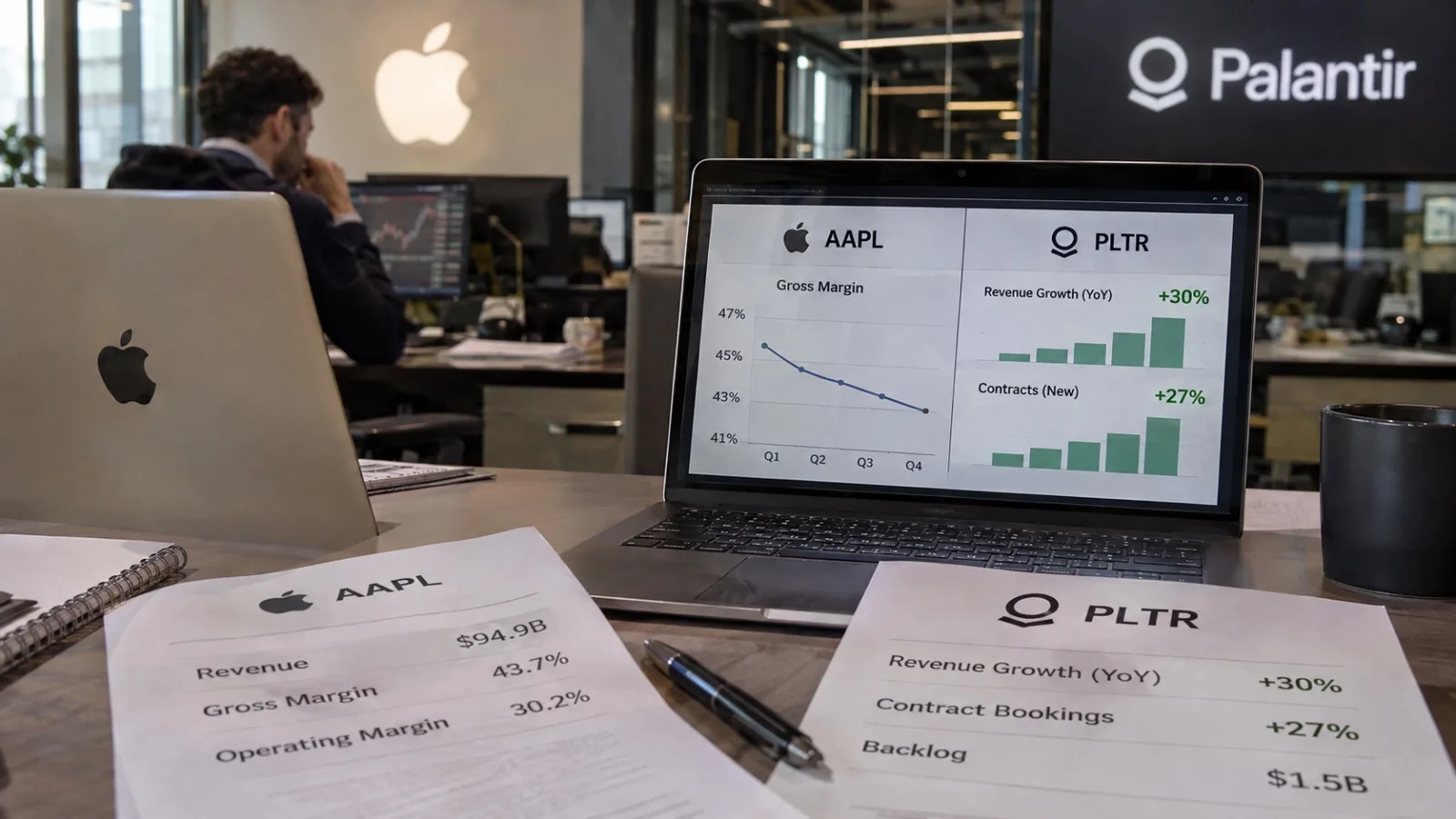
The concern is the next quarter. Apple guided to a gross margin of 45% to 46% for the October-December 2026 quarter, below the prior quarter's 47.9%. Higher memory prices and costs tied to Siri AI are weighing on it. The prior quarter's margin also included a boost of about 1 percentage point from tariff refunds.
So there is little reason to read the lower margin as weaker product competitiveness. What investors need to check is whether Apple can hold high margins once the temporary cost increases pass.
Apple still has pricing power, loyal customers and a vast installed base. If AI creates new demand for device upgrades and more services revenue, it could drive medium- to long-term profit growth.
If, on the other hand, AI spending rises without giving consumers new value they will pay for, profitability could come under pressure even as revenue grows.
The important question for Apple is not whether iPhones sell well. It is how much more profit and cash its huge customer ecosystem can produce.
2. Palantir: Something more important than 96% revenue growth
Palantir's third-quarter 2026 revenue was $2.313 billion, up 96% from a year earlier and 20% from the prior quarter. GAAP operating income was $1.085 billion, a 47% operating margin.
Adjusted free cash flow was $1.216 billion, or 53% of revenue. Explosive growth and strong cash generation showed up together at a software company. Adjusted free cash flow is a non-GAAP measure that excludes some cost items.
| Metric | Figure |
|---|---|
| Revenue growth (YoY) | +96% |
| GAAP operating margin | 47% |
| Adjusted FCF margin | 53% |
| Net dollar retention | 165% |
The most interesting number in the report, though, is not total revenue growth.
It is that U.S. commercial revenue topped U.S. government revenue for the first time.
U.S. commercial revenue was $984 million, up 148% from a year earlier. It passed U.S. government revenue of $953 million for the first time. That is evidence Palantir is broadening from a software company strong in government and defense into an AI operating platform for private businesses.
A more important metric is net dollar retention of 165%. It means trailing-12-month revenue from the existing customer cohort was 65% higher than in the 12 months before.
That shows usage is widening inside existing customers, not just through new customer wins.
In software, the stronger economics come not from adding customers but from customers using a product more deeply and paying more for it.
If Palantir ties AI adoption to real operations, and customers see the payoff and expand spending, the base for long-term growth could become sturdier.
3. Why Palantir's contract metrics deserve a look
However fast current revenue grows, long-term investors care about the contracts that will produce the next revenue.
Palantir's total new contract value (TCV) in the third quarter was $2.918 billion, up 6% from a year earlier. U.S. commercial TCV was $1.463 billion, up 11%. Both are low next to 96% revenue growth.
But TCV varies with contract length, and the timing of large deals can shift from quarter to quarter. U.S. commercial remaining deal value (RDV) was $6.517 billion, up 79%. One quarter of TCV is therefore not enough to judge future growth.
Geographic expansion is another test. The U.S. makes up about 84% of revenue. Whether the AI business model that worked in the U.S. spreads abroad at the same pace remains to be seen.
The real investment case for Palantir rests on keeping growth high while preserving today's strong margins and cash generation.
4. Same strong results, different investment judgments
Both companies run excellent businesses. That does not mean their stocks are always good investments.
| Apple | Palantir | |
|---|---|---|
| Current strength | Global device ecosystem, recurring services revenue | AI software embedded in enterprise operations |
| Growth drivers | Device upgrades, services expansion, AI features | Higher spending by existing customers, new enterprise adoption |
| Key strength | Huge cash generation, customer loyalty | High revenue growth, operating leverage |
| Key risk | Rising costs, slower services growth | Growth slowdown, high valuation |
| Long-term watch | Growth in operating income and FCF | Contract growth and revenue conversion |
Between a company's value and an investor's return sits one more variable: the price paid.
Apple is a mature large-cap tech company, and steady profit growth and shareholder returns support its value. For Palantir, the longer high growth lasts, the easier it is to justify the current valuation.
For a company like Palantir, where expectations for future growth are large, returns can be limited if the market applies a lower price-to-sales or price-to-earnings multiple, even as results keep improving.
It matters to separate a company's growth from a stock's expected return.
- It helps to separate a temporary decline, caused by rising costs or the end of a tariff refund effect, from a structural decline caused by weaker pricing power on products.
- The key test is the margin after Services revenue grows and after product prices and costs normalize.
- The current revenue growth rate is a confirmed result, while new contract metrics are a leading clue to future growth.
- Given differences in contract length and in when contracts were signed, it helps to compare RDV, net dollar retention and future revenue together.
- The current high GAAP operating margin is a positive sign.
- The next test is whether profitability holds as customer acquisition costs, headcount, stock-based compensation and overseas expansion costs rise.
- For Apple, the investment case centers on proven cash generation and a relatively mature business structure.
- For Palantir, the investment case centers on high future growth potential and the resulting risks from expectations and valuation.
- Ultimately, an investment's appeal depends not only on how good the company is but also on the valuation at the time of purchase and the required rate of return.
What to watch
Insight Times Editorial Desk