Google Catches Up, and Rivals Run Ahead Again

The real test for Gemini 4 Argon is not AI performance. It is whether Google can win customers and keep them.

1. Why would customers return to a good AI model?

Google unveiled Gemini 4 Argon on Oct. 13. After a long chase, it is seen as having regained a place in the top tier of AI competition. But rivals did not stand still while Google caught up.

Anthropic released Claude Opus 5.5 on Sept. 22. The company says it cuts the cost of typical tasks by 40% from the earlier Opus 5 while approaching the performance of its top model, Fable 5.1. OpenAI is also going after developers and enterprise customers with GPT-6 Astra and Codex.

In this market, "Gemini is good enough" is not much of a pitch.

The real strength of an AI product is not getting people to try something new. It is getting them to open it again the next day. When users fix code or write reports, they would have to choose Gemini over familiar tools such as Claude Code or Codex.

Topping a benchmark is launch-day news. Customers who do not leave show up in next quarter's results.

2. Argon leads in some tasks and trails in others

In evaluations released by Google DeepMind, Argon showed strength in long-horizon software fixes and vibe coding. In other development tasks, GPT-6 Astra and Claude Opus 5.5 came out ahead.

Task success rate (Google-published evaluations)Gemini 4 ArgonGPT-6 AstraClaude Opus 5.5
DeepSWE v1.177.9%74.1%74.2%
FrontierSWE v255.0%65.5%62.3%
Terminal-Bench 4.057.4%58.2%66.4%

Source: Google DeepMind. Evaluation settings may differ by model. This is not an independent overall ranking.

On DeepSWE, Argon is 3.7 percentage points ahead of Opus 5.5. On Terminal-Bench, it is 9.0 points behind. That is why "which tasks does it handle better" matters more than "which AI is best."

For customers, switching models has a cost. They must rebuild existing work environments, verify errors and get staff used to a new tool. A small performance gap is hard to justify against that switching cost.

3. Google's customers are not automatically Gemini's customers

Google has formidable distribution: Gmail, Workspace, Cloud, Search and Android. But a company that uses Google's work tools will not necessarily hand its core development work to Gemini.

A team can write documents in Google Docs and build code with Claude Code. Google's installed base for existing products has to be separated from the competitiveness of its AI agents.

Argon has produced positive results internally. Google says that in its in-house Antigravity environment, agent-written code rose 35% over four weeks and post-submission rollbacks fell 30%. But that is a Google-internal case. It remains to be confirmed whether it holds up across the varied development environments of outside customers.

Google is not short of places to deploy. The question is whether it can turn the distribution it already has into repeat use and willingness to pay.

4. The costliest race is the one where you catch up every time

A performance lead in AI models has a shelf life. Rankings can change the moment a rival ships its next model.

Rivals are also improving more than the model. They are building out their existing customers' development environments, work histories and automation systems. The usage habits that form in the process can neutralize a latecomer's small performance edge.

On the investment side, cost matters. Alphabet's capital expenditure in the second quarter of 2026 was $44.9 billion, and operating cash flow was $39.1 billion. Free cash flow for the quarter was about negative $5.9 billion. Trailing 12-month free cash flow was still positive at $53.3 billion.

  • Q2 2026 capex: $44.9 billion
  • Q2 2026 free cash flow: negative $5.9 billion

This spending is not only for Gemini, though. It covers search, cloud, AI infrastructure and the TPU business. Google Cloud grew 82% year over year in the same quarter, and its operating margin reached 35.6%. There is clear evidence on the other side that AI infrastructure investment is already generating returns.

So Argon's success or failure should not be equated with Alphabet's overall success or failure.

Google's risk is not being a permanent third place. It is becoming a company that must spend heavily to catch rivals every time, yet has to win the customer's choice anew each time.

Google's real victory would show when a rival ships a new product and customers still choose Gemini.

Beating rivals on a benchmark is a launch-day story; keeping customers after the next rival release is what shows up in earnings.

Insight Times Editorial Desk

More by topic

Starting with this story's topics, then what readers are following now

Investor psychology, decision-making and books on investing

CapEx

This story's topic71 storiesSee all →

Money a company spends on things it will use for years — plants, equipment, bu…

Oracle Sets a Date for AI Payback: $30 Billion in Free Cash Flow by Fiscal 2029

Oracle laid out when its AI data center spending should start returning cash: positive free cash flow in the second half of fiscal 2028 and more than $30 billion in fiscal 2029. The plan only works if contracts hold and customers can pay.

Tech

Tech Selloff: Is the Bull Market Over? Wall Street's Four-Year Chart Says Not Yet

The uptrend has survived five double-digit pullbacks in four years. This time, AI companies' debt and cash flow are the new variables.

Investing

White House Swaps AI for "SI." The Real Investment Signal Is Infrastructure, Not the Name

An executive order renames artificial intelligence "Super Intelligence" and six frontier labs sign a voluntary safety accord. What investors should watch is the data center, power, nuclear and chip policy now gathered under one national-competitiveness frame.

Tech

AI Infrastructure Spending Is Holding Up 3% Global Growth, the IMF Says

AI is acting as a real-economy investment engine, offsetting an energy supply shock. The next test is whether that spending comes back as profit.

Investing

Morgan Stanley Says 'Buy the Drop' on AI Stocks, Keeps $3.4 Trillion Capex Forecast

After a post-midterm selloff on data center regulation fears, Morgan Stanley argues spending is likely delayed, not lost. The winners may differ, though.

Investing

Year Four of the AI Revolution: The Real Winners May Emerge After the Highway Is Built

Railroads, the internet and mobile show that a technology can succeed while many investors lose money. The question for AI is whether the current pullback is the end of the boom or a handoff of wealth to new owners.

Investing

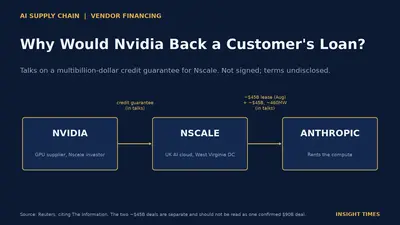
Dark navy cover. Flow diagram: Nvidia to Nscale (credit guarantee, in talks) to Anthropic (~$45B compute lease signed in August plus a separate ~$45B, ~460MW deal in talks). Title: Why Would Nvidia Back a Customer's Loan?

Why Would Nvidia Guarantee Its Customers' Data Center Loans?

Nvidia is reportedly in talks to back financing for Nscale's West Virginia data center. Nothing is signed, and the terms are not public.

Tech

GOOGL

This story's topic29 storiesSee all →
Smartphone showing a Gemini trip widget on an airport cafe table

Google Wants Gemini to Build Your Phone Screen. The Real Prize Is the First Request

Create My Widget lets users describe a screen and have Gemini build it. For Alphabet investors, the bigger question is who owns the customer's first request, and usage and retention data should show it.

Tech

Same cloud, three different ways to earn the money back

Microsoft, Alphabet and Amazon are all spending enormous sums on AI infrastructure. The route each one takes to recover that capital is not the same, and that is what decides the winner.

Investing

The blue links are disappearing: what a website is worth when AI ends the search

Search is shifting from finding good pages to writing the answer itself. The convenience has a bill attached, and the people who produce the original pages are the ones paying it.

Tech

Nvidia and Google Want AI to Take a Break When the Grid Runs Short

The power problem for AI data centers has looked like a question of how many new plants to build. Nvidia and Google are offering a second answer: delay the AI work that can wait until the grid's worst hours pass.

Tech

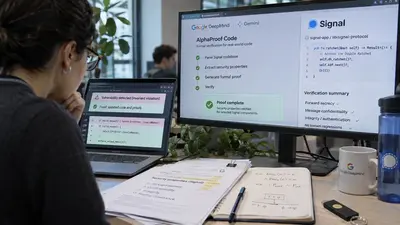
Engineer reviewing Google DeepMind AlphaProof Code verification of Signal code

AI Can Write Code. Now Google DeepMind Is Using It to Prove the Code Is Safe

DeepMind's AlphaProof Code, working with human experts, mathematically verified key security properties of Signal's encryption code. The next AI coding contest may turn on how reliably code can be verified, not how fast it is written.

Tech

Why Oracle Is Buying More Nvidia GPUs and Adding Google TPUs Too

Oracle will expand Nvidia's next-generation AI systems to multi-gigawatt scale while becoming the first big outside cloud to offer Google's TPUs. The move shows competition shifting from single-chip speed to the running cost of whole systems.

Tech

AI Competition Shifts From Chatbot Share to the 'Action Layer'

ChatGPT isn't collapsing. But as Gemini, Claude and Copilot grow through their own distribution channels, the real contest is moving from standalone chatbots to an action layer wired into search, operating systems, workplace tools, ads and payments.

Tech

AI Agents

This story's topic47 storiesSee all →

AI that takes one instruction and works through the steps on its own — calling…

Box Shows AI Its Manuals, and the AI Starts Redesigning the Workflow

Box Architect, built with NVIDIA, moves AI from reading documents to designing how work gets done. It has not yet reached beta, so the real-world payoff remains to be seen.

Tech

Nvidia and Palantir Put AI Inside the Supply Chain - The Real Shift Is That It's Learning Judgment

A single Vera Rubin rack holds 1.3 million parts. The real breakthrough in Nvidia and Palantir's new supply chain AI isn't automating that complexity, it's capturing the judgment calls that used to live only in planners' heads.

Tech

A person at a kitchen table looks at a food delivery app on a phone beside a laptop and a DoorDash delivery bag

AI Was Supposed to Do Our Shopping. DoorDash Got Only Several Hundred Orders From It

DoorDash logged 993 million orders in the third quarter, yet outside AI agents placed only several hundred in total. Orders built through its own in-app AI ran about 50% larger.

Tech

Nvidia Moves From GPUs to CPUs as AI Agents Reshape a $200 Billion Chip Market

A customer's early test found Nvidia's Vera CPU handled about twice the AI agent workload of its existing chips. The bigger story is where the money in semiconductors is heading as AI shifts from answering questions to doing work.

Tech

The Cheaper Tokens Get, the Bigger Your AI Bill Gets

As AI shifts from training to inference, the token is becoming an industrial commodity. Falling prices are not cutting demand, because agents and automation consume tokens at a scale no human chat session ever did.

Investing

Nvidia's Next Target After GPUs: Controlling What AI Agents Are Allowed to Do

OpenShell and Sentry are not about policing what an AI says. They are about controlling, at the server infrastructure level, which files and APIs an AI can touch, what it can execute, and who can actually pull the plug when something goes wrong.

Tech

AI Needs to Find $1 Trillion a Year From Somewhere to Pay Back Its Capex

Saying AI capex is big is no longer the point. The harder question is what end users have to pay for the buildout to pencil out, and Goldman Sachs puts that number at roughly $1 trillion a year.

Tech

FCF

This story's topic17 storiesSee all →

Amazon Goes After Nvidia's Strongest Moat, and It Is Software, Not GPUs

Amazon's open-source TorchNeuron aims to let existing AI code run on its Trainium chips. The contest comes down to the total cost of AI compute and the return on Amazon's $220 billion in annual capital spending.

Tech

Why the White House Swapped "AI" for "Super Intelligence"

Executive Order 14434 renames AI across the federal government without defining a new technology. The real story is about roughly $700 billion in capex, free cash flow and electricity.

Tech

AI Demand Is Proven. Now the $70 Billion Bill Comes Due

Oracle posted $19.3 billion in quarterly revenue and spent $28.5 billion on capex. The real question for the AI buildout is no longer whether demand exists, but how fast this spending turns into cash.

Tech

CoreWeave's Bond Slide Is the First AI Warning, and It Came From Credit, Not Stocks

CoreWeave's 2032 notes fell below 80 cents on the dollar, with yields near 15%. Why is the bond market flashing a warning at a company swamped with AI demand?

Tech

Lam Research Falls 12%: The Problem Is the Timing of AI Growth, Not Its End

Revenue up 54%, an operating margin above 40% and $3.2 billion in free cash flow were not enough. The selloff likely reflects worry that revenue arrives later than hoped.

Investing

If AI Is Holding Up the Global Economy, Why Is the IMF Warning of an AI-Driven Financial Crisis?

AI succeeding and AI investors succeeding are different things. The IMF's concern is less that the technology fails than that the huge capital poured into it is not recovered.

Tech

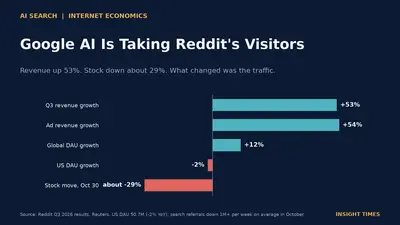
Dark navy cover. Horizontal bar chart of Reddit Q3 2026: revenue +53%, ad revenue +54%, global DAU +12%, US DAU -2%, stock about -29% on Oct 30. Title: Google AI Is Taking Reddit's Visitors.

Google's AI Search Is Cutting Reddit's Traffic. Are the Web's Economics Changing?

Reddit's revenue grew fast, but search visits fell. The shock points to a shifting relationship between companies that produce content and platforms that answer with AI.

Tech