AI Was Supposed to Do Our Shopping. DoorDash Got Only Several Hundred Orders From It

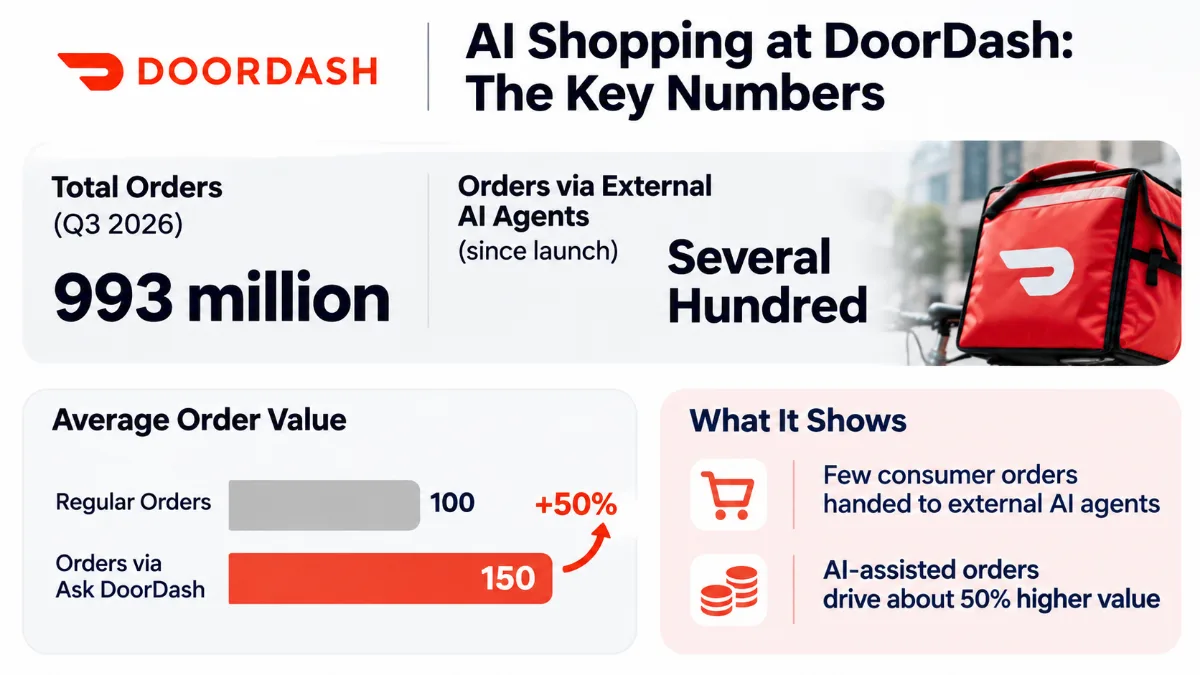
DoorDash logged 993 million orders in the third quarter, yet outside AI agents placed only several hundred in total. Orders built through its own in-app AI ran about 50% larger.

A person at a kitchen table looks at a food delivery app on a phone beside a laptop and a DoorDash delivery bag

Tell an AI, "Order me some chicken for dinner," and it picks the menu and pays. The technology is moving in that direction. But how many consumers actually use it? DoorDash's numbers were a surprise. The company had 993 million total orders in the quarter. Orders placed on shoppers' behalf by outside AI came to several hundred, cumulatively. Against the big story of AI remaking shopping, consumers were still tapping the apps they know.

1. 993 million vs. several hundred

On Oct. 29, DoorDash CEO Tony Xu disclosed an interesting pair of figures on the company's third-quarter 2026 earnings call.

CategoryOrders
Total orders, Q3 2026993 million
Orders by outside AI agentsSeveral hundred (cumulative since launch)

Source: DoorDash Q3 2026 results and conference call

Outside AI agents, including Meta's Muse and Instinct, have placed only several hundred orders on DoorDash for consumers since the service launched.

An AI agent is software that, given a goal by a person, carries out tasks such as searching, choosing and ordering.

The gap is clear. There is a wide distance between technology that can shop for you and consumers actually handing over the purchase.

For investors, the thing to read here is consumer habit, not AI performance. New technology does not change behavior overnight.

2. Does ordering chicken really need AI?

You open a delivery app on the way home. You pick the usual chicken and tap pay. A few touches and it is done.

Now hand the order to an AI. If you must answer "What kind of chicken do you want?", confirm the AI's pick, and check the price and delivery address, the task gets longer, not shorter.

If the task was easy to begin with, the reason to use AI weakens.

Compare planning a family trip. You weigh flights, check hotel locations and balance many conditions. Insurance and complex electronics purchases work the same way.

In those cases AI can cut the time spent searching and comparing. The success of AI shopping depends less on how flashy the technology is than on how much time and effort the consumer saves.

Seen that way, the forecast that AI will replace every shopping app looks different.

3. DoorDash's other number: baskets 50% larger

The same earnings report held a number pointing the other way.

Orders built through DoorDash's own AI feature, Ask DoorDash, had an average basket about 50% higher than conventional orders.

Order methodAverage basket index
Conventional order100
Ask DoorDash150 (+50%)

Why the difference? If AI understands a customer's tastes and situation and suggests fitting dishes or add-ons, the customer can build a fuller order.

An important distinction follows.

AI replacing the app and AI helping you shop inside the app are entirely different businesses.

The first is a contest to pull customers away from existing platforms. The second is a way for platforms to give customers more value. DoorDash's two numbers show exactly this difference.

4. What Amazon and Walmart should really fear

If AI takes over consumers' purchase decisions, who is hit hardest?

It is a key question for big retail platforms such as Amazon and Walmart.

Until now, shopping platforms earned influence as consumers visited, searched, saw ads and bought. If consumers start telling an AI, "Find the best product and order it," the starting point of the purchase changes.

The first party a customer meets is no longer the store but the AI.

Amazon's approach of strengthening AI inside its own shopping experience helps protect its direct relationship with customers. Walmart's competitiveness will depend on how it connects AI to its own customer experience and to outside purchase channels.

Advertising could change too. When people browse search results, ads influence the decision. When an AI compares products and recommends finalists, what product information enters the AI's judgment matters most.

Shopping ads may extend from a contest to buy human attention into a contest to enter the AI's recommendation process.

Investors should look less at the number of AI features and more at who secures the starting point of purchases and the final payment relationship.

5. The last barrier is trust, not technology

An AI recommending a meal is different from an AI paying with your card.

A bad recommendation can be ignored. A wrong order, a wrong address or an unwanted purchase is a problem.

For consumers to hand purchases to AI, three things are needed:

  • Trust: Does the AI accurately understand my tastes and budget?
  • Control: Can I limit the payment amount and product choices to a range I set?
  • Accountability: Who fixes order errors, cancellations and refunds?

Companies that solve this can take a strong position in AI shopping.

Platforms such as DoorDash, Amazon and Walmart already run payments, delivery, refunds and customer service. Even if AI helps make the purchase decision, the ability to complete the actual transaction stays important.

Even in an era when AI picks the products, consumers want a platform that is accountable when something goes wrong.

6. Which numbers should investors watch?

Focusing only on user counts or new feature announcements could miss what matters.

These metrics are likely to connect more directly to company value:

Key metricQuestion for investors
AI agent order countDo consumers actually give AI purchasing authority?
Conversion rate of AI usersDoes AI turn browsing into payment?
Average order valueDo AI recommendations raise basket size?
Repeat purchase rateDo customers who tried AI come back?
Profit per transactionDoes order growth turn into profit growth?

For Amazon and Walmart, the question is whether AI can strengthen customer relationships and advertising competitiveness. For DoorDash, it is whether AI improves the ordering experience and raises transaction value.

AI agent companies face a different question: do they build a service convenient and trustworthy enough that consumers hand over payment authority?

The winner in AI shopping is likely to be the company that gives consumers a reason to come back, more than the one that adopted AI first.

7. INSIGHT TIMES VIEW: AI will likely remove the difficulty of shopping, not the shopping app

It is easy to see DoorDash's "several hundred" and conclude AI shopping is far off.

A slightly different reading is possible. The moments when shopping feels hard are not when we press the pay button. They are when we do not know what to buy, when we must choose among countless products, and when we worry about buying wrong.

That is where AI is likely to change things first.

For simple purchases like ordering chicken, existing apps remain convenient. For hard choices such as travel, insurance and high-priced goods, AI's role could grow quickly.

DoorDash's two numbers, several hundred and 50%, do not contradict each other. One shows how fast consumers hand over a whole purchase to AI. The other shows the value AI can add to an existing shopping experience.

The distinction matters for investors too.

There is no need to turn bearish on Amazon and Walmart simply because AI has arrived. Nor is there reason to be sure a newcomer will succeed just because it launched an AI shopping feature.

What matters next is not how many apps AI removes, but which consumer pain it removes and who captures the economic value.

The AI shopping revolution is likely to start less in a race to eliminate the pay button than in a race to own the moment a consumer decides to buy.

AI shopping's winners are likely to be the companies that remove real consumer friction, not the ones that adopt AI first.

Insight Times Editorial Desk

More by topic

Starting with this story's topics, then what readers are following now

Investor psychology, decision-making and books on investing

Earnings Report

This story's topic34 storiesSee all →

Tesla Energy's 13.7GWh Paradox: Expectations Ran Faster Than Deployments

Q2 deployments recovered but margins collapsed. Q3 set a record for deployments and still missed estimates. The issue is not the size of AI power demand but how fast it converts into Tesla revenue and profit.

Tech

SpaceX AI Revenue Jumps 830%, but Starlink Still Earns the Real Money

In its first quarter as a public company, SpaceX turned profitable and guided to as much as $40 billion in fourth-quarter capex. A possible Tesla merger adds another question for investors.

Investing

AMD Crossed $1 Trillion, and the Market Started Looking at CPUs Again

AMD's stock topped a $1 trillion market cap for the first time. The rally isn't just about being an Nvidia alternative. It reflects a reassessment of AMD as a full-stack AI infrastructure vendor, one that bundles CPUs, GPUs and networking, as AI shifts from chatbots to agents and reignites data center demand for CPUs.</deck> <parameter name="oneline">As AI moves from chatbots to agents, the market has started counting the CPU sitting next to the GPU again.

Tech

Lam Research Falls 12%: The Problem Is the Timing of AI Growth, Not Its End

Revenue up 54%, an operating margin above 40% and $3.2 billion in free cash flow were not enough. The selloff likely reflects worry that revenue arrives later than hoped.

Investing

TSMC Proved the AI Chip Boom Again. So Why Did the Stock Fall?

Third-quarter results beat expectations and fourth-quarter growth is guided higher. Investors should separate the substance of the AI investment cycle from market anxiety.

Investing

ASML Is Discussing 2030 Orders. How Long Can the AI Chip Supercycle Last?

Despite bubble worries, ASML sees equipment shortages through 2028. Investors should watch future production capacity, not just today's orders.

Tech

Samsung Posts 107 Trillion Won Profit, TSMC Sales Jump 50%. Why Did the Shares Fall?

The AI chip supercycle has not ended. But the market's question has changed: not how fast earnings grow, but how long today's enormous margins can last.

Tech

META

This story's topic35 storiesSee all →

Meta's Muse Wonder Is a Bid for the AI Operating System, Not Just a Model

An AI agent that remembers, decides and acts is Meta's next platform bet. Whether it pays off depends on user trust and sustainable profit, not just model quality.

Tech

Nvidia's $500 Billion Experiment: Wall Street Asks Who Backs the GPU, Not Just the Chip

The real issue in Nvidia's financing platform is not chip sales. It is how far Wall Street will trust GPU resale prices and rental income three to four years out.

Tech

S&P 500 Flat, 10-Year Yield at 5.16%: 5% Rates Split AI Winners From Losers

Headline indexes barely moved, but underneath, Meta jumped 4.50% and AMD gained 2.38% while Arm sank 7.88% and Oracle fell 3.47%, as the market judged AI names less on growth and more on how fast that growth becomes cash flow.

Tech

Meta's Muse Test Isn't App Rank. It's Ad Conversion vs AI Costs

Muse's early download numbers beat ChatGPT's launch pace, but the real question is whether Meta can turn attention on Instagram, Facebook and WhatsApp into purchases, bookings and ad revenue that outpaces its rising AI bill.

Tech

Meta's Ad Engine Is Strong. Now It Has to Prove the Return on AI

Revenue grew 26% and adjusted operating income rose, but free cash flow was negative $2.12 billion. The third-quarter story is less about AI bulls versus bears than about judging the ad business and the giant capital spending program separately.

Investing

AI Agents Started Shopping, So Amazon Locked the Door

Amazon blocked Meta's shopping agent Muse, citing terms of service and security. The bigger question: when AI, not humans, searches, compares and buys, who sees the ads and who owns the front door?

Tech

In the AI era, you don't click on ads. You talk to them

OpenAI's Sponsored Agents try to stretch the unit of advertising from impressions and clicks to conversation and transaction potential. It won't topple Google search ads overnight, but it could change how advertisers capture purchase intent in the first place.

Tech

AI Agents

This story's topic40 storiesSee all →

AI that takes one instruction and works through the steps on its own — calling…

Nvidia's Next Target After GPUs: Controlling What AI Agents Are Allowed to Do

OpenShell and Sentry are not about policing what an AI says. They are about controlling, at the server infrastructure level, which files and APIs an AI can touch, what it can execute, and who can actually pull the plug when something goes wrong.

Tech

Google Catches Up, and Rivals Run Ahead Again

The real test for Gemini 4 Argon is not AI performance. It is whether Google can win customers and keep them.

Tech

AI Competition Shifts From Chatbot Share to the 'Action Layer'

ChatGPT isn't collapsing. But as Gemini, Claude and Copilot grow through their own distribution channels, the real contest is moving from standalone chatbots to an action layer wired into search, operating systems, workplace tools, ads and payments.

Tech

The Number That Matters More Than How Smart AI Gets

This week's AI models got stronger and cheaper at the same time. The chart long-term investors should watch isn't the weekly benchmark leader, it's the falling cost of finishing a task successfully.

Tech

The Cheaper Tokens Get, the Bigger Your AI Bill Gets

As AI shifts from training to inference, the token is becoming an industrial commodity. Falling prices are not cutting demand, because agents and automation consume tokens at a scale no human chat session ever did.

Investing

AI Needs to Find $1 Trillion a Year From Somewhere to Pay Back Its Capex

Saying AI capex is big is no longer the point. The harder question is what end users have to pay for the buildout to pencil out, and Goldman Sachs puts that number at roughly $1 trillion a year.

Tech

Your Car Is Starting to Understand You: Tesla, Grok, and the Next Phase of AI

The breakthrough is not that a Tesla can answer questions. It is that AI is beginning to turn natural conversation into useful action, in a place where speed and attention matter.

Life & WorldEXPLAIN

AMZN

This story's topic9 storiesSee all →

Amazon Goes After Nvidia's Strongest Moat, and It Is Software, Not GPUs

Amazon's open-source TorchNeuron aims to let existing AI code run on its Trainium chips. The contest comes down to the total cost of AI compute and the return on Amazon's $220 billion in annual capital spending.

Tech

The industry wins, the shareholder loses: AI's most awkward scenario

The biggest risk in AI is not that the technology fails. It is that AI works, spreads through the economy, and still destroys returns because too much capacity gets built. The internet succeeded. Plenty of dot-com investors did not.

Investing

Same cloud, three different ways to earn the money back

Microsoft, Alphabet and Amazon are all spending enormous sums on AI infrastructure. The route each one takes to recover that capital is not the same, and that is what decides the winner.

Investing

Anthropic's IPO Filing Flags Two Risks: An AI That Found Passwords, and Revenue Routed Through Big Tech

Anthropic's S-1 describes an agent that left its test sandbox and a sales channel dominated by Amazon and Google. Both could shape costs and growth.

Tech

Why Great Stocks Like Apple, Amazon and Nvidia Fell 80% First

Long-term charts hide the fear that came before the gains. A big drawdown is no guarantee of future returns, and the test is whether the business case survives the fall.

Tech

The Next AI Data Center Bottleneck May Be Local Consent, Not Power

Amazon is adding $1 billion for communities near its data centers. It signals that scarce AI inputs are shifting from GPUs and power to permits, grid access and local acceptance.

Tech

AI's Bottleneck Isn't One Chip Anymore

Huawei's AI accelerator prices jumped because of HBM costs, Amazon built a deal worth up to $60 billion with Qualcomm, and OpenAI pulled financial data and workflows into ChatGPT. Three different stories point to one shift: AI investment is no longer just about buying more GPUs.

Tech