Sandisk's Blowout Quarter Asks Where AI Money Lands After Compute
Sandisk's results are more than "AI data centers need more SSDs." The harder question for investors is how much profit remains once supply catches up with demand.
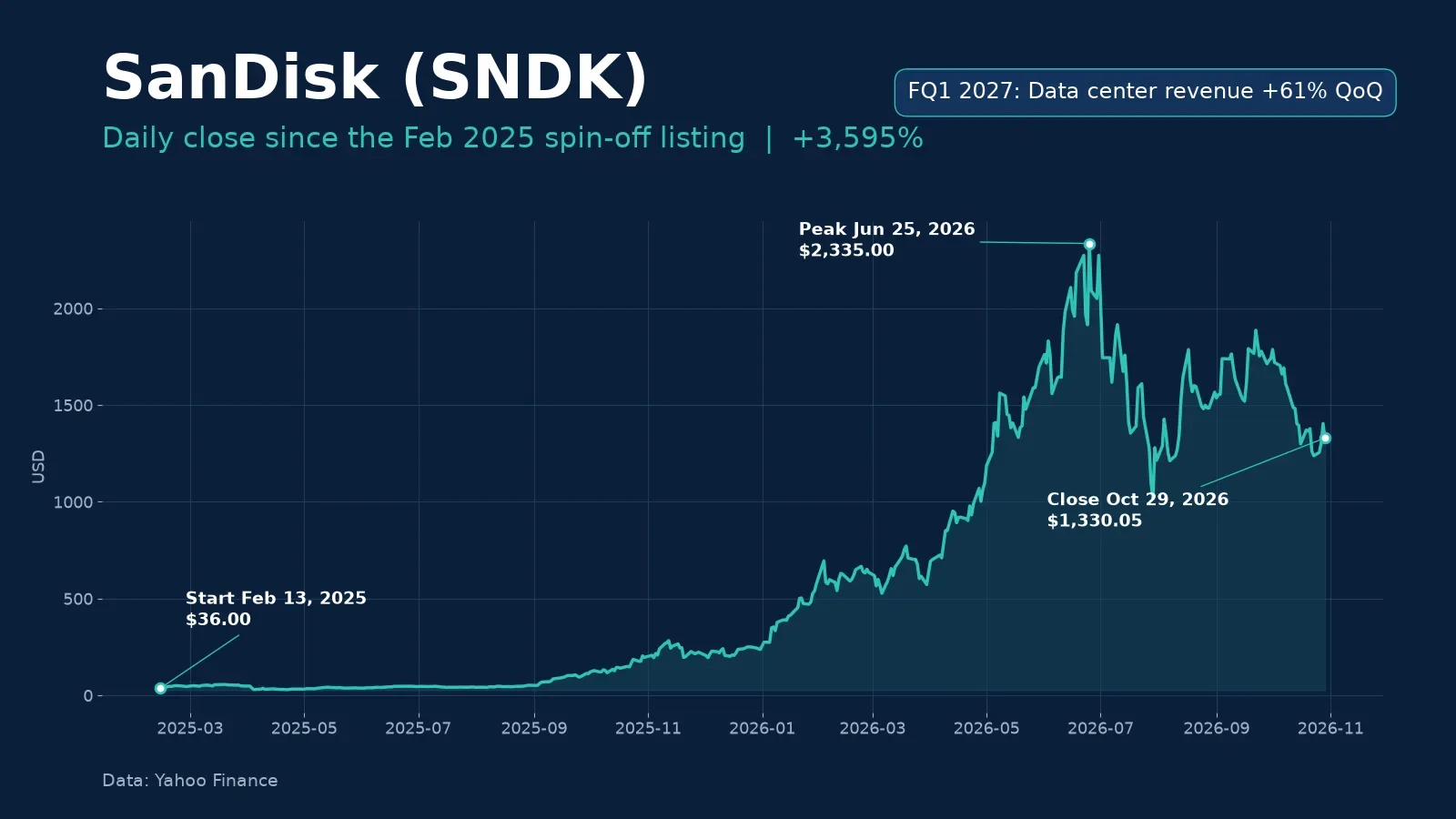
Sandisk's latest results should be read through one lens. This is not simply a story of more AI data centers selling more SSDs. It is a sign that the economic value of AI infrastructure is spreading from compute chips to the layers that feed data, preserve memory and keep expensive compute from sitting idle.
There is a twist for investors, though. Storage becoming more strategically important does not mean today's prices and margins last forever. The quarter shows how strong AI demand is. It also raises a second question: how long the scarcity profit that demand created will last.
1. The shift inside the company matters more than revenue
The report covers fiscal 2027 first quarter, which ended Oct. 2, 2026, not the first calendar quarter of 2026.
Total revenue was $11.031 billion, up 23% from the prior quarter. Within that, data center revenue rose 61% to $4.802 billion, while consumer revenue fell 29% to $397 million. Data center now accounts for about 44% of revenue.
Reading this as "the whole storage market improved" misses the point. Two different markets inside one company are moving in opposite directions. Weak consumer storage and booming data center sales appeared at the same time. That is the case for judging Sandisk by AI infrastructure purchasing power rather than by replacement demand for personal devices.
Contribution to growth matters even more. The quarter-over-quarter gain in data center revenue was about $1.8 billion, which explains most of the company's total revenue gain of about $2.1 billion. This is not an existing business with an AI label attached. The center of the revenue mix has moved.
Still, these figures alone cannot attribute all of the data center growth to AI inference demand, nor split the contribution of higher prices from higher shipments. Investors need to separate the change in the business's direction from the detailed causes of the growth.
2. SSDs move from storing data to protecting GPU productivity
The simplest way to view AI infrastructure is to treat GPUs as factories and data as raw material.
However expensive and fast the factory is, productivity falls if raw material does not arrive on time. The value of surrounding equipment is then set not by its own price but by how much it raises utilization of the core equipment.
The same question is becoming central in storage. "How cheaply can I buy a terabyte of SSD" matters less than "how much can a better storage and transfer setup cut GPU wait time."
The shift shows up in how inference context is handled. Nvidia's inference context memory architecture links GPU HBM, host memory, local SSDs and a flash-based context storage tier. It places reusable KV cache across several tiers and moves needed data ahead of time to reduce GPU stalls.
KV cache is intermediate data that lets a model reuse context it has already processed. The key is finding the best balance between the cost of recomputing context and the cost of storing and retrieving it.
None of this means SSDs replace HBM. It is the opposite. The fastest, most expensive memory cannot hold everything, so tiers with different speeds and costs must be connected more carefully.
The investment implication is clear. Competition in AI chips extends beyond individual chip performance to how much useful work a system produces by combining compute, memory, storage and networking. In that contest, storage may be valued not only for capacity but for its effect on the capital efficiency of the whole system.
3. The strongest thesis is not "there will be more data"
The argument that AI generates a lot of data and so storage demand rises points in the right direction. It is not enough as an investment case.
Not all generated data is kept for long, and not all of it goes onto high-performance SSDs.
The sharper question is this:
What information does AI need to retrieve, how often, and how fast, in order to do its job better?
For AI that uses long context and repeated tasks, the economics of reuse matter as much as capacity. If information already processed can be reused rather than recomputed, storage stops being a pure holding cost and becomes a way to cut compute cost. Efforts to put flash-based context tiers into inference infrastructure point this way.
From this angle, the companies worth watching are not simply those that supply the most bits.
First, companies that cut latency in customers' actual workloads.
Second, companies that lower storage and power costs while meeting required performance.
Third, companies with products and software links likely to be adopted repeatedly inside customer systems.
These are screening criteria, not a claim that any supplier's advantage is already settled. A rising role for the storage tier and excess returns for an individual company have to be verified separately.
4. How to read an 85% gross margin
The most striking number in the report is the margin, not revenue growth.
Sandisk's non-GAAP gross margin was 85.1%, up sharply from 29.9% a year earlier. Guidance for the next quarter is 84.5% to 85.5%. The company's near-term outlook, at least, does not build in a sharp normalization of profitability.
But a high margin creates the hardest valuation problem. A fair value differs widely depending on whether much of current profit comes from durable technology and product strength, or from pricing power during a period of constrained supply.
What is needed now is a breakdown that goes beyond "results are good."
Did revenue rise because shipped bits grew?
Did it rise because the price per bit went up?
Did profitability improve because the data center mix grew?
Did customer contract structures make future cash flow more stable?
The segment revenue in the official results cannot fully separate these factors. The blanks should not all be filled in as structural growth.
In memory stocks especially, there is a trap: the larger current earnings get, the lower the price-to-earnings ratio can look. What investors need to calculate is not a price that extends today's profit unchanged, but the profit that remains after prices and supply change.
5. Cash flow is strong too, but definitions matter
Sandisk's operating cash flow this quarter was about $6.363 billion. Free cash flow as presented by the company was $6.309 billion. Free cash flow adjusted for Flash Ventures-related flows and for prepayments and deposits under new business-model contracts was $5.696 billion.
The three numbers answer different questions. Operating cash flow shows how much cash came in from operations. Ordinary free cash flow subtracts capital spending on tangible assets. Adjusted free cash flow tries to separate further the effects of joint-venture funding and customer prepayments.
This matters because customers' behavior in securing supply in the AI chain can affect a supplier's cash flow. Prepayments ease the supplier's funding burden, but cash received in a given quarter should not be treated as the same thing as repeatable operating cash generation.
In fact, ordinary free cash flow fell from the prior quarter this time, while adjusted free cash flow rose. The headline direction and the adjusted direction differed.
AI investors now need to read not only whether revenue is real but through which contracts and financing structures the cash arrives.
6. Good news for Sandisk is not the same as good news for the cloud
Linking Sandisk's strong results to PCs and peripherals, servers and storage, and data centers and cloud is a useful start for understanding how the industry connects. For investing, those links need to be split again along the income statement.
A supplier's higher selling price is a buyer's higher cost.
That Sandisk can sell storage at higher prices does not automatically mean cloud operators' profits rise. Coverage of these results cites AI build-out demand and hyperscalers' acceptance of higher storage prices as part of the backdrop.
So interests diverge even within the same AI expansion.
For storage suppliers, what matters is selling price, product mix and supply volume.
For server makers, it is whether higher component costs can be passed on to customers, and how their systems differ.
For cloud operators, it is whether usage, revenue and productivity improve faster than infrastructure costs rise.
This is not a claim about any company's current profitability. It is a method for analyzing the value chain.
While AI spending grows, every company's revenue can rise together. Returns on investment do not necessarily improve together. Where one side's excess profit shows up as another side's cost burden, share prices within the same theme can move in different directions.
7. What to buy is the profit that remains after normalization, not AI demand
The most important change in Sandisk's results is that storage no longer sits only at the edge of AI infrastructure. Rapid data center growth and designs that extend inference context into the storage tier show that looking only at compute is not enough when discussing AI economics.
But industrial necessity and investment appeal are not the same thing.
A necessary component can lose pricing power once supply is ample. Even a company producing outstanding cash flow can disappoint on returns if that durability is already excessively priced in.
So the final question for AI chip investors reading this should not stop at "does the world need more SSDs?"
"Why must AI customers pay more for storage, and for how long can suppliers turn that spending into high cash returns?"
And one step further:
"How many years does the current share price assume for that period?"
Finding a good industry is where analysis begins. Estimating the profit that remains after scarcity fades, and comparing it with the price the market puts on that profit, is where actual investing starts.
Insight Times Editorial Desk