Karpathy's "Sharp Funnel": Why People See Such Different AIs
For some, AI is a chatbot that answers off target. For others, it is a capability climbing almost vertically. Andrej Karpathy says the gap is widening.
The 20-second read
For some people, AI is a chatbot that answers questions off target. It is a slightly more convenient search engine.
Other developers hand AI agents jobs that used to take days. At frontier labs, researchers are testing systems in which many agents collaborate over long periods.
So who is seeing AI correctly?
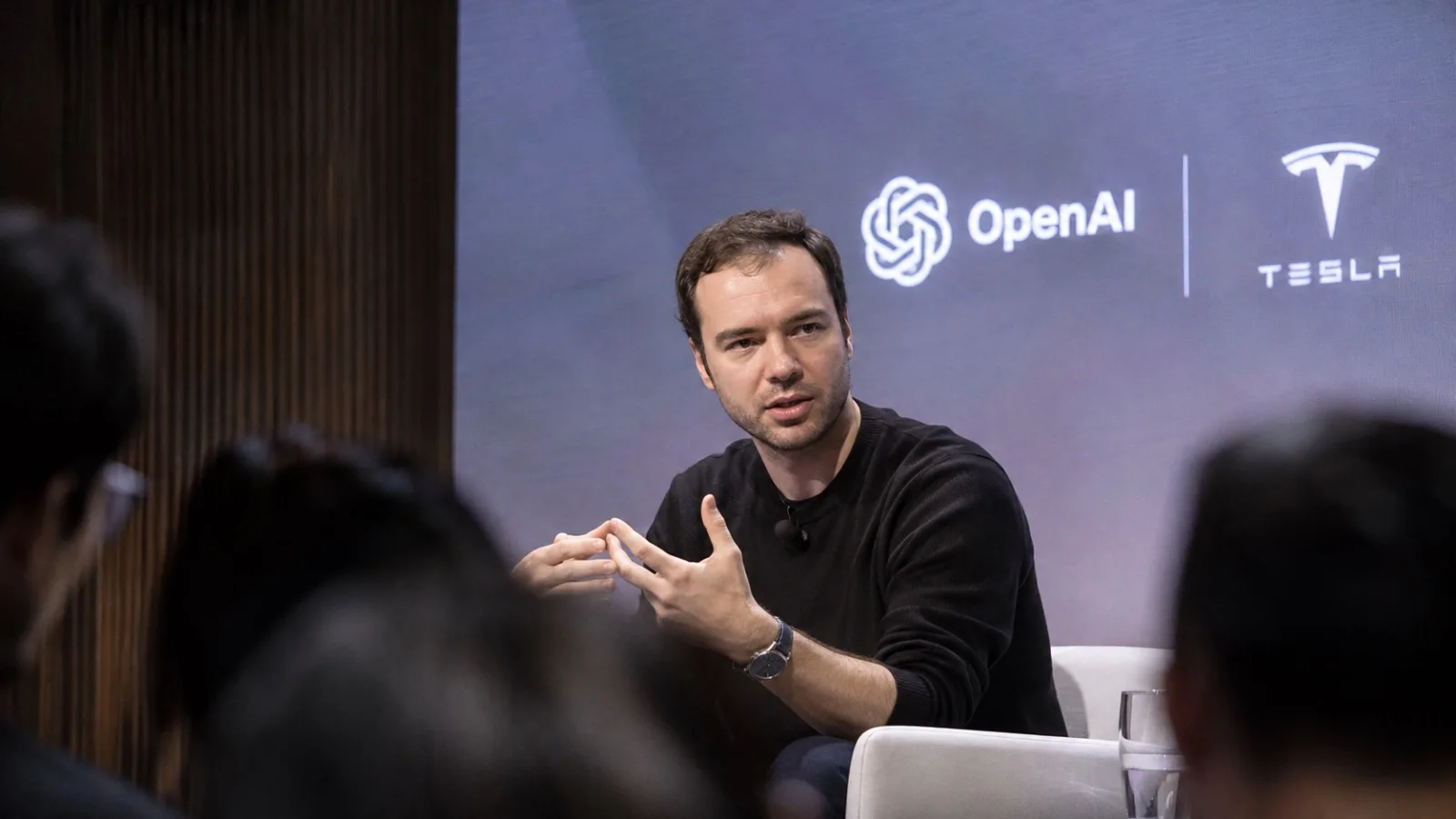
Andrej Karpathy, Tesla's former AI chief and an OpenAI co-founder, described the gap in an Oct. 11, 2026 post on X. He called it a "Sharp Funnel." In April, he said, two very different groups could barely talk to each other. Now, he argues, the gap is wider.
1. A funnel that sorts humanity into four tiers
Karpathy's estimate of four tiers of AI experience
The population figures are Karpathy's rough estimates, not official usage statistics. Bar lengths in the original graphic were conceptual, not proportional to population.
- About 6 billion people: those who have barely experienced AI.
- About 1 billion to 2 billion: occasional users of free chatbots.
- About 20 million: professionals using frontier models for their work.
- About 5,000: people with access to frontier systems inside research labs.
The first group, about 6 billion people, has barely touched a large language model (LLM). The second uses free chatbots now and then, for search, translation and writing help.
The picture changes at the third tier. About 20 million mathematicians, developers and others use high-performance models to build applications or analyze complex code. Karpathy cited cases in which agents finish projects that once took weeks or months.
The fourth group is about 5,000 people. According to Karpathy, they work with frontier systems inside labs and are seeing the potential of large-scale agent collaboration in cybersecurity, mathematics and scientific research.
The precision of the headcounts is not the point. Karpathy himself labeled them "napkin math." What matters is that judgments about the same technology change completely with how deeply a person has experienced AI.
2. Why the gap does not close
Karpathy points to three causes.
First, the size of the problem handed to AI
Short questions and answers rarely show what a strong model can do. An agent's value shows more clearly in projects that need multi-step planning, execution and revision.
Second, AI ability is uneven across fields
Current models are especially strong where answers can be checked fairly clearly, such as coding and math. In reinforcement learning, it is easier to use measurable rewards, such as whether code passes its tests.
In work where the right answer is hard to judge, such as personal taste, complex negotiation or running an organization, the benefit of better performance may be less clear.
Third, differences in access
Free-model users, paying users of high-end models and users of internal research systems do not experience the same capabilities. Some frontier features have not been released to the general public.
That makes the AI debate not only about what the technology can do, but also about differences in judgment among people who have used different products in different settings.
3. AI's output speed is outrunning human verification
The most interesting part of Karpathy's post sits at the top of the funnel.
He mentioned a case in which mathematicians are analyzing 722 AI-generated math research manuscripts. OpenAI's public research repository also holds hundreds of manuscripts, and some have not yet completed formal verification.
This does not mean AI has proved hundreds of new theorems. The validity of the results has to be confirmed separately.
Still, an important question remains. When AI-generated code and research results multiply, how quickly can humans understand and verify them?
Going forward, the variable that decides productivity may not be raw generation speed. How reliably one can finish output that can be verified may become the stronger edge.
Underrating AI is a problem. So is accepting abilities that have not been verified as achievements already delivered.
The strange moment Karpathy describes is that both realities exist at once. The key question is no longer how impressive AI is. What problems are we giving AI, and are we ready to verify the results?
- Not necessarily. Free models are good enough for many everyday tasks. But on complex, long-running projects, differences can show up depending on the high-performance model and the environment you use it in.
- More important than coding itself is the ability to define a problem clearly and verify the results. Non-developers can also see productivity gains through data analysis and work automation.
- No. It is not an official statistic from a survey of headcount at each lab. It is his rough estimate.
- The risk can grow. That is why automated testing, reproducible experiments and independent review systems are becoming more important.
What to watch
Insight Times Editorial Desk