Big Tech's Cash Is Draining. Its AI Business Is Earning More

Nomura's J-curve points to a timing gap between falling free cash flow and the payback on AI spending. For investors, the two are not the same thing.
The 20-second read

1
Profits from the AI business are growing. In the third quarter of 2026, AWS revenue rose 39% from a year earlier and Google Cloud revenue rose 103%. Cloud operating margins improved at both companies.
2
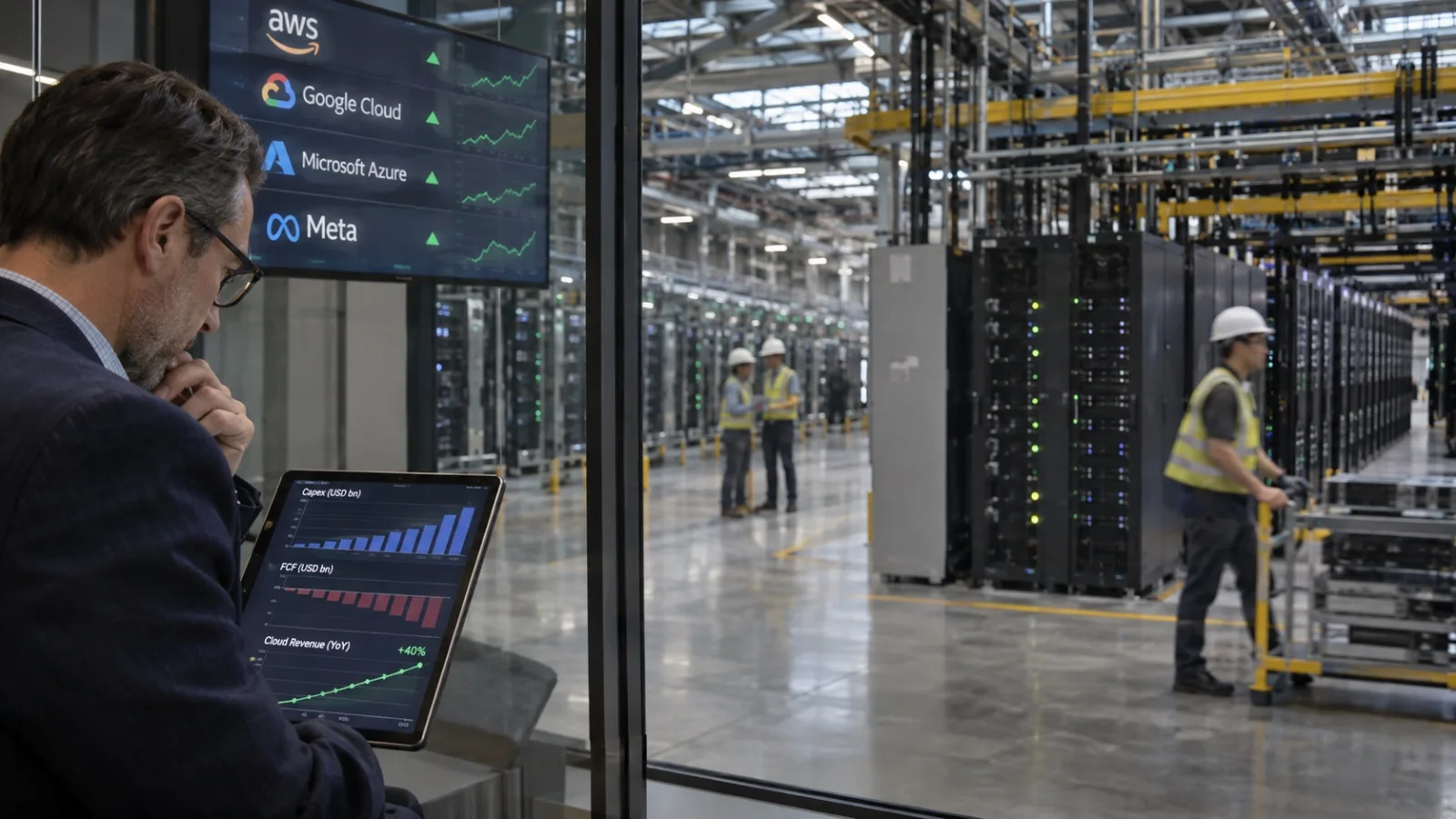
Cash flow, however, is moving the other way. Amazon's trailing 12-month free cash flow is -$42.4 billion, and Alphabet's third-quarter FCF is -$9.1 billion. Nomura interprets this as a J-curve effect, in which huge infrastructure spending is paid out first.
3
What investors need to check is the ability to bring cash back in. Cloud revenue and margins, contract backlog, and the growth rate of capital expenditure should be viewed together. Whether the J-curve actually recovers depends on the pace of future investment and cash generation.

Is cash falling because the business isn't making money?

Amazon generated $168.3 billion in operating cash flow over the past 12 months. Its free cash flow was still negative, at $42.4 billion. Capital spending, led by AI infrastructure, surged.

Alphabet tells a similar story. It reported third-quarter operating cash flow of $42.3 billion, but capital expenditure reached $51.4 billion. Free cash flow (FCF) fell to -$9.1 billion.

When a company earns cash from operations but spends more than that on data centers and chips, FCF turns negative.

The point that matters is whether a deficit comes from weak operations or from expanded investment for future earnings.

The cloud units are already highly profitable

Metric (Q3 2026, YoY)AWSGoogle Cloud
Revenue growth+39%+103%
Operating margin38.7%36.2%

Source: Amazon and Alphabet third-quarter 2026 earnings releases.

AWS posted quarterly revenue of $46 billion and operating income of about $17.8 billion. Google Cloud posted revenue of $30.7 billion and operating income of about $11.1 billion.

Google Cloud's operating margin rose to 36.2% from 23.7% a year earlier, a gain of 12.5 percentage points.

That suggests cloud profitability can improve even as AI infrastructure spending grows. One caveat: the cloud segments also include legacy businesses, so these figures do not directly prove the return on new AI data center investment.

What the J-curve really means: cash goes out first, comes back later

Nomura's J-curve is simple.

Building a data center and buying GPUs sends out a huge amount of cash at once. The revenue and cash a data center generates once it is running arrive over several years.

Companies also build new data centers every year. Cash may start flowing in from last year's facilities, but if this year's investment is larger, overall FCF can keep worsening.

How the J-curve works

A conceptual illustration of the J-curve principle: cash falls during the initial investment burden, then rises as investment is recovered. It does not show actual company FCF figures or Nomura's estimated curve.

Nomura's Nov. 2 note suggests there may be a lag between operating profit growth and an FCF recovery at Big Tech. It models the cash flow burden around 2028 and the recovery path after that.

There is an important condition. Even if investment keeps rising, the J-curve recovers only if cash generated by existing facilities grows faster than the burden of new investment.

Customers are waiting. The question is contract quality

The numbers behind the AI supply shortage are large.

CompanyDisclosed contract balance
Microsoft commercial RPO$677 billion
AWS backlog$578 billion
Google Cloud backlog$560.8 billion

Microsoft's commercial remaining performance obligation (RPO) rose 73% from a year earlier. AWS disclosed its $578 billion backlog in its third-quarter earnings discussion. Google Cloud's is $560.8 billion.

Contracts worth hundreds of billions of dollars are a positive sign of long-term demand. But a contract balance is not cash inflow. The speed at which it converts to revenue depends on customer usage, contract length, cancellation terms and the customer's ability to perform.

A key issue is whether AI company customers earn enough to keep paying for massive amounts of infrastructure.

The bottom line: the ability to recover cash after investing matters as much as the size of the AI spending itself. Investors who read the cause behind the minus sign on the cash flow statement, and the path to recovery, are likely to judge better than those who read only the sign.

Can operating profit be positive when FCF is negative?
  • Yes. Operating profit reflects depreciation spread over time, while the cost of buying equipment is recorded when the cash goes out.
If it is a J-curve, will recovery come without fail in 2028 to 2030?
  • No. That path is Nomura's estimated scenario. The timing of recovery can change depending on the growth rate of new investment, the profitability of existing equipment, and customer demand.
Are semiconductors better positioned than hyperscalers right now?
  • During an infrastructure expansion, chip suppliers can benefit first. But when investment slows, earnings volatility at chip companies can grow larger. Valuation also needs to be weighed.
What is the warning sign investors should watch most closely?
  • It is a situation where investment keeps rising while revenue growth and margins slow at the same time. That could signal a worsening return on investment, not just a timing gap in cash flow.

What to watch

Cloud growth and operating marginWhether growth holds up while margins improve.
CapEx growth and operating cash flowWhether the pace of investment growth is slowing relative to the pace of cash generation.
Conversion of RPO and backlog into revenueWhether contracted demand turns into actual billings and cash receipts.
GPU utilization and rental pricesWhether the supply shortage persists, or early signs of overcapacity appear.
Leases, borrowing, and share issuanceWhat cost the financing needed to sustain investment imposes on shareholder value.
Big Tech's cash deficits likely reflect AI investment more than weak operations, and the question is when and how much of that money comes back.

Insight Times Editorial Desk
More by topic

Starting with this story's topics, then what readers are following now

Investor psychology, decision-making and books on investing

CapEx

This story's topic69 storiesSee all →

Money a company spends on things it will use for years — plants, equipment, bu…

Amazon Goes After Nvidia's Strongest Moat, and It Is Software, Not GPUs

Amazon's open-source TorchNeuron aims to let existing AI code run on its Trainium chips. The contest comes down to the total cost of AI compute and the return on Amazon's $220 billion in annual capital spending.

Tech

SpaceX AI Revenue Jumps 830%, but Starlink Still Earns the Real Money

In its first quarter as a public company, SpaceX turned profitable and guided to as much as $40 billion in fourth-quarter capex. A possible Tesla merger adds another question for investors.

Investing

Google Catches Up, and Rivals Run Ahead Again

The real test for Gemini 4 Argon is not AI performance. It is whether Google can win customers and keep them.

Tech

Memory Chip Supercycle: Not at Peak Yet, But 5 of 6 Warning Signs Are Flashing

Memory prices are still climbing, but the pace is slowing and PC and smartphone demand is starting to crack under the weight of higher chip costs. This looks less like a price peak and more like a profit plateau building toward the next supply cycle.

Investing

Why the White House Swapped "AI" for "Super Intelligence"

Executive Order 14434 renames AI across the federal government without defining a new technology. The real story is about roughly $700 billion in capex, free cash flow and electricity.

Tech

AI's Next Bottleneck Is Money, Not Chips

Broadcom is lending Anthropic up to $42 billion, and Nvidia wants to build a $500 billion market for loans backed by GPUs. The AI race may turn on what rate buyers pay to borrow.

Tech

AWS Has Most of Its 2027 AI Compute Booked. That Is Not the Same as a Return

Customers are now contracting compute that has not been built yet. Sold-out capacity and a return on capital are different questions.

Tech

FCF

This story's topic17 storiesSee all →

Lam Research Falls 12%: The Problem Is the Timing of AI Growth, Not Its End

Revenue up 54%, an operating margin above 40% and $3.2 billion in free cash flow were not enough. The selloff likely reflects worry that revenue arrives later than hoped.

Investing

GOOGL

This story's topic23 storiesSee all →

AI Competition Shifts From Chatbot Share to the 'Action Layer'

ChatGPT isn't collapsing. But as Gemini, Claude and Copilot grow through their own distribution channels, the real contest is moving from standalone chatbots to an action layer wired into search, operating systems, workplace tools, ads and payments.

Tech

AI Data Centers in Space? The Real Test Launches This Week

On October 1, a SpaceX rocket carries a sub-50kg satellite with a Nvidia Orin NX chip and Google TPU test hardware into orbit. It is too early to call this a "space data center," but the signal is clear: the AI industry is rethinking where computing should physically sit.

Tech

Apple's Real AI Bet Isn't a Chatbot. It's Siri Running Your Apps

Apple has stepped back from the race to build a smarter chatbot than ChatGPT. Instead it is building an "OS agent" that connects Mail, Photos, Calendar and hundreds of thousands of apps to actually finish tasks. 2026 is the first year that strategy gets tested as a product, not a keynote promise.

Tech

Why Meta jumped 6.5%: Muse is the first price tag on AI compute

Muse is not a big revenue line yet. But in a capex race running toward $145 billion a year, it is the first product-shaped answer to the question every AI investor is asking: how does this money come back?

Tech

The industry wins, the shareholder loses: AI's most awkward scenario

The biggest risk in AI is not that the technology fails. It is that AI works, spreads through the economy, and still destroys returns because too much capacity gets built. The internet succeeded. Plenty of dot-com investors did not.
Investing

Same cloud, three different ways to earn the money back

Microsoft, Alphabet and Amazon are all spending enormous sums on AI infrastructure. The route each one takes to recover that capital is not the same, and that is what decides the winner.

Investing

The blue links are disappearing: what a website is worth when AI ends the search

Search is shifting from finding good pages to writing the answer itself. The convenience has a bill attached, and the people who produce the original pages are the ones paying it.

Tech

Big Tech

This story's topic12 storiesSee all →

DeepSeek's $15 Billion Raise: Model Makers May Feel It Before Nvidia Does

China's DeepSeek is closing a round about twice its original target. For US investors, the question is less the size of the check than where the money goes and whose profits it could erode.

Tech

Why Microsoft Rebuilt Copilot: AI Billing Shifts From Seats to Workload

The redesign is less about new features than about Microsoft expanding its enterprise AI revenue model beyond the per-seat subscription into task delegation and agent execution.

Tech

US Rates Are at 5%. Why Traders Still Fear a Yen Carry Blowup

The rate gap isn't the danger, the yen's speed is. A 2024 playbook suggests growth-stock investors need to watch USD/JPY, Japanese rates and volatility together, not just the Fed.

Macro

Rates Are Rising and Big Tech Is Holding. Here Is Why That Is Not a Contradiction

The 10-year yield tells you the price of money. It does not tell you how much money is left. Put the two together and the confusing headlines of the past three years line up into one picture.

Investor Mind

A 36% Crash by 2027? The Real AI Risk Is Whether the Money Comes Back

Believing AI will change the world is not the same as believing AI stocks will keep rising. The 2027 crash call turns on one question: can investors recover what they are spending?

Investing

Google's Real Moat May Not Be Search. It May Be What You Were Curious About

The EU's new legal fight with Google raises a bigger question than search regulation. In the AI era, the edge may not end with who builds the best model, it may shift to who can legally see the proprietary data and user context behind it.

Tech

If Big Tech Cuts AI Spending, What Happens to Chip Stocks?

AI's long-term growth and chipmakers' near-term profits may not move together. A Bank of Korea downside scenario for 2027 raises a question for US equity investors too.

Tech