Anthropic Books $17 Billion in a Quarter, and Still Posts a Loss

Figures from Anthropic's IPO materials show revenue surging and operating profit turning negative. The money it spends becomes revenue for cloud and chip companies.
The 20-second read

1
AI demand has shown up in real revenue. Anthropic's third-quarter 2026 revenue was $16.96 billion, about 12.3 times the same period a year earlier and up about 47% from the previous quarter.
2
Despite the surge in revenue, it posted an operating loss. It swung from an operating profit of about $974 million in the second quarter to an operating loss of about $567 million in the third. The burden comes from the cost of running AI services and various accounting costs.
3
What matters to investors is the flow of money. Anthropic has disclosed compute and related infrastructure commitments of about $895.4 billion. The structure means the costs of AI model companies become revenue opportunities for cloud, chip, and data center companies.

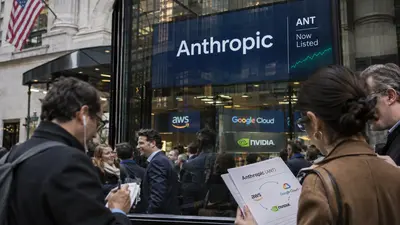
Anthropic's IPO materials contain a striking number: about $17 billion in revenue for a single quarter. Yet the maker of Claude swung back to an operating loss.

1. Revenue surges as more companies actually buy AI

  • Q3 2026 revenue: $16.96 billion
  • Growth: about 12.3 times the year-earlier quarter and up about 47% from the prior quarter

Quarterly revenue, in billions of dollars:

QuarterRevenue
Q3 2025$1.382B
Q2 2026$11.555B
Q3 2026$16.960B

The customer numbers may matter more. As of the end of September 2026, more than 1,900 customers spend over $1 million a year with Anthropic. About 250 spend over $10 million a year. Annual spending here is based on trailing 12-month revenue.

That points to companies moving past AI trials and putting substantial budgets into real work.

Expectations around AI may carry some froth. But it is increasingly clear that companies are spending real money on AI.

2. Why did it swing to a loss?

Rising revenue usually brings rising profit. The business model of an AI model company works somewhat differently.

More customers mean more computation, and that requires more GPUs and servers.

ItemQ2 2026Q3 2026
Revenue$11.56B$16.96B
Operating income+$974M-$567M
Operating marginabout +8.4%about -3.3%

Anthropic took on heavy compute and other costs while keeping up with fast demand growth. Short-term compute capacity purchases and accounting costs tied to a stock donation match weighed on profitability.

One distinction matters. A non-cash accounting charge is not the same as cash leaving the company. An operating loss alone therefore does not show that running the servers is a money-losing business.

Likewise, a positive adjusted operating profit does not make the cost burden disappear.

The key question is how much the cost of serving AI rises for each additional dollar of AI revenue.

3. A bigger number: about $895.4 billion in commitments

$895.4 billion in purchase contracts, leases and similar obligations to be fulfilled over future years. This is not money spent in one quarter, and it is not debt due immediately in full.

The reason for such large contracts is simple. With AI demand rising fast, Anthropic cannot supply the services customers want unless it secures enough servers.

And what Anthropic spends becomes another company's revenue.

  • Enterprise customers pay for Claude.
  • Anthropic builds AI models and runs the service.
  • The money then flows to cloud and data centers, GPUs and networking, power and cooling, and memory and storage.

Actual counterparties and the size of the benefit differ by company.

4. Which US-listed companies to watch

AI growth creates different opportunities for different companies.

CompanyPossible changeWhat to check
Amazon (AMZN), Alphabet (GOOGL)Higher demand for cloud servicesData-center capital spending, cash flow
Nvidia (NVDA)Rising demand for GPUs and networkingSupply expansion, margin retention
Data-center and power companiesExpansion of facilities needed to run serversActual orders, utilization, power access
Anthropic (IPO planned)AI usage and revenue growthCompute cost, margins, valuation

A caution applies. Not all of what AI model companies spend turns into net profit for chip makers. Cloud providers must invest heavily in power and equipment, and GPU suppliers can face competition and falling prices.

In AI investing, it matters who takes the revenue and also how much of that revenue they keep as profit and cash.

Three things to watch

  • Anthropic's compute cost ratio: A falling ratio of costs to revenue would signal better economics for the AI model business.
  • Profitability at Amazon's AWS and Google Cloud: This shows whether rising AI demand covers data-center spending and still leaves cash.
  • Anthropic's IPO valuation: A starting point for judging what price to pay for high growth, and how much future profit is already in the price.
Is Anthropic's loss a bad sign for the AI industry as a whole?
  • Not necessarily. Customer demand and revenue growth are positive in themselves.
  • What needs sorting out is whether the cost increase is structural and ongoing, and how much one-time cost is included.
If adjusted operating profit is positive, isn't the company actually making money?
  • Adjusted operating profit is a profitability measure that leaves out some costs.
  • To judge a company's overall economics, you also need to check stock-based compensation, cash flow, and the burden of long-term contracts.
Will Nvidia and cloud companies keep benefiting?
  • Rising use of AI services is a positive factor for chip and cloud demand.
  • However, actual investment results can differ depending on revenue growth, capital spending, price competition, and margin changes.
Would Anthropic be a good investment opportunity if it goes public?
  • Its growth is confirmed in its results, but the listing price is a separate matter.
  • You would need to compare the IPO offering price, the expected market capitalization, and the market's expectations for future cash flow.

What to watch

Anthropic's compute cost ratioWatch next quarter's results to see whether compute costs as a share of revenue are falling.
Return to operating profitCheck whether operating income, which was -$567 million in the third quarter, turns positive again.
AWS and Google Cloud profitabilityQuarterly results will show whether AI demand covers data center investment costs and still leaves cash.
Anthropic's IPO valuationIt is worth weighing the valuation offered at the IPO against quarterly revenue of $16.96 billion.
Anthropic's revenue grew fast but it posted a loss, and that spending becomes revenue for infrastructure companies such as cloud and chip makers.

Insight Times Editorial Desk
More by topic

Starting with this story's topics, then what readers are following now

Investor psychology, decision-making and books on investing

IPO

This story's topic21 storiesSee all →

SoftBank Bet $64.6 Billion on AI. Why Is the Market Pricing Default Risk?

Believing in AI's future is not the same as backing a company that can survive until it arrives. SoftBank's credit spike raises that question for long-term investors.

Tech

Anthropic Started Late but Took the Lead in Enterprise AI Revenue

Claude Code changed the game. But understanding the $2 trillion IPO story means looking past explosive revenue growth to $518 billion in compute commitments and customer concentration.

Tech

Anthropic's IPO: The Number That Matters More Than $100 Billion Is $2 Trillion

Claude-maker Anthropic is growing at a stunning pace, but the real question for investors is not how fast, only how long, and how much cash is left after GPUs and data centers.

Tech

Editorial chart cover: illustrative 18-year growth of one SpaceX (SPCX) share in a Trump account, comparing 7% vs 10% returns and 5-20% share growth scenarios.

Why Musk wants to give 72 million US children a share of SpaceX
Elon Musk says he will gift one SpaceX share to every American child. The plan is not yet detailed, and the bigger driver of a child's wealth may be 18 years of steady saving.

Investing

Anthropic Talked Slowdown. Its Actions Say Otherwise

A next-gen Claude model, an IPO push, and an actual biology lab. Put the three together and Anthropic's message isn't "stop AI." It's build stronger models while scaling up verification and control at the same pace.

Tech

The AI Race Just Got Its First Brake: What Amodei, Altman and Musk's Slowdown Signals

For the first time, AI safety concerns are shaping both model release schedules and IPO timing at once. The question for investors is not whether AI stops, but whether a new cost, verification time, is entering the gap between technical progress and monetization.

Tech

AI's Next Bottleneck Is Money, Not Chips

Broadcom is lending Anthropic up to $42 billion, and Nvidia wants to build a $500 billion market for loans backed by GPUs. The AI race may turn on what rate buyers pay to borrow.

Tech

A building that houses servers and networking gear and supplies them with powe…

Why Nebius Is Keeping Some 2027 AI Capacity Off the Shelf

Nebius mixes long-term contracts, short-term premiums and auctions. Holding back capacity pays only if the servers stay busy, and it is not yet clear the pricing will last.

Tech

AI ran out of memory before it ran out of GPUs

The HBM bottleneck is spreading into DRAM prices, server costs and the price of the next laptop or phone.

Tech

Is Space Cooler for AI? Why Musk Wants Data Centers in Orbit

The next limit on AI may be power and cooling, not GPUs. Elon Musk is looking to Earth orbit for an answer, but the test is cost per hour of compute.

Tech

White House Swaps AI for "SI." The Real Investment Signal Is Infrastructure, Not the Name

An executive order renames artificial intelligence "Super Intelligence" and six frontier labs sign a voluntary safety accord. What investors should watch is the data center, power, nuclear and chip policy now gathered under one national-competitiveness frame.

Tech

Musk Sees the Next Phase of AI Infrastructure: Who Can Switch GPUs On, Fast

If neoclouds struggle under financial pressure, AI demand may not shrink. It may simply favor the few operators with the capital and execution to serve it, a shift that could matter for SpaceX and Tesla.

Tech

Weekly Check: The AI Bull Market Isn't Over, It's Just Gotten Harder

A 5% 10-year yield, 470 gigawatts stacked up in Texas, Chinese DRAM, and whether data centers actually get switched on are starting to decide who wins the AI trade through 2027.

Tech

Is Memory Peaking? In the AI Era, Watch the Bottleneck, Not the Demand

Demand still outruns supply. But memory stocks can peak before demand does. The real question is how long HBM4, server DRAM, CXL and Big Tech capex keep the cash flowing.

Tech

NVDA

101 storiesSee all →

Who Hits $1 Trillion Next: Reading AMD and ASML by Different Rules

One company is chasing Nvidia's GPU empire. The other sells the machine that draws the chips for every advanced chipmaker, including Nvidia. Both get floated as 2028 trillion-dollar candidates, but the numbers investors need to watch are entirely different.

Investing

Box Shows AI Its Manuals, and the AI Starts Redesigning the Workflow

Box Architect, built with NVIDIA, moves AI from reading documents to designing how work gets done. It has not yet reached beta, so the real-world payoff remains to be seen.

Tech

Tech Selloff: Is the Bull Market Over? Wall Street's Four-Year Chart Says Not Yet

The uptrend has survived five double-digit pullbacks in four years. This time, AI companies' debt and cash flow are the new variables.

Investing

Marvell's $115 Billion Lumentum Deal: Is AI's Next Bottleneck Light, Not Chips?

Marvell's purchase of Lumentum points to a contest beyond GPU speed, in data transfer and power efficiency. Whether the price is right is not yet confirmed.

Tech

Nvidia and Palantir Put AI Inside the Supply Chain - The Real Shift Is That It's Learning Judgment

A single Vera Rubin rack holds 1.3 million parts. The real breakthrough in Nvidia and Palantir's new supply chain AI isn't automating that complexity, it's capturing the judgment calls that used to live only in planners' heads.

Tech

If You Only Watch Tesla, You May Be Missing Half the AI Story

Nvidia builds the AI brain. Who supplies the electricity to run it? Six power companies Tesla investors should know, and why Tesla's storage business is just one link in the chain.

Investing

Nvidia Moves From GPUs to CPUs as AI Agents Reshape a $200 Billion Chip Market

A customer's early test found Nvidia's Vera CPU handled about twice the AI agent workload of its existing chips. The bigger story is where the money in semiconductors is heading as AI shifts from answering questions to doing work.

Tech

GPU

73 storiesSee all →

A chip built to draw graphics, whose ability to run thousands of identical cal…

The Next AI Chip Race Is About How Chips Connect

Applied Materials will lift its stake in Dutch equipment maker BESI from about 9% to 20%. The bet is less about control than about a new way to link chips.

Tech

US AI Data Centers Are Headed for 90GW. Gigawatts Now Matter More Than Dollars

Goldman Sachs expects US data center capacity to grow from 64GW at the end of 2026 to 90GW at the end of 2027. The AI race is moving from buying GPUs to building power plants and transmission lines alongside them.

Tech

Nvidia's $500 Billion Experiment: Wall Street Asks Who Backs the GPU, Not Just the Chip

The real issue in Nvidia's financing platform is not chip sales. It is how far Wall Street will trust GPU resale prices and rental income three to four years out.

Tech

The Cheaper Tokens Get, the Bigger Your AI Bill Gets

As AI shifts from training to inference, the token is becoming an industrial commodity. Falling prices are not cutting demand, because agents and automation consume tokens at a scale no human chat session ever did.

Investing

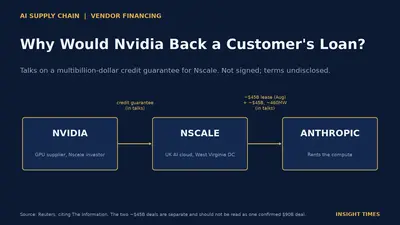
Dark navy cover. Flow diagram: Nvidia to Nscale (credit guarantee, in talks) to Anthropic (~$45B compute lease signed in August plus a separate ~$45B, ~460MW deal in talks). Title: Why Would Nvidia Back a Customer's Loan?

Why Would Nvidia Guarantee Its Customers' Data Center Loans?

Nvidia is reportedly in talks to back financing for Nscale's West Virginia data center. Nothing is signed, and the terms are not public.

Tech

Two Companies Drive 34% of S&P 500 Earnings Growth as AI Pays Sellers First

Nvidia and Micron generate a third of expected earnings growth in US large caps. Apollo says the financial effect of AI is not yet visible in the S&P 493.

Investing

Amazon Goes After Nvidia's Strongest Moat, and It Is Software, Not GPUs

Amazon's open-source TorchNeuron aims to let existing AI code run on its Trainium chips. The contest comes down to the total cost of AI compute and the return on Amazon's $220 billion in annual capital spending.

Tech