Nvidia Put $2 Billion Into Lumentum. Optics May Be the Next Bottleneck, but the Stock Has Already Run

Optical networking is emerging as the next constraint on AI data centers. Investors need to separate the industry's growth potential from the price they are already paying for it.
1. Why light may be the next AI data center bottleneck

On Oct. 9, 2026, Lumentum CEO Michael Hurlston said in a Bloomberg interview in Tokyo that production capacity for some optical components is fully booked through early 2029.

He also said some products are expected to fall short of demand by about 70% through 2027, and others by about 30% through 2028. These describe different product lines. They are not a shortage rate for the optical industry as a whole.

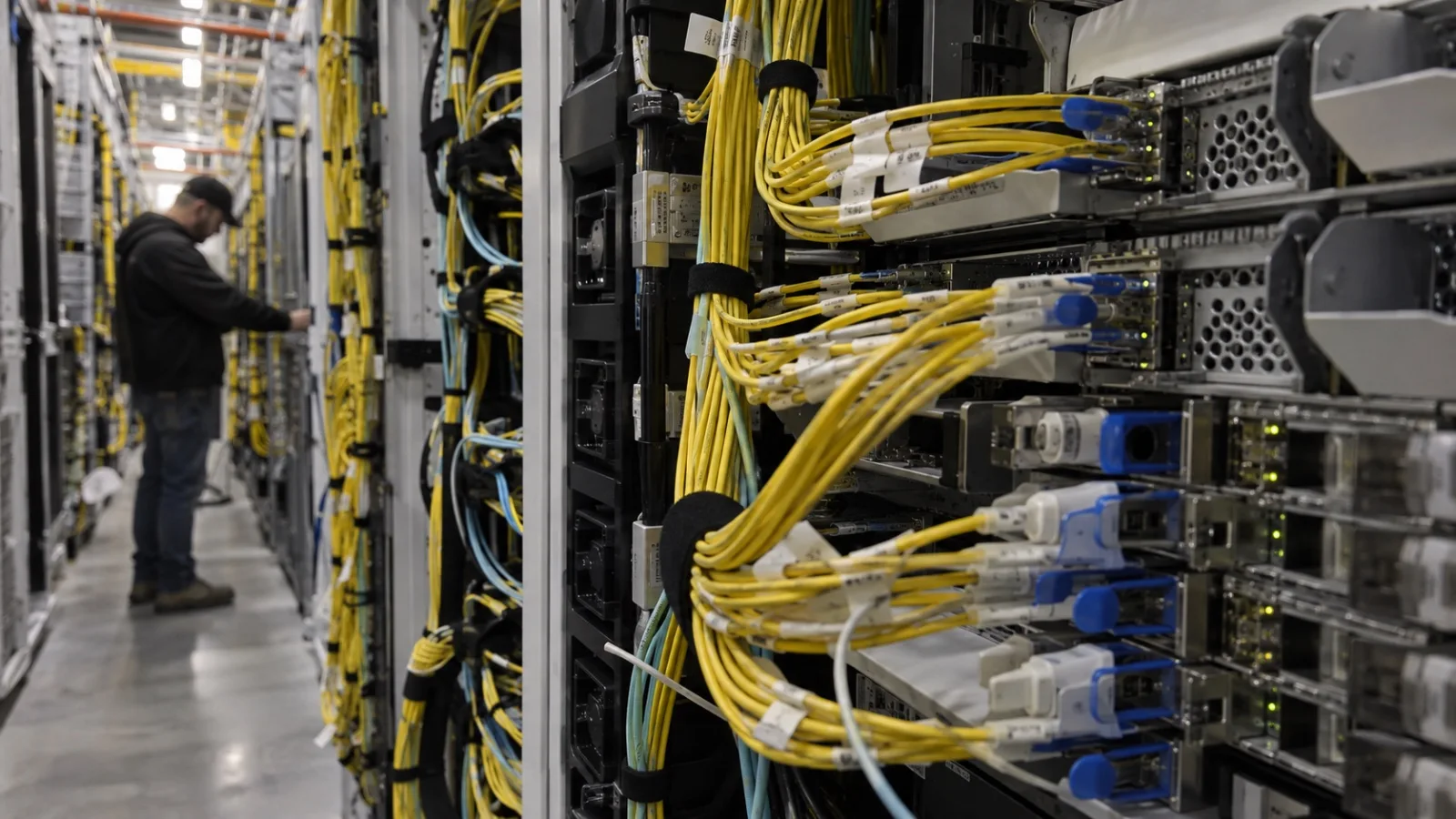
In an AI data center, GPUs do the computing. The network moves the data those GPUs need. Training a large AI model requires many GPUs to exchange results continuously.

If the network slows, expensive GPUs spend more time waiting for data. That is why adding GPUs does not raise total system performance in proportion.

GPU -> Network -> GPU: a delay in high-speed data exchange lowers overall computing efficiency.

Optical networking converts electrical signals into light to move large volumes of data quickly. It is central to high-speed links between servers and to scaling data centers. Not every connection will turn optical, though. Copper and optical links will coexist, depending on distance, power efficiency and cost.

2. Why Nvidia put $4 billion into optical companies

On March 2, 2026, Nvidia announced strategic agreements to invest $2 billion in Lumentum and $2 billion in Coherent.

The agreements include multiyear purchase commitments, access to future production capacity, and expanded research and development and U.S. manufacturing. Both deals are non-exclusive.

Nvidia is not seeking investment returns alone. It also wants to reduce the risk that a shortage of optical parts delays customers' AI system builds.

That suggests a GPU supplier now has to manage the supply chain for networking, connectivity and the whole system, not just chips.

Nvidia's interests differ from those of ordinary shareholders, however. Nvidia can gain strategically from a secure supply of parts. Shareholders have to weigh today's share price against future cash flow.

3. The industry looks promising, but the stock has already climbed

Rising demand for optical networking is not new. About six months earlier, Lumentum had said its capacity would be booked through 2028.

What changed in the latest news is that the shortage could last longer than expected.

The share price already reflects much of that growth expectation.

  • Lumentum close, Oct. 9, 2026: $1,103.36 (+5.22% on the day)
  • Coherent close, Oct. 9, 2026: $312.62 (+3.40% on the day)

Lumentum rose about 184%, from $368.59 at the end of 2025 to $1,048.60 on Oct. 8, the day before the shortage reports. It is also up about 50% from $700.91 on Feb. 27, just before Nvidia's investment announcement.

Valuation is hard to ignore. Applying the provided fiscal 2027 normalized EPS estimate of $21.78, the Oct. 9 close implies a forward P/E of about 50.7. Normalized EPS differs from GAAP earnings, and the multiple can vary with how estimates are compiled.

Coherent has also been re-rated sharply. Neither company is easy to present as an AI beneficiary the market has yet to discover.

4. Earnings can grow 30% and the stock can still fall

In growth investing, the rate of earnings growth is not the only thing that matters. So does any change in the multiple investors apply to those earnings, the P/E.

EPS changeP/E changeTheoretical price change
+30%50x to 50x+30%
+30%50x to 40x+4%
+30%50x to 35x-9%
+50%50x to 35x+5%

Simple arithmetic assuming a starting P/E of 50x. Not a price target or return forecast.

A company can grow as expected and still see its P/E shrink if the market judges that growth as less durable. If results keep beating expectations, a high multiple could hold or even expand.

So the central question for Lumentum is not whether optical demand will grow.

It is how far actual EPS can exceed current market estimates, and how long that growth can last.

5. "Sold out through 2029" is not guaranteed profit

Booked capacity improves visibility into demand. It does not mean all revenue and profit for that period are locked in.

A shortage signals strong demand. It also means the volume that can be shipped is limited. Unmet demand is not yet revenue.

Expanding production takes time and money. Delays in adding capacity limit how fast sales convert. If demand or technology shifts by the time new plants are finished, the burden of recovering the investment grows.

That is why laser and optical component yields, average selling prices, gross margins and free cash flow all need checking.

6. Which companies could benefit

CompanyRole in the industryKey investment question
Lumentum (LITE)Lasers and optical components for high-speed optical networkingHow fast added supply turns into EPS and cash flow
Coherent (COHR)Optical materials, lasers and optical networking componentsProfitability by business, expansion efficiency, how much growth is priced in
Broadcom (AVGO)AI network switches and custom chipsNetworking revenue and contribution to overall AI results
Marvell (MRVL)Data center connectivity chips and optical-related technologyCustomer adoption and gross margin by product

All four are tied to the optical ecosystem, but their business models differ. A shortage in one Lumentum product should not be translated directly into Broadcom's or Marvell's overall growth rates.

Optical networking is likely the next bottleneck in AI data centers, but Lumentum's stock already reflects much of that expectation.

Insight Times Editorial Desk

More by topic

Starting with this story's topics, then what readers are following now

Investor psychology, decision-making and books on investing

Data Centers

This story's topic90 storiesSee all →

A building that houses servers and networking gear and supplies them with powe…

US AI Data Centers Are Headed for 90GW. Gigawatts Now Matter More Than Dollars

Goldman Sachs expects US data center capacity to grow from 64GW at the end of 2026 to 90GW at the end of 2027. The AI race is moving from buying GPUs to building power plants and transmission lines alongside them.

Tech

Why the White House Swapped "AI" for "Super Intelligence"

Executive Order 14434 renames AI across the federal government without defining a new technology. The real story is about roughly $700 billion in capex, free cash flow and electricity.

Tech

Nvidia's Next Target After GPUs: Controlling What AI Agents Are Allowed to Do

OpenShell and Sentry are not about policing what an AI says. They are about controlling, at the server infrastructure level, which files and APIs an AI can touch, what it can execute, and who can actually pull the plug when something goes wrong.

Tech

2027 Investing Needs Alignment, Not Prediction

A new investing book argues the hard part was never picking the next winner. It's staying aligned with where value and bottlenecks are moving while keeping old human weaknesses in check.

Investor Mind

AMD Crossed $1 Trillion, and the Market Started Looking at CPUs Again

AMD's stock topped a $1 trillion market cap for the first time. The rally isn't just about being an Nvidia alternative. It reflects a reassessment of AMD as a full-stack AI infrastructure vendor, one that bundles CPUs, GPUs and networking, as AI shifts from chatbots to agents and reignites data center demand for CPUs.</deck> <parameter name="oneline">As AI moves from chatbots to agents, the market has started counting the CPU sitting next to the GPU again.

Tech

Why Nebius Is Keeping Some 2027 AI Capacity Off the Shelf

Nebius mixes long-term contracts, short-term premiums and auctions. Holding back capacity pays only if the servers stay busy, and it is not yet clear the pricing will last.

Tech

DeepSeek's $15 Billion Raise: Model Makers May Feel It Before Nvidia Does

China's DeepSeek is closing a round about twice its original target. For US investors, the question is less the size of the check than where the money goes and whose profits it could erode.

Tech

NVDA

This story's topic85 storiesSee all →

Amazon Goes After Nvidia's Strongest Moat, and It Is Software, Not GPUs

Amazon's open-source TorchNeuron aims to let existing AI code run on its Trainium chips. The contest comes down to the total cost of AI compute and the return on Amazon's $220 billion in annual capital spending.

Tech

The US-China Summit Didn't Erase Taiwan Risk for Chip Stocks
Washington's Taiwan policy held, but roughly $14 billion in arms sales is still on hold. For AI chip investors, the summit reads less like risk removed and more like a fragile balance extended.

Macro

AI's Next Bottleneck Is Money, Not Chips

Broadcom is lending Anthropic up to $42 billion, and Nvidia wants to build a $500 billion market for loans backed by GPUs. The AI race may turn on what rate buyers pay to borrow.

Tech

ASML Is Discussing 2030 Orders. How Long Can the AI Chip Supercycle Last?

Despite bubble worries, ASML sees equipment shortages through 2028. Investors should watch future production capacity, not just today's orders.

Tech

Tesla Energy's 13.7GWh Paradox: Expectations Ran Faster Than Deployments

Q2 deployments recovered but margins collapsed. Q3 set a record for deployments and still missed estimates. The issue is not the size of AI power demand but how fast it converts into Tesla revenue and profit.

Tech

Why Nvidia Is Happy to Help Make AI Models Nearly Free

Falling model prices can squeeze model makers. For Nvidia, the number that matters is the total volume of tokens generated worldwide and the compute that produces them.

Tech

The Number That Matters More Than How Smart AI Gets

This week's AI models got stronger and cheaper at the same time. The chart long-term investors should watch isn't the weekly benchmark leader, it's the falling cost of finishing a task successfully.

Tech

GPU

This story's topic61 storiesSee all →

A chip built to draw graphics, whose ability to run thousands of identical cal…

The Next AI Chip Race Is About How Chips Connect

Applied Materials will lift its stake in Dutch equipment maker BESI from about 9% to 20%. The bet is less about control than about a new way to link chips.

Tech

Musk Borrowed $40 Billion for GPUs. He Also Warned AI Cloud Firms Could Go Bust

SpaceX's giant financing shows a new dividing line in AI: who borrows matters as much as how much is spent. Firms with other revenue may outlast those that rent out GPUs alone.

Tech

AI Data Centers' Next Bottleneck: Getting Power From the Grid to the GPU

Securing a gigawatt of power does not mean a gigawatt reaches GPU compute. The next fight in AI infrastructure is happening inside the data center, over how little electricity gets wasted before it reaches the chip.

Tech

AI Stops Just Talking, Starts Working: The Second Infrastructure Cycle

The center of the AI race is shifting from chatbot performance to agents that finish real work. For investors, what matters is not model rankings but how a single query turns into dozens of inference calls, pulling demand beyond GPUs into CPUs, HBM, networking and power.

Tech

The AI Bubble Question Has Changed: By Late 2026, It's ROIC Over GPUs

There is no sign yet that AI investment is slowing. If anything, hyperscaler spending forecasts keep climbing. But as the scale of that capital has grown, the market's question has shifted from "is AI growing" to "when, and how much, does this capital come back as cash."

Tech

If GPUs Are the Muscle, the Network Is the Nervous System

AI data centers do not get faster just by buying more GPUs. When thousands of accelerators cannot exchange data on time, the most expensive asset in the building sits idle. That is the whole investment case for Arista.

Investing

Nvidia's $500 Billion Experiment: Wall Street Asks Who Backs the GPU, Not Just the Chip

The real issue in Nvidia's financing platform is not chip sales. It is how far Wall Street will trust GPU resale prices and rental income three to four years out.

Tech

Valuation

This story's topic32 storiesSee all →

Measuring where a share price sits relative to the company’s results.

Anthropic's IPO: The Number That Matters More Than $100 Billion Is $2 Trillion

Claude-maker Anthropic is growing at a stunning pace, but the real question for investors is not how fast, only how long, and how much cash is left after GPUs and data centers.

Tech

Oil at $110, 10-Year Yield at 5%: The Discount Rate on Growth Stocks Is Rising Again

Brent crude spiked to $109.97 intraday and the US 10-year Treasury yield tested the 5% threshold. What matters is not the numbers themselves but that oil-driven inflation fears are pushing bond yields higher across the globe at once.

Macro

ARK Sets Tesla 2031 Target at $4,400, Betting on 8.1 Million Robotaxis and Optimus

ARK Invest's new model implies a $17.5 trillion market cap for Tesla by 2031. It reads less like a forecast than a scenario that assumes robotaxis and robots earn real money.

Tech

AI Needs to Find $1 Trillion a Year From Somewhere to Pay Back Its Capex

Saying AI capex is big is no longer the point. The harder question is what end users have to pay for the buildout to pencil out, and Goldman Sachs puts that number at roughly $1 trillion a year.

Tech

Year Five of the Bull Market: Why U.S. Stocks Aren't Expensive Yet, and What AI Chips and Power Must Deliver

U.S. stocks have gained about 117% since the October 2022 low. What happens next depends less on the bull market's age than on whether expected earnings, which lean heavily on AI semiconductors, turn into reality.

Investing

AI Can Lift More Than Stocks: It May Push Long-Term Yields Higher Too

The AI boom can grow the numerator of corporate earnings while also growing the denominator of the discount rate. Investors watching long-term Treasury yields now need to add "AI capital demand" to the Fed, inflation and the deficit.

Tech

Lam Research Revenue Jumped 54%. The Stock Fell 12%. Here Is Why

Record results and a sharp sell-off at Lam Research show a paradox of growth investing. The key question is not how fast a company grows, but how much investors paid for that growth.

Tech