Meta's Ad Engine Grew 26%, but Free Cash Flow Turned Negative on AI Spending
Meta beat revenue estimates in the third quarter, but operating margin halved and free cash flow fell below zero. The company now has to show its AI spending earns a return.
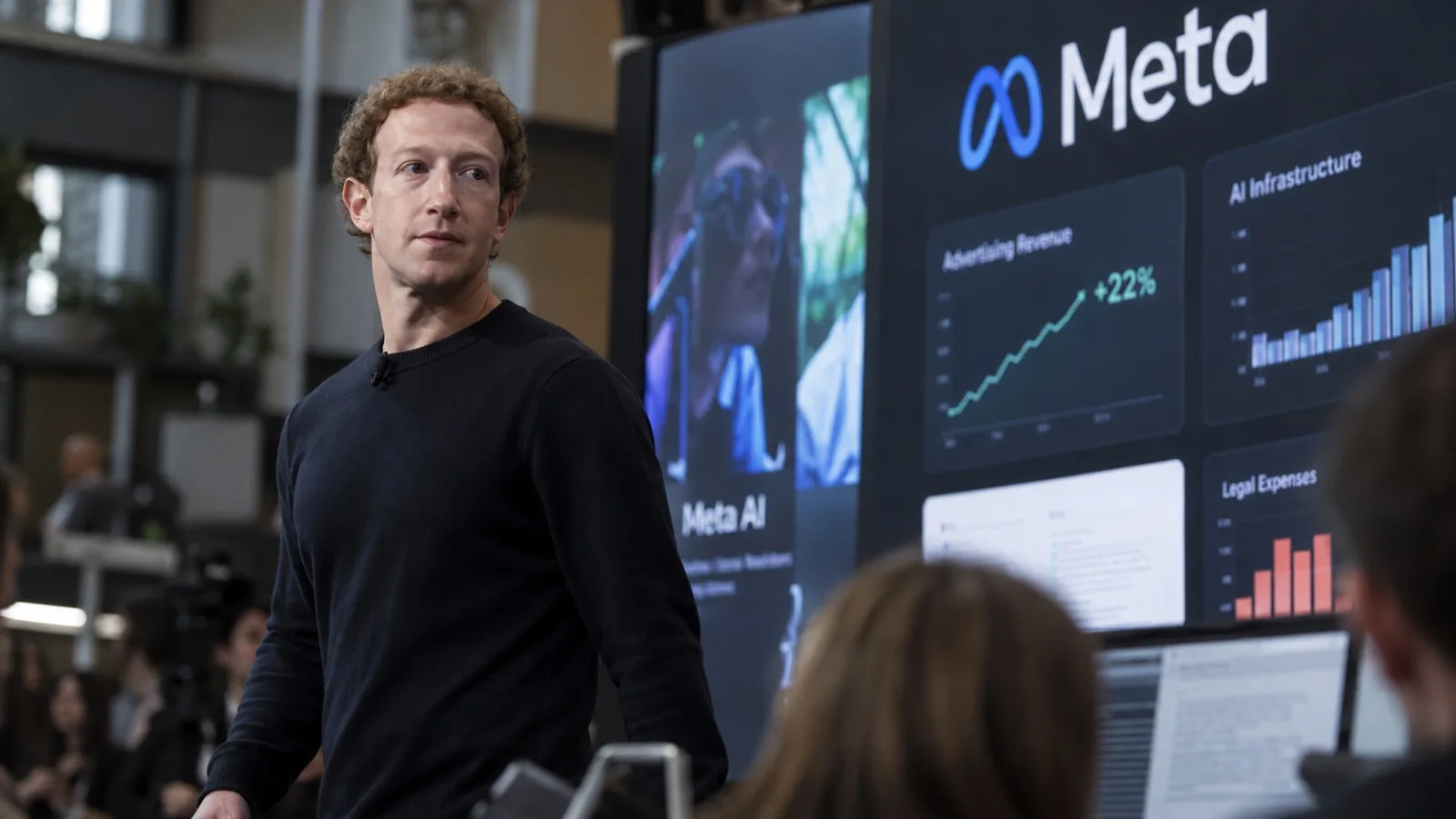
Meta beat Wall Street's revenue estimate in the third quarter, and earnings per share excluding legal costs also came in above expectations. But operating margin was cut roughly in half, and free cash flow turned negative. Meta is shifting from a company that earns well on ads to one that has to prove how efficiently it invests that money in AI.
1. Revenue grew and profit fell. Which is the real result?
| Metric | Q3 | Comparison |
|---|---|---|
| Revenue | $64.60B | +26% year over year |
| GAAP operating margin | 20% | 40% a year earlier |
| Operating margin excluding legal costs | 35.4% | Adjusted figure from this analysis |
Meta's third-quarter 2026 revenue, reported Oct. 21, was $64.601 billion, up 26% from a year earlier. That topped the consensus estimate of about $63.3 billion.
GAAP operating income fell 37% to $12.988 billion. Operating margin dropped to 20% from 40%.
The main cause is a $9.89 billion charge tied to a settlement over youth mental health claims with attorneys general from 52 U.S. states and others. The company said the maximum payout is about $18.59 billion. The charge recognized this quarter should be kept separate from the total that could eventually be paid.
Excluding the charge, operating income was $22.88 billion and operating margin about 35.4%. Adjusted diluted EPS rises to $7.40 from $3.83.
One more comparison matters. Against operating income of $20.535 billion in the year-earlier third quarter, operating income excluding legal costs grew about 11.4%. That is below the 26% pace of revenue growth.
2. Ads are strong because of monetization efficiency, not users
Ad revenue was $63.061 billion, up about 26% from a year earlier. Ad impressions rose 10% and the average price per ad rose 14%.
Management attributes the gains to better recommendation systems across Instagram, Facebook and Threads, and to AI-based ad optimization that lifts engagement and monetization.
Family of Apps daily active people reached 3.64 billion, up 3%.
Users grew 3% while ad revenue grew 26%. Meta's earnings engine now depends less on adding users at scale and more on reading existing users' interests more precisely and making ads more efficient.
That is evidence that AI spending is already feeding into parts of the existing business. Still, not all ad growth can be credited to AI. Advertiser demand, pricing and the broader market also play a part.
3. Muse passes 10 million accounts as Meta looks for its next revenue stream
Mark Zuckerberg used the earnings call to highlight Muse, Meta's personal AI agent.
Accounts in the U.S. and Canada have passed 10 million, and the company cited daily usage of about 25%. The plan is to develop Muse into a personal agent connected to shopping, email and calendars.
Shopping is especially interesting. Some users are already browsing or buying products through Muse, according to the company.
Meta laid out several paths to monetization: transaction fees, premium AI subscriptions, enterprise services and links to the existing ad system.
The key question is less the number of users than how much buying behavior the AI actually creates, and how much of it Meta can capture.
The launch of Muse Wonder, the company's first frontier model, also matters. But user growth and a proprietary model do not guarantee profitability. Inference costs and paid conversion rates have yet to be shown.
4. The real burden is the payback period on AI spending, not legal costs
Third-quarter capital expenditures, including principal payments on finance leases, were $34.91 billion.
Operating cash flow was $32.79 billion, but free cash flow turned negative at -$2.12 billion. A year earlier it was positive $10.625 billion, a swing of about $12.745 billion.
Meta set full-year capex guidance at $135 billion to $145 billion. The low end rose from the prior range of $130 billion to $145 billion.
The spending is a long-term investment not only in better ad recommendation but also in Muse, in-house AI models, data centers and computing infrastructure.
If it works, it could lead to higher ad profitability and revenue from new AI services. If AI monetization is slow, depreciation and infrastructure operating costs could keep pressuring earnings.
Cash and marketable securities of $82.45 billion at the end of September are a financial cushion. A large cash pile, however, does not guarantee a return on investment.
5. Why does Meta's new non-voting share class matter?
Meta approved a plan to distribute one new Class C non-voting share for each Class A and Class B share. The effective date is set for Jan. 19, 2027. The record and payment dates for the stock dividend will be set later.
By the company's description, Class A shares should see a price adjustment similar to a 2-for-1 stock split.
In substance, though, this is not a stock split.
Class C shares can be used for future fundraising, employee compensation and acquisitions, and they also preserve the existing voting structure.
For long-term investors it cuts both ways. Meta gains flexibility in raising capital for heavy AI spending. But investors also need to weigh economic dilution from future share issuance and how durable the founder-centered control structure is.
6. Reality Labs shrinks as resources shift to AI
Reality Labs posted third-quarter revenue of $443 million and an operating loss of $4.129 billion.
Meta expects a 2026 Reality Labs loss of $18 billion to $19 billion, narrowing to about $15 billion in 2027.
This does not mean Meta is abandoning the metaverse. It reads more as slowing VR-centered investment and concentrating resources on areas with a clearer path to commercialization, such as AI glasses and personal agents.
Fourth-quarter revenue guidance is $73 billion to $76 billion. The $74.5 billion midpoint is above the consensus of about $73.6 billion.
The company says it will keep growing the existing ad business while continuing to invest in new AI businesses.
Bottom line
The picture is fairly clear. Meta is not a company investing in AI because its ad business is faltering. It can spend heavily on AI because its ad business is strong.
That strength does not mean unlimited capacity to spend, though. Meta's valuation will likely be judged less on how much it spends on AI than on how much added profit and cash that spending produces.
Insight Times Editorial Desk