AI Chip Boom Rolls On, but Wall Street Wants to See the Cash

Chip results are at records while the cash flow of big AI spenders weakens. The market is starting to ask whether the money invested comes back as cash.

The 20-second read

1
Demand for chips is still strong. Lam Research's quarterly revenue rose 22% from the previous quarter, and 2-nanometer chips reached 8% of TSMC's revenue. Memory prices are also still climbing.
2
The problem is whether the companies buying the chips can afford to keep investing. Meta's revenue grew 26%, but its free cash flow was a deficit of $2.12 billion. Worries about AI spending are spreading from the stock market to the credit market.
3
2028 is not a scheduled cycle peak but a test. How well AI demand and cash generation absorb new chip production capacity as it comes online will likely shape long-term investment returns.

Chip sellers and chip buyers feel differently

On Oct. 21, chip equipment maker Lam Research reported fiscal 2027 first-quarter revenue of $8.22 billion. That was up 22% from the prior quarter, with a non-GAAP operating margin of 40.2%. The stock fell sharply the next day.

Chips did not stop selling. The market has begun judging future growth, and the expectations already built into the share price, more strictly than current results.

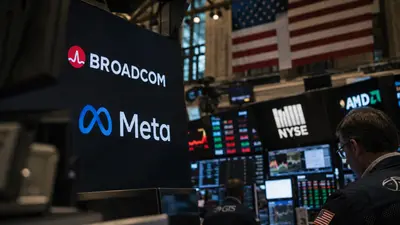
The picture is different for Meta, a buyer of AI infrastructure. Third-quarter revenue was $64.6 billion, up 26% from a year earlier. Free cash flow was negative $2.12 billion. Capital spending and repayment of finance lease principal exceeded operating cash flow.

That does not mean Meta's business is losing money. Operating income was positive in the same quarter, and the company also booked a large one-time charge tied to legal proceedings. But AI infrastructure spending is clearly running ahead of the pace at which cash is being generated.

+22%: Lam Research revenue, September 2026 quarter, quarter over quarter

-$2.12B: Meta free cash flow, third quarter 2026

Memory and foundry: the real economy is still rising

TrendForce expects fourth-quarter 2026 contract prices for commodity DRAM to rise 10% to 15% from the prior quarter, and NAND prices to rise 15% to 20%. A slower rate of increase is not the same as falling prices.

Still, gaps are widening inside the market. Enterprise SSDs benefit from strong cloud demand, while high prices are weighing on buyers of PC memory and SSDs. Western Digital, which is HDD-focused, grew revenue 55%, but that result should not be read as direct evidence of firm NAND pricing.

Foundry shows the same pattern. TSMC's third-quarter revenue was $46.72 billion, with a gross margin of 66.4%. The 2-nanometer share of wafer revenue rose to 8% from 3% in the previous quarter. Commercial production of leading-edge nodes is expanding.

But if HBM and advanced packaging supply grows, and Chinese memory makers gain share in the commodity market, today's shortage could become tomorrow's oversupply.

Will $1.5 trillion of spending all pay off?

TrendForce projects combined capital spending by nine major global cloud providers will rise from about $957 billion in 2026 to more than $1.5 trillion in 2027. It expects AI server shipments to grow about 36% over the same period. These are research firm forecasts, not confirmed spending.

Will actual AI service revenue and cash flow grow as much as GPU and data center spending?

Higher spending also reflects rising equipment prices and advance purchases. The fact that spending is up does not mean customer usage or profitability is improving at the same rate.

Operators that build data centers with debt are especially exposed to higher rates. The jump in yields on CoreWeave bonds and the rise in Meta's credit risk gauges suggest the industry is starting to reprice its cost of capital. Wider credit spreads alone, though, do not show that the odds of an actual default have jumped.

Why 2028 matters

Through 2026 and 2027, new fabs are being built and existing capacity expanded. A finished plant does not add chip supply at once, because equipment installation, yield stabilization and customer qualification take time.

In 2028 and 2029, new capacity and HBM productivity gains could start to show up in full. If AI inference and data center demand are growing enough by then, the cycle could run longer.

If instead falling memory prices, fewer equipment orders, lower data center utilization and cuts to customer capex appear together, a turn in the real cycle would be worth suspecting.

The point is not to call a peak in a particular year. It is to check whether several leading indicators weaken at the same time.

Bottom line

The real AI chip cycle is still rising, but the conditions needed to justify investor expectations have become tougher.

What decides returns on chip investment from here is not how many GPUs are built or how many data centers go up. It is how much cash those facilities generate, at what utilization and margin.

2028 is not a year to pencil in as a sell date. It is when the productivity of today's investment could start to be tested in the numbers.

If chip earnings are strong but ETFs are falling, is that a buying opportunity?
  • If it is a valuation adjustment and earnings forecasts hold up, buying in installments is worth considering.
  • If customer orders and earnings estimates are falling together, you need to revisit your investment thesis.
If the rate of DRAM price increases slows, has the memory cycle ended?
  • A slower rate of price increases is not the same as an actual price decline.
  • Judge it by looking at contract prices, inventory, customer orders and new supply capacity together.
Are in-house AI chips bad for NVIDIA's growth?
  • Wider use of ASICs could affect NVIDIA's market share and pricing power.
  • If the overall AI computing market grows quickly, GPUs and ASICs could grow together.
Should I sell chip ETFs in 2028?
  • There is little basis for treating a particular year as an automatic sell signal.
  • What matters is checking whether supply growth, customers' return on investment, memory prices and equipment orders are actually getting worse.

What to watch

Indicators to checkThe table below compares conditions that strengthen the bullish case with warning signs.
Conditions that strengthen the bullish caseThese are the readings that support the thesis.
Warning signsThese are the readings that signal trouble.
DRAM and HBM pricesA strong case means high ASPs and contracts holding. A warning sign is prices actually starting to fall.
Chip equipment ordersA strong case means new orders and continued customer investment. A warning sign is falling orders and lowered forecasts.
Cloud revenue and FCFA strong case means revenue growth and cash flow improving together. A warning sign is capital spending rising on its own.
GPU rental rates and utilizationA strong case means stable prices and utilization for the same product. A warning sign is prices and utilization falling together.
AI infrastructure credit costsA strong case means stable borrowing costs and improving financial health. A warning sign is a growing interest burden and refinancing risk.
The AI chip boom is still running, but the market now wants numbers showing that invested money returns as cash.

Insight Times Editorial Desk
More by topic

Starting with this story's topics, then what readers are following now

Investor psychology, decision-making and books on investing

CapEx

This story's topic71 storiesSee all →

Money a company spends on things it will use for years — plants, equipment, bu…

Oracle Sets a Date for AI Payback: $30 Billion in Free Cash Flow by Fiscal 2029

Oracle laid out when its AI data center spending should start returning cash: positive free cash flow in the second half of fiscal 2028 and more than $30 billion in fiscal 2029. The plan only works if contracts hold and customers can pay.

Tech

Tech Selloff: Is the Bull Market Over? Wall Street's Four-Year Chart Says Not Yet

The uptrend has survived five double-digit pullbacks in four years. This time, AI companies' debt and cash flow are the new variables.

Investing

White House Swaps AI for "SI." The Real Investment Signal Is Infrastructure, Not the Name

An executive order renames artificial intelligence "Super Intelligence" and six frontier labs sign a voluntary safety accord. What investors should watch is the data center, power, nuclear and chip policy now gathered under one national-competitiveness frame.

Tech

AI Infrastructure Spending Is Holding Up 3% Global Growth, the IMF Says

AI is acting as a real-economy investment engine, offsetting an energy supply shock. The next test is whether that spending comes back as profit.

Investing

Year Four of the AI Revolution: The Real Winners May Emerge After the Highway Is Built

Railroads, the internet and mobile show that a technology can succeed while many investors lose money. The question for AI is whether the current pullback is the end of the boom or a handoff of wealth to new owners.

Investing

Dark navy cover. Flow diagram: Nvidia to Nscale (credit guarantee, in talks) to Anthropic (~$45B compute lease signed in August plus a separate ~$45B, ~460MW deal in talks). Title: Why Would Nvidia Back a Customer's Loan?

Why Would Nvidia Guarantee Its Customers' Data Center Loans?

Nvidia is reportedly in talks to back financing for Nscale's West Virginia data center. Nothing is signed, and the terms are not public.

Tech

Amazon Goes After Nvidia's Strongest Moat, and It Is Software, Not GPUs

Amazon's open-source TorchNeuron aims to let existing AI code run on its Trainium chips. The contest comes down to the total cost of AI compute and the return on Amazon's $220 billion in annual capital spending.

Tech

META

This story's topic39 storiesSee all →

Meta Weighed Cutting Some Teams by 60% for AI, Then Backed Off. Why?

Meta tested whether AI doing half the work means half the staff. Employee pushback and weaker-than-expected productivity gains led it to drop further cuts.

Tech

After the Smartphone, the Contest Is Over Delegation, Not Screens

Meta Connect 2026 showed where AI glasses are heading. The question is who will handle users' tasks for them, and how much control users keep.

Tech

A person at a kitchen table looks at a food delivery app on a phone beside a laptop and a DoorDash delivery bag

AI Was Supposed to Do Our Shopping. DoorDash Got Only Several Hundred Orders From It

DoorDash logged 993 million orders in the third quarter, yet outside AI agents placed only several hundred in total. Orders built through its own in-app AI ran about 50% larger.

Tech

OpenAI's Dots Fights Back: Where the 24-Hour AI Worker War Will Be Decided

OpenAI's Dots, Meta's Muse and xAI's Grok Bot all keep working after the user leaves. Each is aiming at a different seat: the control plane of work, personal life context, or the AI org chart.

Tech

Nvidia's $500 Billion Experiment: Wall Street Asks Who Backs the GPU, Not Just the Chip

The real issue in Nvidia's financing platform is not chip sales. It is how far Wall Street will trust GPU resale prices and rental income three to four years out.

Tech

Why Is Meta Planning Up to $95 Billion in Stock Issuance?

Meta holds $82.45 billion in cash and securities, yet it has outlined an equity raise of up to $95 billion. AI data center spending is growing faster than the cash on hand.

Tech

"You Should Have Bought Only the Crashes": The Hindsight Trap in Big Tech Investing

Cherry-picked chart lows make everyone look like a genius. Nvidia and Meta show why waiting for the bottom and building time in the market are different bets.

Investor Mind

A building that houses servers and networking gear and supplies them with powe…

Why Nebius Is Keeping Some 2027 AI Capacity Off the Shelf

Nebius mixes long-term contracts, short-term premiums and auctions. Holding back capacity pays only if the servers stay busy, and it is not yet clear the pricing will last.

Tech

NVDA

101 storiesSee all →

Who Hits $1 Trillion Next: Reading AMD and ASML by Different Rules

One company is chasing Nvidia's GPU empire. The other sells the machine that draws the chips for every advanced chipmaker, including Nvidia. Both get floated as 2028 trillion-dollar candidates, but the numbers investors need to watch are entirely different.

Investing

Box Shows AI Its Manuals, and the AI Starts Redesigning the Workflow

Box Architect, built with NVIDIA, moves AI from reading documents to designing how work gets done. It has not yet reached beta, so the real-world payoff remains to be seen.

Tech

Nvidia and Palantir Put AI Inside the Supply Chain - The Real Shift Is That It's Learning Judgment

A single Vera Rubin rack holds 1.3 million parts. The real breakthrough in Nvidia and Palantir's new supply chain AI isn't automating that complexity, it's capturing the judgment calls that used to live only in planners' heads.

Tech

If You Only Watch Tesla, You May Be Missing Half the AI Story

Nvidia builds the AI brain. Who supplies the electricity to run it? Six power companies Tesla investors should know, and why Tesla's storage business is just one link in the chain.

Investing

Nvidia Moves From GPUs to CPUs as AI Agents Reshape a $200 Billion Chip Market

A customer's early test found Nvidia's Vera CPU handled about twice the AI agent workload of its existing chips. The bigger story is where the money in semiconductors is heading as AI shifts from answering questions to doing work.

Tech

China's AI Labs Went Open Source Because They Had to, Not Because They Wanted To

A GPU shortfall pushed Chinese AI labs toward efficiency and open weights, and that constraint is now reshaping the global competition over who controls AI's basic infrastructure.

Tech

What Jensen Huang sold at the G20 was not GPUs. It was national infrastructure

Nvidia's message is that AI should be laid down like electricity, roads and the internet. After the hyperscalers, the buyers are governments, telcos, regional clouds and industrial data centers.

Tech