Big Tech Is Earning Record Cash. It Is Returning Much Less of It.
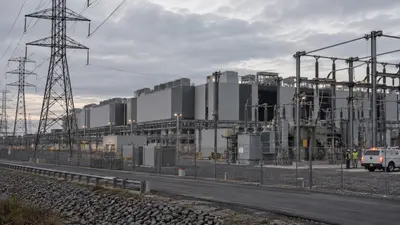
The cause is not weak profits. Heavy AI data center spending is changing how the largest tech companies allocate cash.
1. Cash is up, shareholder returns are down
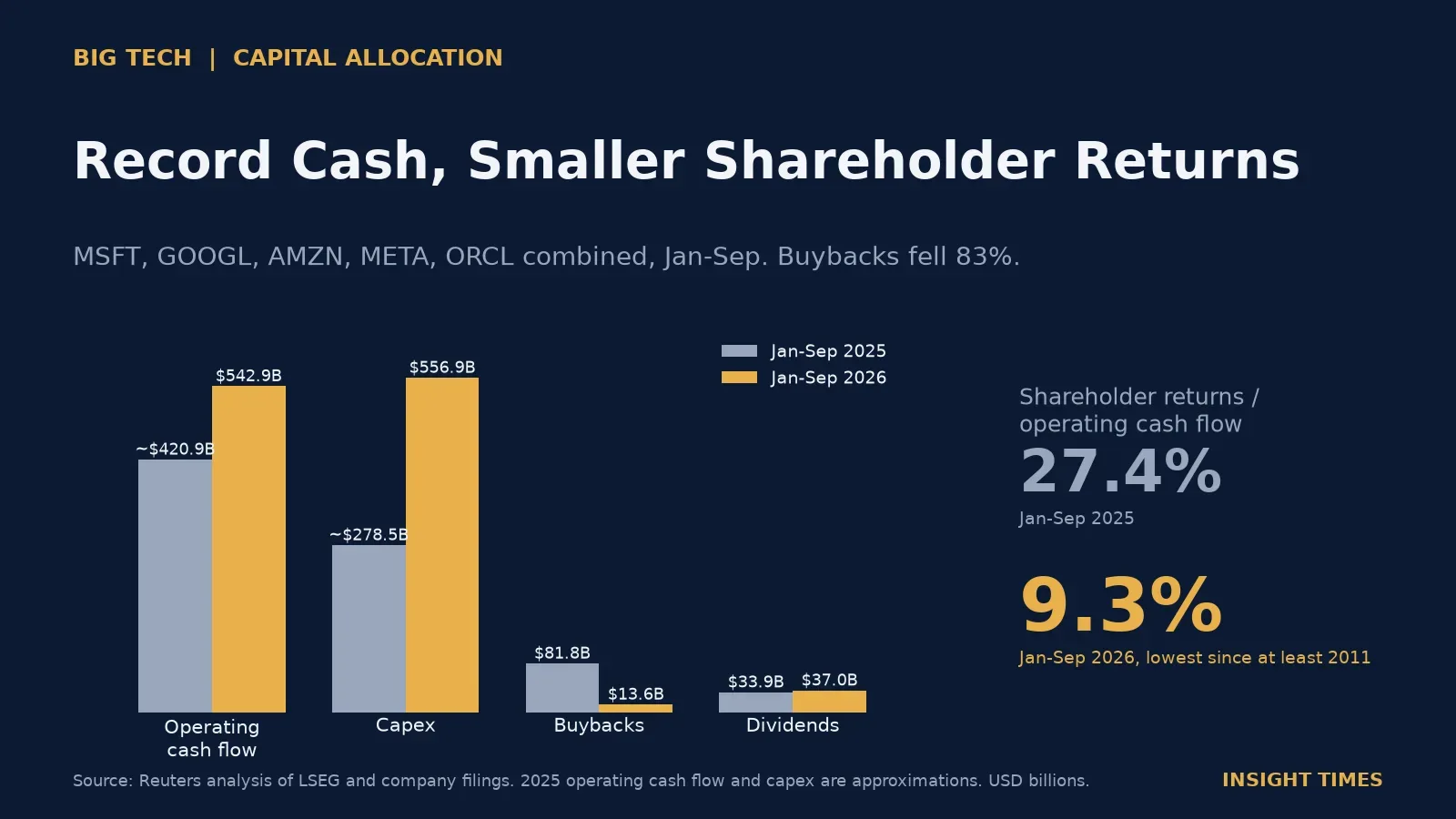
Microsoft, Alphabet, Amazon, Meta and Oracle generated a combined $542.9 billion in operating cash flow from January to September 2026. That is up 29% from a year earlier and a record. But capital spending over the same period reached $556.9 billion, more than operating cash flow.
Buybacks fell 83%, from $81.8 billion to $13.6 billion. Dividends rose from $33.9 billion to $37.0 billion, but total shareholder returns still dropped from $115.7 billion to $50.6 billion. Shareholder returns as a share of operating cash flow fell from 27.4% to 9.3%, the lowest in the analysis period, which begins in 2011.
2. How the cash moved
| Item | Jan-Sep 2025 | Jan-Sep 2026 |
|---|---|---|
| Operating cash flow | about $420.9 billion | $542.9 billion |
| Capital spending | about $278.5 billion | $556.9 billion |
| Free cash flow | +$143.5 billion | -$14.0 billion |
| Buybacks | $81.8 billion | $13.6 billion |
| Dividends | $33.9 billion | $37.0 billion |
| Total shareholder returns | $115.7 billion | $50.6 billion |
| Shareholder returns / operating cash flow | 27.4% | 9.3% |
Combined figures for the five companies. Some 2025 numbers are approximations back-calculated from growth rates. Apple and Nvidia are not included. Fiscal years and capex structures differ by company, so the combined result cannot be applied directly to any single firm.
3. What fewer buybacks mean for EPS
A company with $10 billion in net income and 1 billion shares earns $10 per share. If it buys back and retires shares, cutting the count to 900 million, EPS rises about 11.1% to roughly $11.11, even with no change in net income.
According to ING, Alphabet cut its share count by 9.5% through buybacks from the end of 2020 to the end of 2025. In 2026, though, Alphabet and Meta have not repurchased shares. The two companies bought back a combined $66.5 billion in January to September 2025 alone.
If buybacks stay low, future EPS growth may depend more on actual growth in net income. At the same time, spending on GPUs and servers for AI data centers could translate into heavier depreciation. The key question is whether added revenue and profit offset it.
4. Smaller payouts do not automatically destroy value
Cutting buybacks makes sense if a company can reinvest at returns above its cost of capital. If the cost of capital is 10% and new investment earns 20% over the long run, reinvestment may raise shareholder value. If returns fall short of the cost of capital, the larger the spending, the more value could be lost.
So the 83% drop in buybacks is not, by itself, a reason for optimism or pessimism. What matters is how much additional profit and future cash flow the AI data center spending produces.
5. What long-term, regular investors can check
- Operating cash flow and capex: Whether investment keeps exceeding the cash earned from operations.
- Free cash flow: Whether cash generation recovers while heavy spending continues.
- EPS and share count: Whether EPS growth comes from net income growth or from buybacks.
- Depreciation and return on investment: Whether AI infrastructure earns more than it costs.
For investors who buy in installments, the durability of the investment case matters more than one day's price move. Revenue growth alone is not enough. It helps to look at where the cash goes and how likely it is to come back.
Insight Times Editorial Desk