Is Microsoft Really an AI Winner? The Key Is Where Work Starts, Not the LLM

Azure grew 48% and Microsoft still produced $18.6 billion in free cash flow. But its long-term edge depends less on model rankings than on where people begin their work and who they pay.

The 20-second read

1
Growth and cash together: In the first quarter of fiscal 2027, revenue was $92.3 billion, Azure grew 48%, and free cash flow was $18.6 billion. The company kept its cash generation even as AI spending expanded.
2
Work standards matter more than the AI model: Even if its own LLM is not the best, Microsoft can sell AI through Excel, Word, PowerPoint, enterprise data, and its permission management systems.
3
The key long-term risk: Customer access and pricing power depend on whether users apply AI inside Microsoft 365, or finish their work in outside AI such as ChatGPT and Claude and only bring the files back.

1. Wall Street prized cash generation more than AI growth

Microsoft's fiscal first-quarter 2027 revenue (July to September 2026) was $92.3 billion, up 19% from a year earlier. Azure revenue reached $33.17 billion, up 48%. The company guided to 49% to 50% Azure growth next quarter in constant currency.

Operating cash flow was $58 billion. Free cash flow (FCF) was $18.6 billion. Microsoft left a sizable amount of cash even while spending heavily on AI.

MetricFigureChange
Quarterly revenue$92.3 billion+19% year over year
Azure growth+48%year over year
Operating cash flow$58 billion+29% year over year
Free cash flow$18.6 billionabout -27% year over year

Microsoft FY2027 Q1. Figures rounded.

A closer look at cash flow shows a different picture.

Quarterly capital spending was $45.2 billion. Delays in infrastructure deliveries from some outside suppliers played a part, and the company expects capex above $50 billion next quarter.

The $45.2 billion includes finance leases. Cash paid for property and equipment was about $39.4 billion. Subtract that from operating cash flow and the result is the $18.6 billion in free cash flow.

The key point is that free cash flow fell about 27% from a year earlier. It was better than the market expected, but cash flow itself did not improve.

Microsoft's strength in the AI buildout is a reliable cash-generating base. Still, the fact that existing businesses can fund AI spending is not the same as AI spending earning a high return.

2. Why Microsoft can make money without the best LLM

One question comes up often when Microsoft's AI strategy is assessed.

If its own LLM is not better than the top models from OpenAI, Anthropic and Google, does its competitiveness weaken over the long run?

Microsoft is developing its own models, including MAI-Thinking-1. It also uses outside models in its Copilot products. The agent in Microsoft 365 Copilot that creates Word, Excel and PowerPoint files uses an Anthropic model.

This structure is both a weakness and an opportunity.

Heavy reliance on outside models exposes Microsoft to suppliers' pricing and contract terms. But if it can choose and swap models, it can tune quality and cost to the task.

The yardstick for the value of its own models changes too. They do not need to rank first on every benchmark. Handling repetitive enterprise work at lower cost, and so lifting the margin on the service, is enough to create economic value.

The key, then, is not the rank of Microsoft's own LLM but its bargaining power with model suppliers and the unit cost of its AI services.

3. Azure is smaller than AWS. Is it still competitive?

Global cloud infrastructure market share in the third quarter of 2026 was estimated at 26% for AWS, 19% for Microsoft and 16% for Google. AWS's scale advantage is clear.

But market share, growth and return on investment are different measures.

Azure is winning new demand quickly, growing 48%. About three-quarters of this quarter's capex, however, went to relatively short-lived assets such as CPUs and GPUs. That structure could mean heavier depreciation and equipment replacement costs ahead.

A cloud company's competitiveness does not end with how many servers it secures. What matters is how heavily it uses those servers and how much profit remains after costs and depreciation.

4. The real moat is in Excel, Word and PowerPoint

To understand Microsoft's long-term position, it helps to look away from LLMs and the cloud.

Why do so many companies around the world still use Excel, Word and PowerPoint?

It is not because cheaper alternatives are missing. Corporate documents, financial models, macros, data connections and approval processes are already built around these tools.

A financial firm that wants to move off Excel, for example, cannot just convert file formats. It must verify existing calculations, external data links, macros and compatibility with clients.

That is switching cost.

Microsoft's strength is not that people like Excel. It is that replacing Excel means an organization must change too many other things at once.

If that structure holds in the AI era, Microsoft can have a chance to monetize AI without building the best LLM itself.

5. Where work starts matters more than how smart the AI is

An AI that writes a good answer is different from an AI that performs real corporate work.

Corporate work requires access to documents and data, user permissions, security policies, review and approval, and collaboration. Microsoft 365 integrates Copilot into that work environment.

Two scenarios then split how AI value gets divided.

Scenario A: Microsoft 365 is where work starts

  • Work starts in Excel, Word and Teams within Microsoft 365.
  • Copilot plus outside and in-house AI models supply the intelligence inside the existing work environment.
  • Outcome: Microsoft keeps the customer relationship and gets a chance at added AI revenue.

Scenario B: an outside AI is where work starts

  • Work starts in ChatGPT, Claude or Gemini: analysis, drafting, editing and review.
  • Results are handed off as Excel and Word files, and Office becomes the final editing tool.
  • Outcome: the customer relationship shifts, and pricing power comes under pressure.

In the first scenario, AI raises the value of Office. Microsoft keeps its existing customer relationships and can charge extra.

In the second, even if the Office file format survives, the place users pay may be the outside AI.

The difference is decisive.

Keeping the standard file format is not the same as controlling where work begins.

It is not known how many top model developers will remain. More important is whether they stay Microsoft's technology suppliers or become competitors that win enterprise customers directly.

Conclusion: When models change, where does work start?

Microsoft's competitiveness cannot be explained by a single top-performing LLM. It combines the cash-generating power of existing businesses, enterprise customer relationships, cloud infrastructure and work standards built up over decades.

Whether AI becomes a feature that makes Office stronger, or turns Office into a mere tool for processing output, is not yet settled.

For individual investors assessing Microsoft, the question is this.

If AI models keep changing, will people still start their work in Microsoft? And can Microsoft turn that customer relationship into lasting profit and cash flow?

This quarter's results lent support to that possibility. Long-term investment returns will likely depend on how that question is answered, and on how much of the answer the current share price already reflects.

If Microsoft's own LLM is not the best, is that a long-term disadvantage?
  • There is a risk of higher fees for outside models and greater technical dependence. On the other hand, choosing among model suppliers and handling some tasks with its own models could strengthen Microsoft's cost bargaining power. The key test is not whether it owns the top-performing model, but total cost relative to service quality, and customer retention.
AWS has the No. 1 market share, so is Azure still attractive as an investment?
  • AWS leads at its current scale. Azure is winning new demand with its high growth rate. Long-term value is determined not only by market share but also by infrastructure utilization, depreciation, operating profit, and cash flow.
Can AI agents fully replace Excel?
  • AI's role in creating and editing Excel files can expand. But replacing a company's existing data connections, calculation checks, permission management, and collaboration environment is a separate contest. The survival of the file format should be distinguished from the pricing power of the Excel program.
Capital spending came in lower than expected. Isn't that a positive sign?
  • Some spending moved into the next quarter because of delays in outside infrastructure deliveries. The company's outlook for next quarter's capital spending is above $50 billion. A more important test is whether Azure growth and free cash flow hold up together afterward.
What should a long-term investor check first?
  • Whether growth in paying Copilot customers and usage turns into real additional profit. Whether Microsoft 365's customer access and pricing power hold. Whether the current share price is reasonable relative to expected profit and cash flow growth.

What to watch

Key indicatorsItems to track.
Criteria for judgmentHow to read them.
Copilot paid adoptionAre actual usage, paid seats, renewals, and add-on revenue growing?
AI business profitabilityCan Microsoft keep its profit margin while covering model fees and infrastructure costs?
Capital spending and FCFDoes cash generation hold up after quarterly spending of $50 billion or more?
Change in where work startsDo enterprise users start work in Microsoft 365, or move to outside AI?
ValuationWill future growth in profit and cash flow meet the growth expectations built into the current share price?
Portfolio-wide exposure to the AI investment cycleThis should be reviewed too. The GPUs and memory Microsoft buys become revenue for Nvidia and the semiconductor supply chain. Even if you spread your money across several companies, you may still be exposed to the same AI capital spending cycle.
Microsoft's fate is likely to turn less on AI model rankings than on where people start their work.

Insight Times Editorial Desk

More by topic

Starting with this story's topics, then what readers are following now

Investor psychology, decision-making and books on investing

Cloud Computing

This story's topic17 storiesSee all →

Why Nebius Is Keeping Some 2027 AI Capacity Off the Shelf

Nebius mixes long-term contracts, short-term premiums and auctions. Holding back capacity pays only if the servers stay busy, and it is not yet clear the pricing will last.

Tech

Why AI Is Moving Back to the Laptop: Anduril and Qualcomm's BlueChip

Anduril and Qualcomm's new BlueChip laptops point to a bigger question: where should AI run? Production and sales are still unproven.

Tech

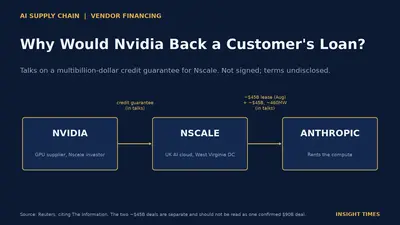
Dark navy cover. Flow diagram: Nvidia to Nscale (credit guarantee, in talks) to Anthropic (~$45B compute lease signed in August plus a separate ~$45B, ~460MW deal in talks). Title: Why Would Nvidia Back a Customer's Loan?

Why Would Nvidia Guarantee Its Customers' Data Center Loans?

Nvidia is reportedly in talks to back financing for Nscale's West Virginia data center. Nothing is signed, and the terms are not public.

Tech

Same cloud, three different ways to earn the money back

Microsoft, Alphabet and Amazon are all spending enormous sums on AI infrastructure. The route each one takes to recover that capital is not the same, and that is what decides the winner.

Investing

AI Needs to Find $1 Trillion a Year From Somewhere to Pay Back Its Capex

Saying AI capex is big is no longer the point. The harder question is what end users have to pay for the buildout to pencil out, and Goldman Sachs puts that number at roughly $1 trillion a year.

Tech

Anthropic Talked Slowdown. Its Actions Say Otherwise

A next-gen Claude model, an IPO push, and an actual biology lab. Put the three together and Anthropic's message isn't "stop AI." It's build stronger models while scaling up verification and control at the same pace.

Tech

AI is no longer competing on intelligence. It is competing on leftover cash

The race for better models continues, but the industry's center of gravity has moved. The question now is who can turn enormous data center and power spending into revenue and cash flow.

Investing

A building that houses servers and networking gear and supplies them with powe…

AI ran out of memory before it ran out of GPUs

The HBM bottleneck is spreading into DRAM prices, server costs and the price of the next laptop or phone.

Tech

Is Space Cooler for AI? Why Musk Wants Data Centers in Orbit

The next limit on AI may be power and cooling, not GPUs. Elon Musk is looking to Earth orbit for an answer, but the test is cost per hour of compute.

Tech

White House Swaps AI for "SI." The Real Investment Signal Is Infrastructure, Not the Name

An executive order renames artificial intelligence "Super Intelligence" and six frontier labs sign a voluntary safety accord. What investors should watch is the data center, power, nuclear and chip policy now gathered under one national-competitiveness frame.

Tech

Musk Sees the Next Phase of AI Infrastructure: Who Can Switch GPUs On, Fast

If neoclouds struggle under financial pressure, AI demand may not shrink. It may simply favor the few operators with the capital and execution to serve it, a shift that could matter for SpaceX and Tesla.

Tech

Weekly Check: The AI Bull Market Isn't Over, It's Just Gotten Harder

A 5% 10-year yield, 470 gigawatts stacked up in Texas, Chinese DRAM, and whether data centers actually get switched on are starting to decide who wins the AI trade through 2027.

Tech

Is Memory Peaking? In the AI Era, Watch the Bottleneck, Not the Demand

Demand still outruns supply. But memory stocks can peak before demand does. The real question is how long HBM4, server DRAM, CXL and Big Tech capex keep the cash flowing.

Tech

Marvell's $115 Billion Lumentum Deal: Is AI's Next Bottleneck Light, Not Chips?

Marvell's purchase of Lumentum points to a contest beyond GPU speed, in data transfer and power efficiency. Whether the price is right is not yet confirmed.

Tech

NVDA

101 storiesSee all →

Who Hits $1 Trillion Next: Reading AMD and ASML by Different Rules

One company is chasing Nvidia's GPU empire. The other sells the machine that draws the chips for every advanced chipmaker, including Nvidia. Both get floated as 2028 trillion-dollar candidates, but the numbers investors need to watch are entirely different.

Investing

Box Shows AI Its Manuals, and the AI Starts Redesigning the Workflow

Box Architect, built with NVIDIA, moves AI from reading documents to designing how work gets done. It has not yet reached beta, so the real-world payoff remains to be seen.

Tech

Tech Selloff: Is the Bull Market Over? Wall Street's Four-Year Chart Says Not Yet

The uptrend has survived five double-digit pullbacks in four years. This time, AI companies' debt and cash flow are the new variables.

Investing

Nvidia and Palantir Put AI Inside the Supply Chain - The Real Shift Is That It's Learning Judgment

A single Vera Rubin rack holds 1.3 million parts. The real breakthrough in Nvidia and Palantir's new supply chain AI isn't automating that complexity, it's capturing the judgment calls that used to live only in planners' heads.

Tech

If You Only Watch Tesla, You May Be Missing Half the AI Story

Nvidia builds the AI brain. Who supplies the electricity to run it? Six power companies Tesla investors should know, and why Tesla's storage business is just one link in the chain.

Investing

Nvidia Moves From GPUs to CPUs as AI Agents Reshape a $200 Billion Chip Market

A customer's early test found Nvidia's Vera CPU handled about twice the AI agent workload of its existing chips. The bigger story is where the money in semiconductors is heading as AI shifts from answering questions to doing work.

Tech

Nvidia's $500 Billion Experiment: Wall Street Asks Who Backs the GPU, Not Just the Chip

The real issue in Nvidia's financing platform is not chip sales. It is how far Wall Street will trust GPU resale prices and rental income three to four years out.

Tech

GPU

73 storiesSee all →

A chip built to draw graphics, whose ability to run thousands of identical cal…

The Next AI Chip Race Is About How Chips Connect

Applied Materials will lift its stake in Dutch equipment maker BESI from about 9% to 20%. The bet is less about control than about a new way to link chips.

Tech

US AI Data Centers Are Headed for 90GW. Gigawatts Now Matter More Than Dollars

Goldman Sachs expects US data center capacity to grow from 64GW at the end of 2026 to 90GW at the end of 2027. The AI race is moving from buying GPUs to building power plants and transmission lines alongside them.

Tech

The Cheaper Tokens Get, the Bigger Your AI Bill Gets

As AI shifts from training to inference, the token is becoming an industrial commodity. Falling prices are not cutting demand, because agents and automation consume tokens at a scale no human chat session ever did.

Investing

Two Companies Drive 34% of S&P 500 Earnings Growth as AI Pays Sellers First

Nvidia and Micron generate a third of expected earnings growth in US large caps. Apollo says the financial effect of AI is not yet visible in the S&P 493.

Investing

Amazon Goes After Nvidia's Strongest Moat, and It Is Software, Not GPUs

Amazon's open-source TorchNeuron aims to let existing AI code run on its Trainium chips. The contest comes down to the total cost of AI compute and the return on Amazon's $220 billion in annual capital spending.

Tech

AI's Next Bottleneck Is Power, Not GPUs

Jensen Huang and Elon Musk sent the same warning in Washington. The AI race is widening from building better models to supplying power and chips at industrial scale.

Tech

AI Demand Is Proven. Now the $70 Billion Bill Comes Due

Oracle posted $19.3 billion in quarterly revenue and spent $28.5 billion on capex. The real question for the AI buildout is no longer whether demand exists, but how fast this spending turns into cash.

Tech