Morgan Stanley Says 'Buy the Drop' on AI Stocks, Keeps $3.4 Trillion Capex Forecast
After a post-midterm selloff on data center regulation fears, Morgan Stanley argues spending is likely delayed, not lost. The winners may differ, though.
The 20-second read
Morgan Stanley's report, published Nov. 8, carries a blunt title: "Buy the Drop."
AI and semiconductor stocks fell sharply after the U.S. midterm elections on fears of data center regulation. Morgan Stanley judged the market reaction excessive. It sees the pullback as a chance to selectively buy high-quality AI companies.
The core evidence is one number. The bank left its combined 2027 and 2028 hyperscaler capital spending forecast unchanged at about $3.4 trillion.
Other Wall Street banks, including UBS, HSBC and Jefferies, have also said regulatory worries are overpriced. But Morgan Stanley is not telling investors to buy every AI-related stock. The report's central point is that tighter regulation favors companies that own capital, power and data centers already running.
1. The key number: $3.4 trillion has not gone away
- 2027 expected capex: $1.6T (about $1.6 trillion)
- 2028 expected capex: $1.8T (about $1.8 trillion)
Morgan Stanley hyperscaler capex forecast (billions of dollars)
| Year | Capex |
|---|---|
| 2025 | $481B |
| 2026 | $951B |
| 2027 | $1,641B |
| 2028 | $1,760B |
Source: Morgan Stanley Research, Exhibit 1. The figures are combined company-wide capex forecasts and do not equal AI-only spending.
After the midterms, the market worried less about a Democratic win itself than about the chance that regulation could block data center construction and sharply cut AI investment.
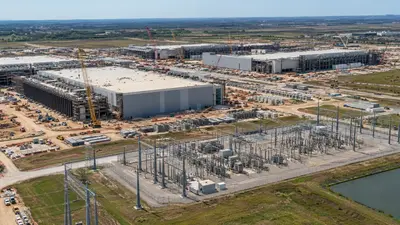
Morgan Stanley's math differs. It estimates that about 5 GW of U.S. data center capacity scheduled for completion in 2028 could slip to 2029. That equals roughly 20% of U.S. projects and about 10% of global projects for that year.
Projects already under way for 2027 are expected to largely stay on track. Downside risk remains for 2028 spending, but a scenario in which investment plans collapse entirely is not the base case.
Morgan Stanley argues delays could rebalance an overheated supply chain, raise rents on computing capacity already secured, and lengthen the AI capex cycle.
Delays can still hurt. Some equipment makers that counted on 2028 revenue could see weaker results. That is why growth in the AI industry should not be equated with gains in every AI stock.
2. The paradox: tougher rules favor Amazon and Google
Why does Morgan Stanley prefer the large hyperscalers?
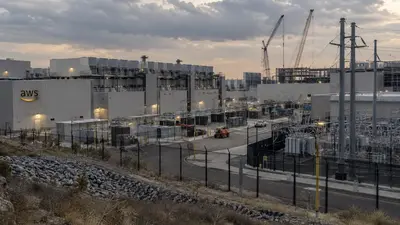
If building new data centers gets harder, the assets of companies that already hold power, land and servers become more valuable. New entrants arrive later, and incumbents may be able to charge more for scarce computing capacity.
Big tech companies can also shift construction to other regions and raise funding on relatively favorable terms. Morgan Stanley says those strengths favor large companies such as Amazon, Alphabet and Meta.
| Company | Strength Morgan Stanley highlights |
|---|---|
| AMZN, META, GOOGL | Large capital base and ability to scale AI services |
| MSFT | Cloud and enterprise AI platforms |
| NVDA | Chips that raise AI compute per unit of power |
| SPCX | SpaceX's separate growth story and AI infrastructure opportunities |
The yardstick for AI competition is also shifting. Until now, what mattered was who secured more GPUs. Increasingly, what may matter is how much useful AI output a company can produce from the same amount of power.
Morgan Stanley noted that Meta aims to raise compute efficiency tenfold in 2027. It also cited Google's next-generation TPU as an example of efficiency gains.
Competitiveness in AI is widening from GPU holdings to productivity per unit of power and the ability to generate actual revenue.
That matters for Nvidia too. Chips that make training and inference more efficient can capture demand from companies trying to get more out of existing capacity, even if new construction is delayed.
3. Chips and power stocks are not all the same opportunity
Morgan Stanley is far more cautious on the data center supply chain.
If 2028 construction slips, demand for servers, semiconductors and power equipment could arrive later than expected. Fewer orders and rising inventory could weaken some suppliers' pricing power and margins.
By contrast, data centers that already have power connections, and companies that can deliver power quickly, may benefit.
| Relatively favored | Watch with caution |
|---|---|
| EQIX: existing data center operating base | Companies whose revenue is concentrated in new construction schedules |
| WULF, RIOT, HUT, APLD: relatively low Texas exposure | CIFR, GLXY, MARA: risk of Texas project delays |
| Facilities with secured, operational power | Facilities with uncertain power connections or permits |
This split is not a grade on any company's overall profitability. It is a sorting of project exposure to policy change.
The regulation-exposed regions Goldman Sachs reviewed account for about 45% of planned U.S. data center capacity, and Texas alone for about 25%. A company's data center locations and approval stages could therefore become key variables in judging its stock.
4. Morgan Stanley is not the only bull
Wall Street views compiled by Reuters on Nov. 9 are similar.
UBS said the market was too pessimistic about AI-related policy, credit risk and the possibility of spending cuts. HSBC said it is using the pullback to add to U.S. and Asian tech stocks. Jefferies also read the Nov. 5 plunge as an immediate market reaction rather than a fundamental collapse in valuations.
That does not mean Wall Street sees no problems in AI investment.
JPMorgan forecasts about $900 billion in AI-related capex for 2026. It stresses that cloud revenue to recoup the massive spending, future backlog and the ability to raise more funding all matter.
The common direction is clear. Rather than denying the AI industry's long-term growth, Wall Street is judging more strictly who can secure the capital and power that growth requires, and turn it into real profit.
- No. Judging that the decline was overdone is different from calling the exact bottom in prices.
- Morgan Stanley's strategy is closer to selective, staged buying.
- Delays in installing new GPUs are a short-term burden.
- But the need to do more computing with limited power raises the value of high-performance chips.
- No. It is the sum of Morgan Stanley's corporate capex forecasts for 2027 and 2028.
- It should be distinguished from committed AI-specific contract amounts or money already spent.
- Regulatory delays drag on past 2029 and cloud revenue growth falls short of expectations.
- In that case, capex could be cut, and earnings estimates across the data center supply chain could be revised down in a chain reaction.
- Separate long-term conviction in the AI industry from the right buying price for each individual stock.
- Distinguish companies with stable cash flow from those that depend on financing, and first check how concentrated your existing portfolio is in AI.
What to watch
Insight Times Editorial Desk