Why Did AMD Pay $8.2B for an AI Research Lab, Not a GPU Company?
The race is shifting from faster GPUs to understanding what future AI will need to compute. AMD's $8.2 billion all-stock deal for World Labs looks like a bid to claim that ground first.
The 20-second read
1. The GPU company did not buy GPU technology
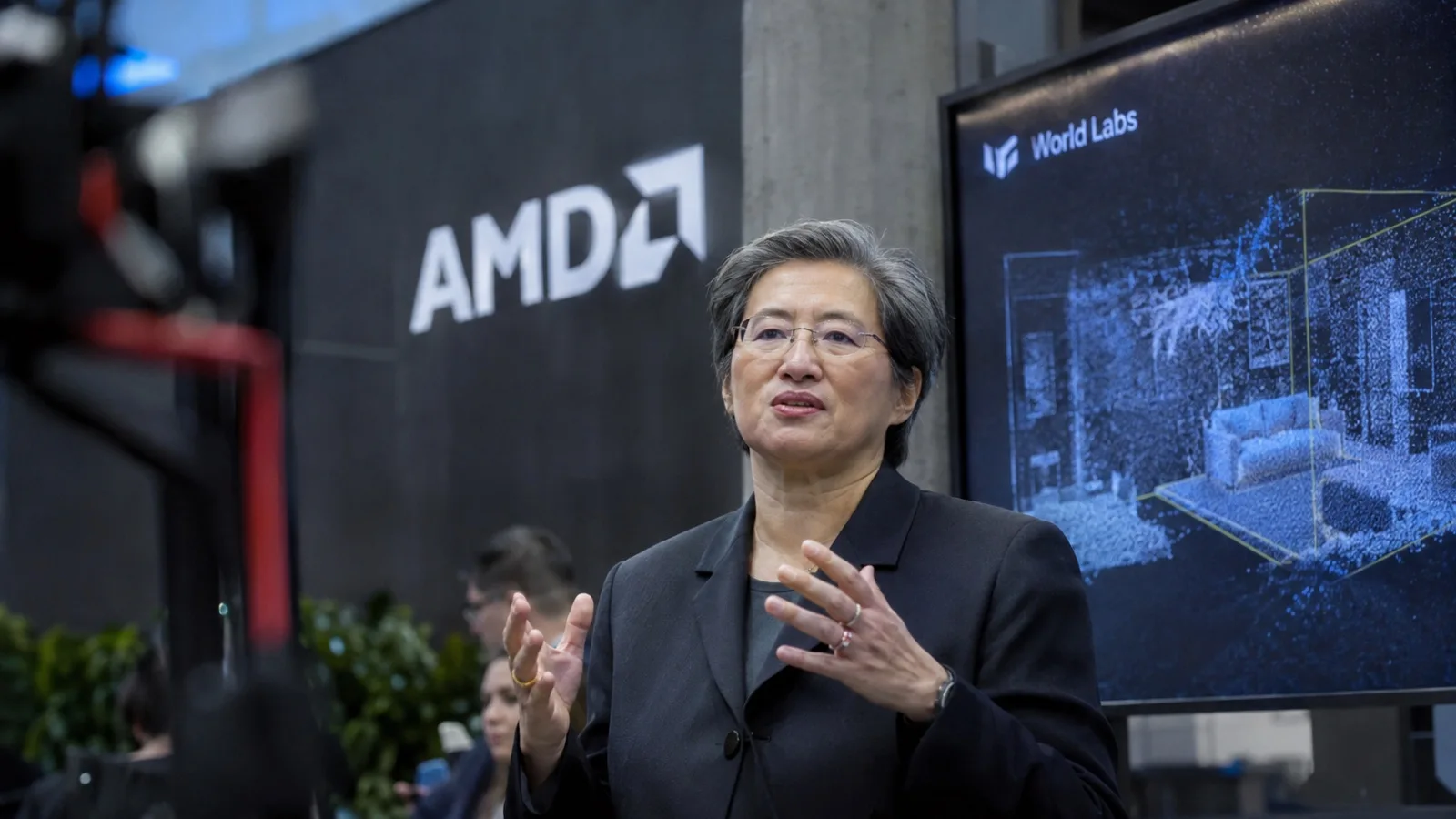
AMD completed its acquisition of AI research company World Labs on Nov. 13. The price was about $8.2 billion. Under an agreement reached Sept. 26, AMD paid entirely in its own stock, issuing 14,978,322 new shares to World Labs' existing shareholders.
World Labs does not design chips. It researches how AI can understand three-dimensional worlds, generate new environments inside them and simulate movement.
Why would a chipmaker buy a lab like this? The answer lies less in the GPUs selling well today than in the problems AI will have to solve tomorrow.
2. When AI leaves the screen, the computing changes
Conversational AI reads a sentence and produces the next words. Spatial intelligence goes a step further. It is the ability of AI to understand the layout of a room, locate objects and rehearse the consequences of actions in a virtual world.
Think of a robot. Knowing the sentence "pick up the cup" is not enough. It has to understand where the cup is, how to move its hand and what happens if it bumps something.
As this kind of AI grows, chips may be asked for different kinds of computation, different ways of using memory and different software to run it all. A company that studies future models first gets a chance to conceive the hardware earlier.
3. Why Fei-Fei Li reports directly to Lisa Su
World Labs founder and AI researcher Fei-Fei Li joins AMD as executive vice president and chief scientist. She reports to CEO Lisa Su.
After the deal, World Labs continues its foundation-model research and works with AMD to design future AI infrastructure. That creates a channel to carry what the lab learns about computation into chip and system design.
In competing with Nvidia, the software ecosystem, represented by CUDA, matters as much as GPU speed. AMD is developing open platforms including ROCm. At the same time, it appears to be aiming to align future AI models, chips and software together.
4. What investors should watch beyond the $8.2 billion
Research results do not turn into GPU revenue right away. For long-term investors, what matters is less the price than the process by which research becomes real competitive strength.
First, watch how quickly spatial-intelligence research shows up in AMD's hardware and system design. Next is the ease of development and the reach of ROCm. A chip's strengths reach customers only if new AI models run on it easily.
New customer wins are another test. Even if demand for spatial intelligence and robot learning grows, the strategic value is limited if customers do not choose AMD's platform. Because the deal was paid entirely in stock, the dilution that the new shares cause for existing shareholders also needs checking.
- About $8.2 billion. It was paid entirely in AMD stock.
- AMD issued 14,978,322 new shares to World Labs' existing shareholders.
- It is an AI research company, not a chip designer.
- It researches how AI can understand the three-dimensional world, create new environments and simulate motion.
- Based on the article's explanation, it can be seen as a way to secure future AI research capability.
- Understanding the next generation of AI could be a starting point for designing the next generation of chips. However, actual results have not yet been confirmed.
- Spatial intelligence AI understands spatial structure and practices the results of actions in a virtual world.
- As this kind of AI grows, it may require different kinds of computation, different ways of using memory, and different software.
- She joins as senior vice president and chief scientist.
- She will report to CEO Lisa Su.
What to watch
Insight Times Editorial Desk